

I've spent over twenty years in marketing and more than $40 million of other people's ad budgets — and I still nearly talked myself out of ever starting my own course business.
Not because I didn't know how. Because I knew too much. And knowing too much, it turns out, can keep you stuck far longer than knowing nothing at all.
So this post is different from the others on this site.
If you'd rather watch than read, the video version is embedded above — same ground, slightly different format.
The previous seven posts in this series were comparative and analytical — pricing tables, feature lists, honest verdicts — all built to help you evaluate platforms against each other on objective grounds. All of that is still here if you need it.
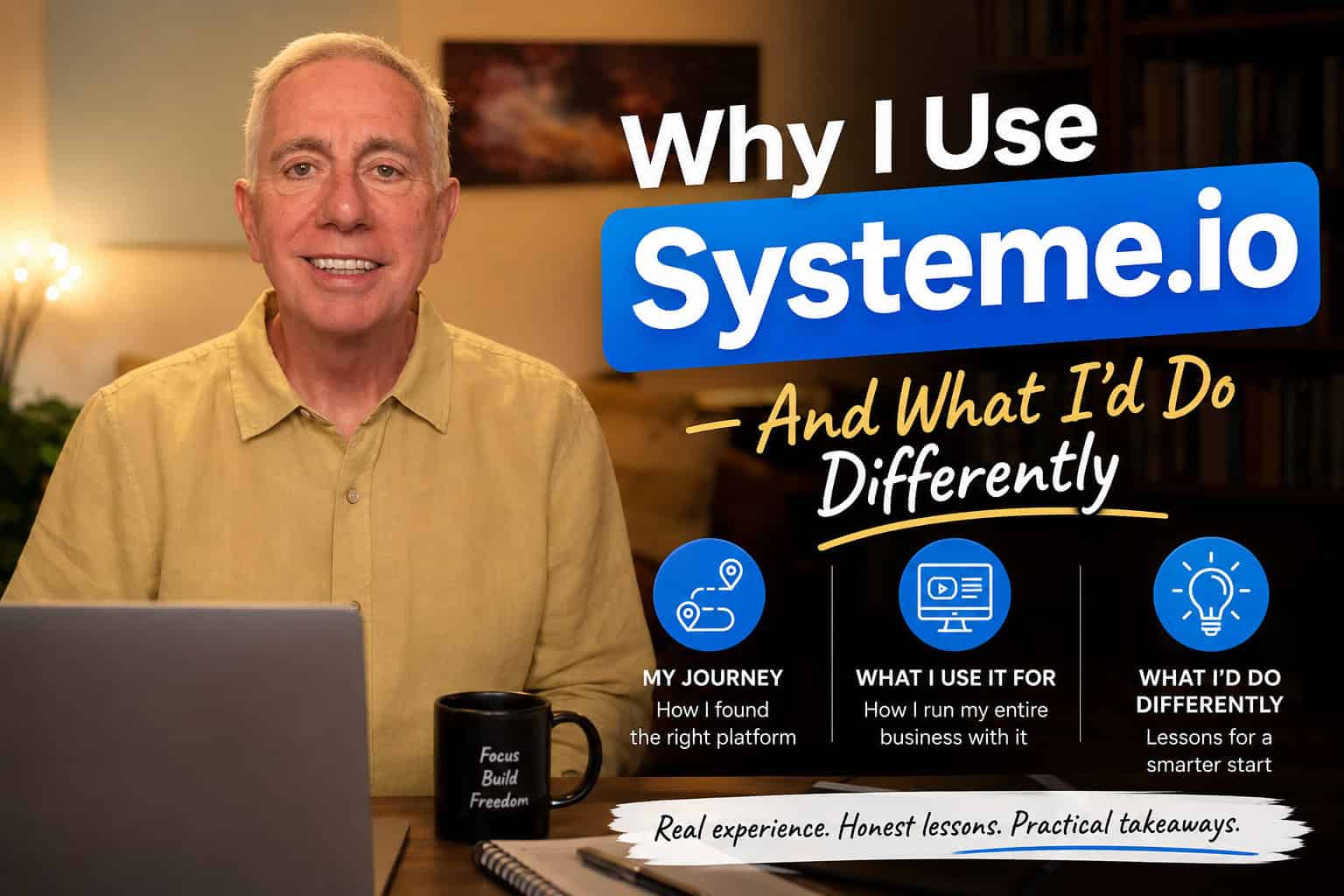
This one is personal. It's the story of how I actually ended up using Systeme.io as the backbone of my course business — what the journey looked like before I landed on it, what I use it for day to day, and, most usefully I hope, what I'd do differently if I was starting again today.
No pricing tables. No feature comparisons. Just the honest version of what this looks like when it's your actual business, your actual money, and your actual time on the line.
There's a category of information that comparison posts simply can't give you — the kind that only comes from someone who has lived with a decision long enough to know what they got right and what they'd change. That's what this is.
A Bit of Context
I've been in digital marketing for over twenty years. In that time I've spent more than $40 million on paid advertising across client campaigns, worked with over two hundred clients across a range of industries, and built a coaching practice helping course creators, coaches, and consultants build and sell their programmes more effectively.
I have an MBA and a Fellowship from the Chartered Institute of Marketing. I've watched a lot of tools come and go, and I've been close enough to the marketing technology space, for long enough, to have opinions about most of it.
I tell you this not to establish credentials for their own sake — but because what comes next is genuinely useful.
None of that experience made choosing a course platform easy. If anything, it made it harder.
The Problem With Knowing Too Much
When I first seriously looked at building a course business, I had a heightened version of the problem many experienced professionals face with any new decision: I knew enough about the landscape to have an opinion about everything — which meant I could find a legitimate reason to like, and a legitimate reason to dislike, every platform I evaluated.
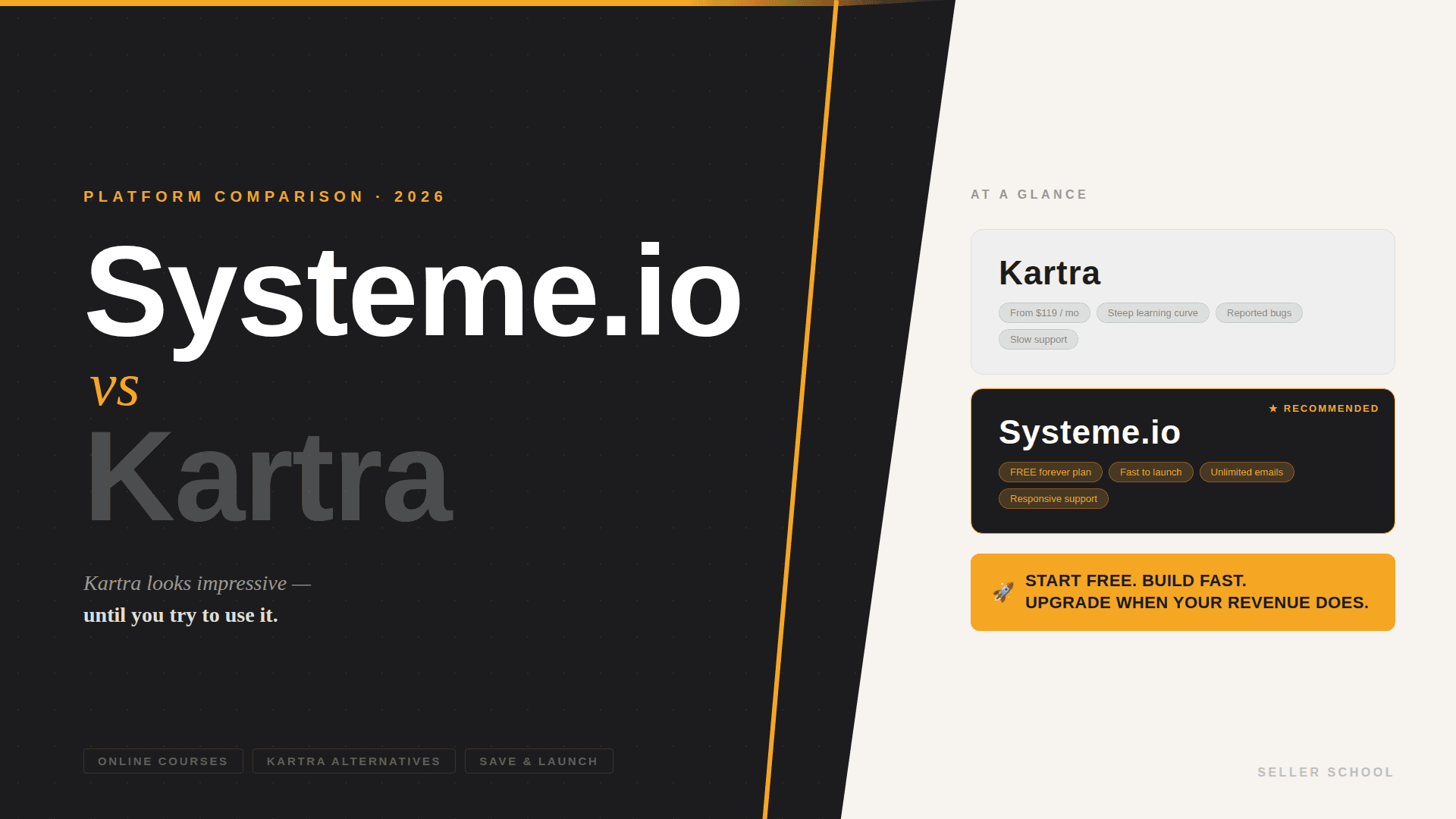
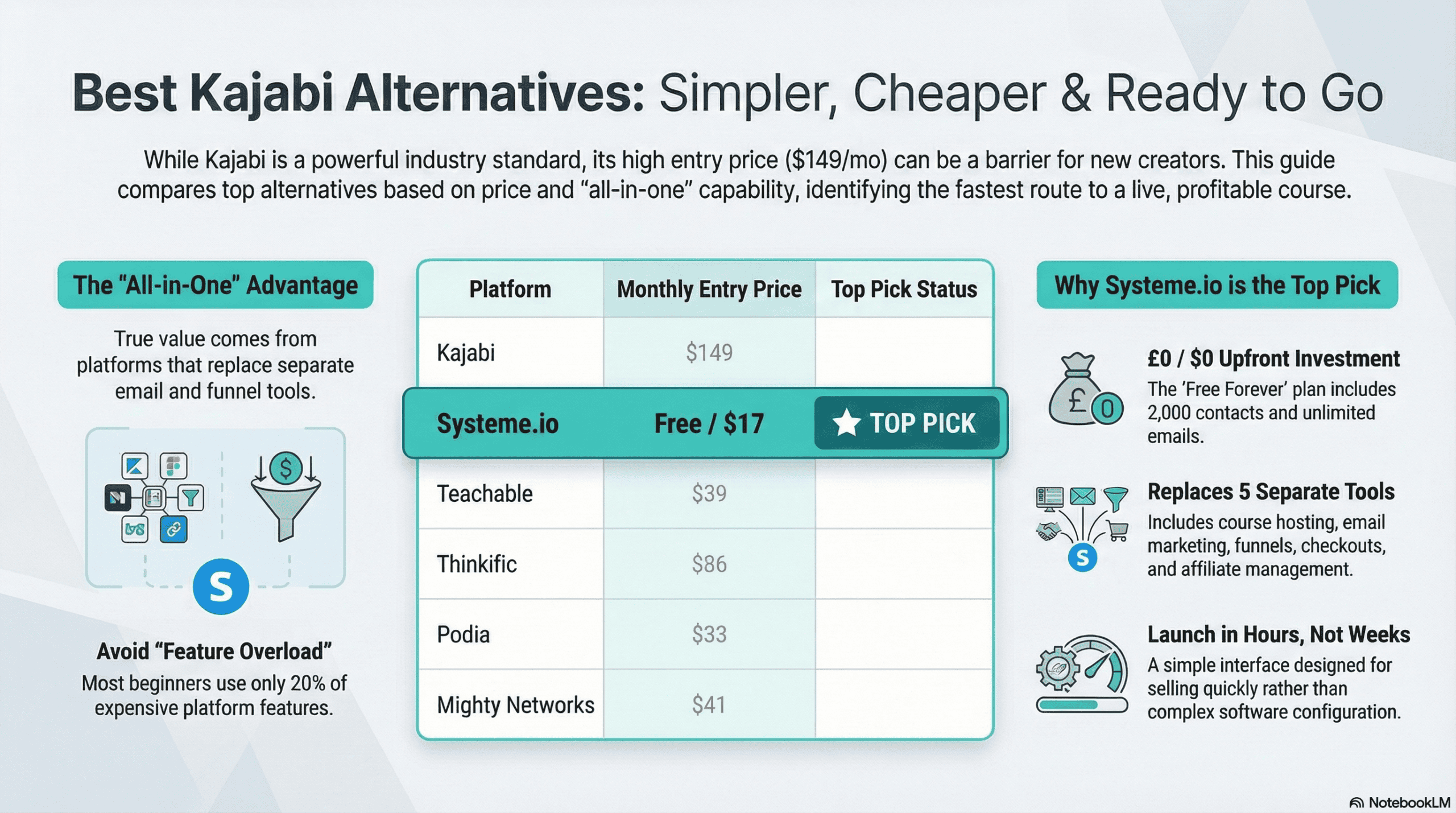
I looked at Kajabi. Loved the brand positioning and the polish of the product, and I signed up - and paid for it for almost 3 years. Thought the price was steep for where I was at that point, and I wasn't convinced the premium was justified before I had course revenue to offset it. In hindsight, big mistake. Expensive mistake. I needed an alternative to Kajabi.
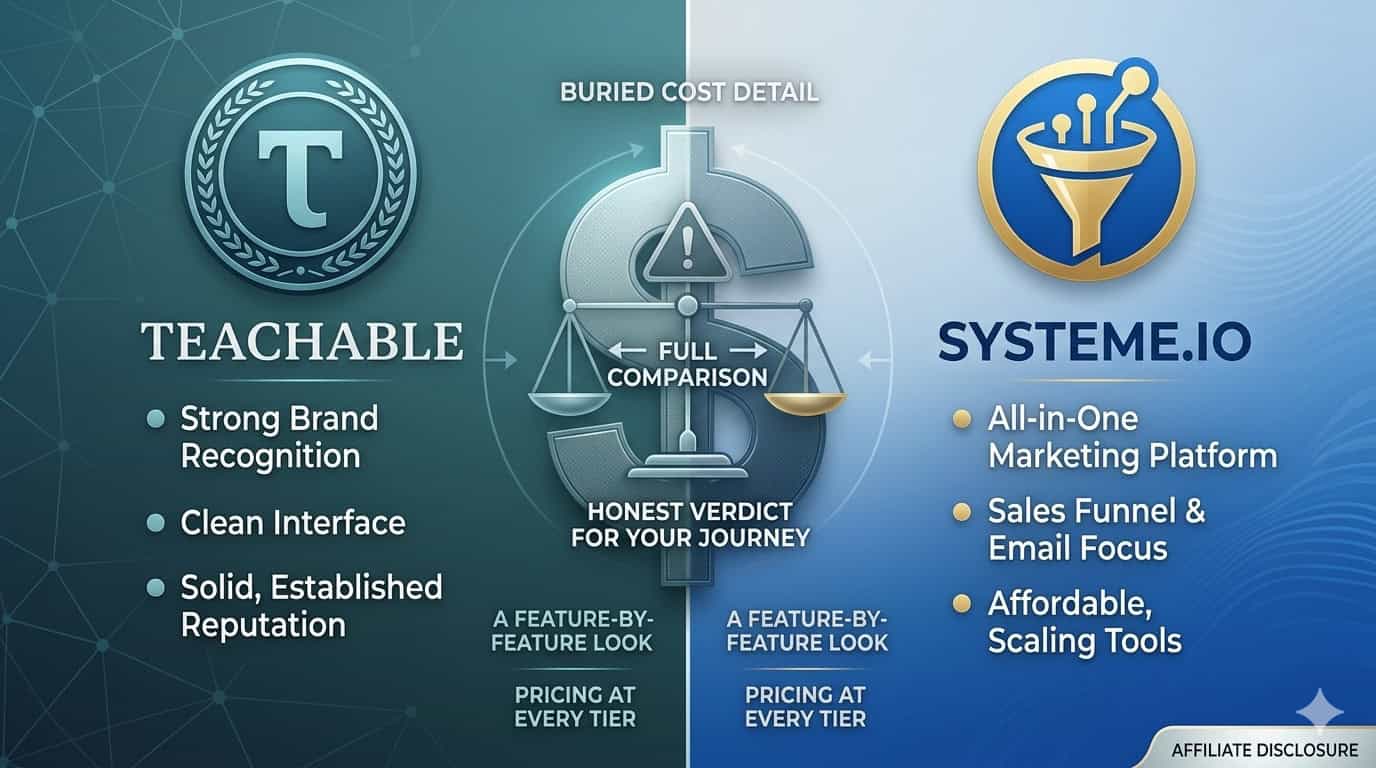
I looked at Teachable. Liked the simplicity of the interface. Didn't like the transaction fees on the lower plans, which I knew would compound quickly once a course started selling.
I looked at Thinkific. Genuinely impressed by the course builder and the student experience. Wondered whether I'd miss having funnels and email marketing built in, given how central those are to any serious course marketing.
I looked at platforms most people haven't heard of. I spent time in dashboards I'd never return to. I built comparison spreadsheets capturing features I wasn't sure I'd ever need.
And all of that evaluating — all the comparing and tab-opening and note-taking — was, in significant part, a sophisticated way of not making a decision.
I'm telling you this because the analysis paralysis doesn't lift just because you know more than the average person. Sometimes knowing more just gives you better reasons to delay. The only thing that breaks it is choosing something — and building something with it.
How I Found Systeme.io
I came across Systeme.io the way most people do — it came up in a conversation as an alternative worth a look.
My first reaction was scepticism. Not hostility — professional scepticism. The entry price seemed almost suspiciously low. A platform that handles courses, funnels, email marketing, automations, and affiliate management — free to start, and modest at the first paid tier?
My instinct said there was a catch somewhere. A feature missing that mattered, a reliability issue that would surface under pressure, or a support experience that explained why it sat so far below the competition on price.
So I did what I'd have advised any client to do. I stopped comparing on paper and started actually using it.
I created a free account. I built something real in it — a basic course structure, a simple funnel, a couple of email sequences. I ran it through the scenarios that mattered to my business: course delivery, email automation, sales funnel performance, checkout flow.
And what I found was that it did what it said it would. Consistently, and without drama.
Not with the polish of Kajabi at its top tier. Not with the assignment depth of Thinkific's student tools. But solidly, reliably, and without making me connect it to three other platforms to get the functionality I needed.
The thing that convinced me wasn't a specific feature. It was a month of using the platform and never hitting a wall. Everything I needed to do, I could do. Nothing broke in a way that cost me a sale or caused a problem for a student.
For a business tool, that's the bar. Does it do the job reliably? Systeme.io did. It still does. And it's still getting better.
Later, when I needed webinar functionality for a programme I was running, I moved up to the webinar-tier plan. That upgrade felt proportionate — I was paying more because I was doing more, not because I'd been backed into a corner. That matters when you're making long-term decisions about platform dependency.
What It Costs (At a Glance)
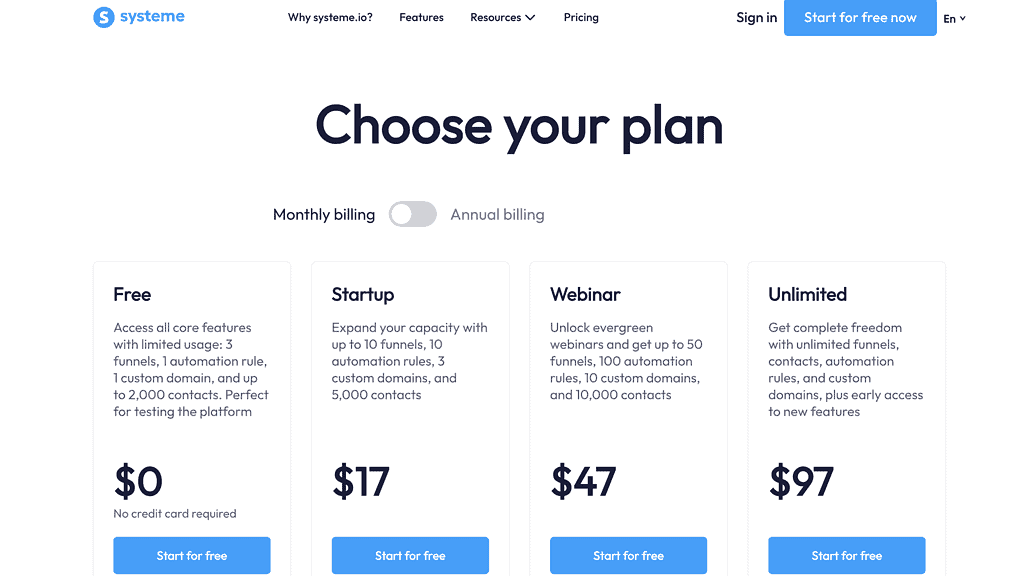
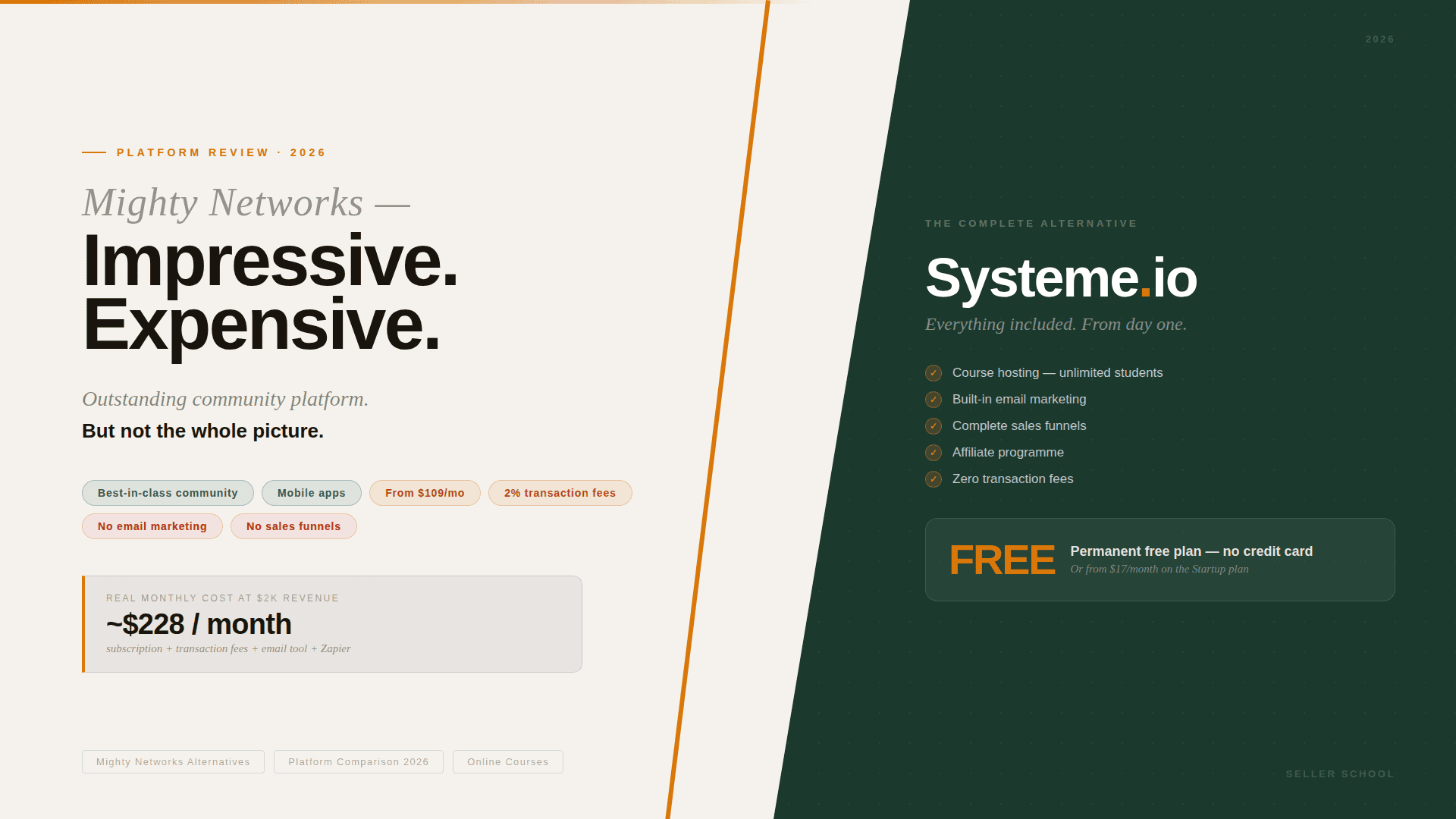
Systeme.io runs on four tiers, and the reason I keep recommending it is that the shape of that ladder is right for a growing business — you scale the investment as the revenue grows, and you're never paying for more than you actually need:
- Free — 1 course, 3 sales funnels, up to 2,000 contacts, 0% transaction fees. A genuine starting point, not a trial. (Confirm current limits before publishing.)
- Startup $17/£13 — the first paid tier; a credible first investment once you've outgrown the free limits.
- Webinar $47/£35 — where we are at Seller School; adds automated webinars and gives a serious course business everything it needs at a price a modest launch can comfortably support.
- Unlimited $97/£72 — removes contact caps and sub-accounts; for established businesses.
Pay annually for Sysyeme io and you get 2 months free, so for example, Startup is $170 or about £130 annually. Prices move, so treat the figures on this page as indicative and check the live pricing page before you commit — I'll keep this post updated as tiers change.
What I Actually Use It For
Let me be specific about what Systeme.io does in my business day to day, because specificity is more useful than generality here.
Course delivery
My courses live on Systeme.io. Content is structured into modules and lessons, student access is managed automatically, and delivery is reliable. Students get what they paid for, when they're meant to get it, without me manually managing enrolments or access permissions.
The course builder isn't the most sophisticated on the market — if you've read our Thinkific comparison, you'll know Thinkific's student experience is more polished. But for the courses I run and the students I work with, it does the job without friction.
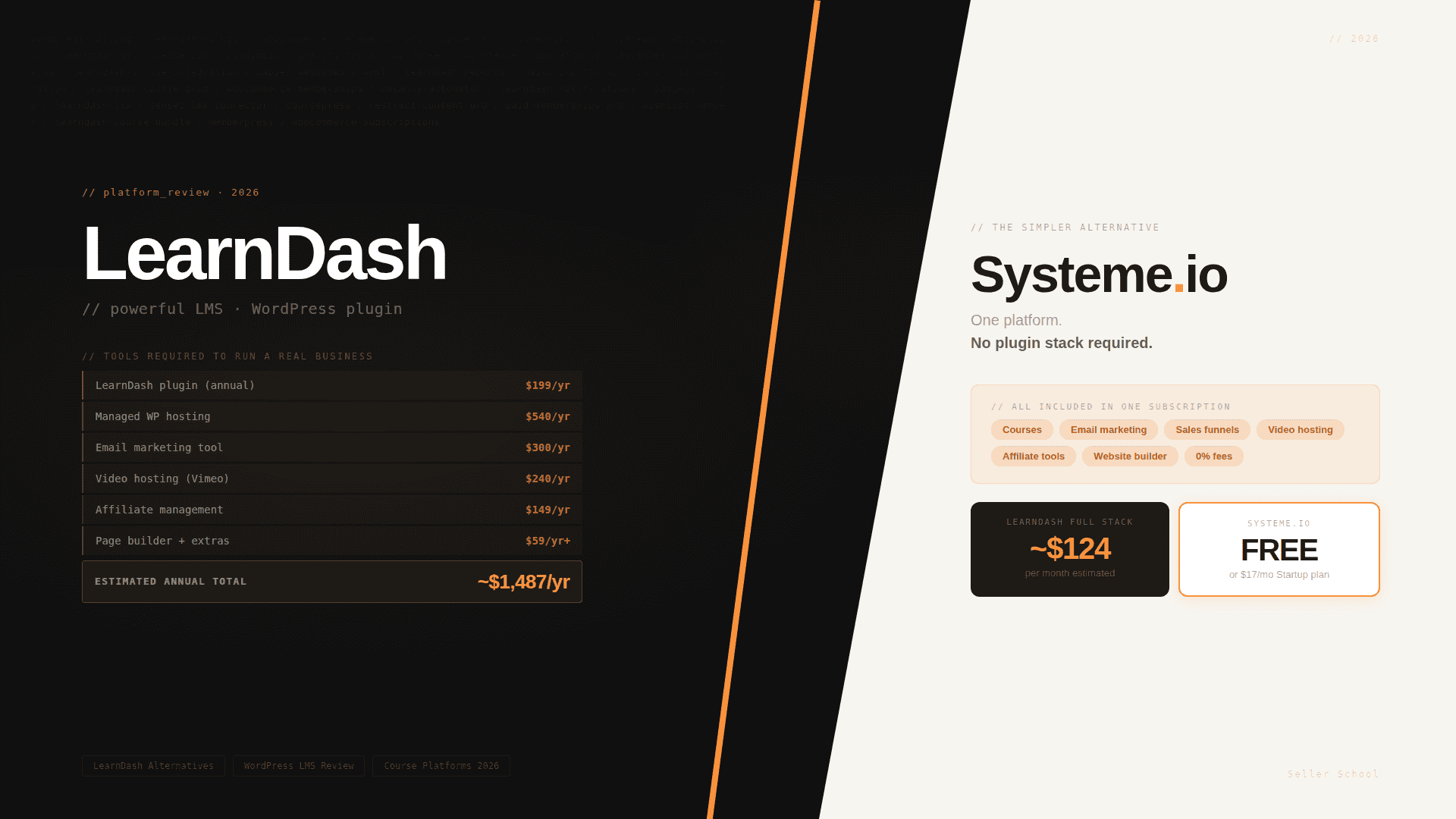
Thinkific vs Systeme.io 2026 — Which Should You Choose?
Sales funnels
When someone lands on one of my course pages, goes through checkout, and becomes a student, that entire journey happens inside Systeme.io — sales page, order page, thank-you page, post-purchase automation. One connected system. No integrations to maintain, no third-party tools holding critical parts together.
This matters more than it sounds. Every integration in a tech stack is a potential point of failure: a Zapier workflow that stops working, an API connection that breaks after a platform update, a webhook that silently fails so a student never gets their welcome email. Keeping the core journey inside one platform removes all of those failure points.
Email marketing
My email list is managed through Systeme.io — automated welcome sequences for new students, follow-ups for prospects who didn't buy, broadcasts to my list when I'm running a launch or sharing new content, all inside the same platform.
Because everything is connected natively, the email system knows what's happening on the course side. When someone buys, the automation knows. When someone joins a particular course, the relevant sequence fires. I don't need to tell one system what another has done.
Affiliate management
My affiliate programme runs through Systeme.io's built-in affiliate tools. People who want to refer others to my courses do so through links generated inside the platform, and commissions are tracked and managed without a separate tool.
What I don't use it for
In the spirit of honesty: as my business has grown and my website needs have become more sophisticated, I've added a dedicated website - this site - using WordPress. I've used WordPress for many years and it's where I'm comfortable. I made that decision when the specific gap was real and measurable — not in anticipation of a gap that hadn't emerged.
That's the principle I'd encourage you to apply. Use Systeme.io for everything until something specific forces you to add a tool. Then add that one tool. Don't build complexity before it's earned.
What I'd Do Differently
This is the section I suspect will be most useful to you. These aren't polished lessons with neat conclusions — they're genuine things I'd change if I was starting again today.
I'd stay on the free plan longer
I upgraded from the free plan earlier than I needed to. Not because it was limiting me — it wasn't, not yet — but because paying for something felt more committed. More serious. Like I was declaring this a real business rather than an experiment.
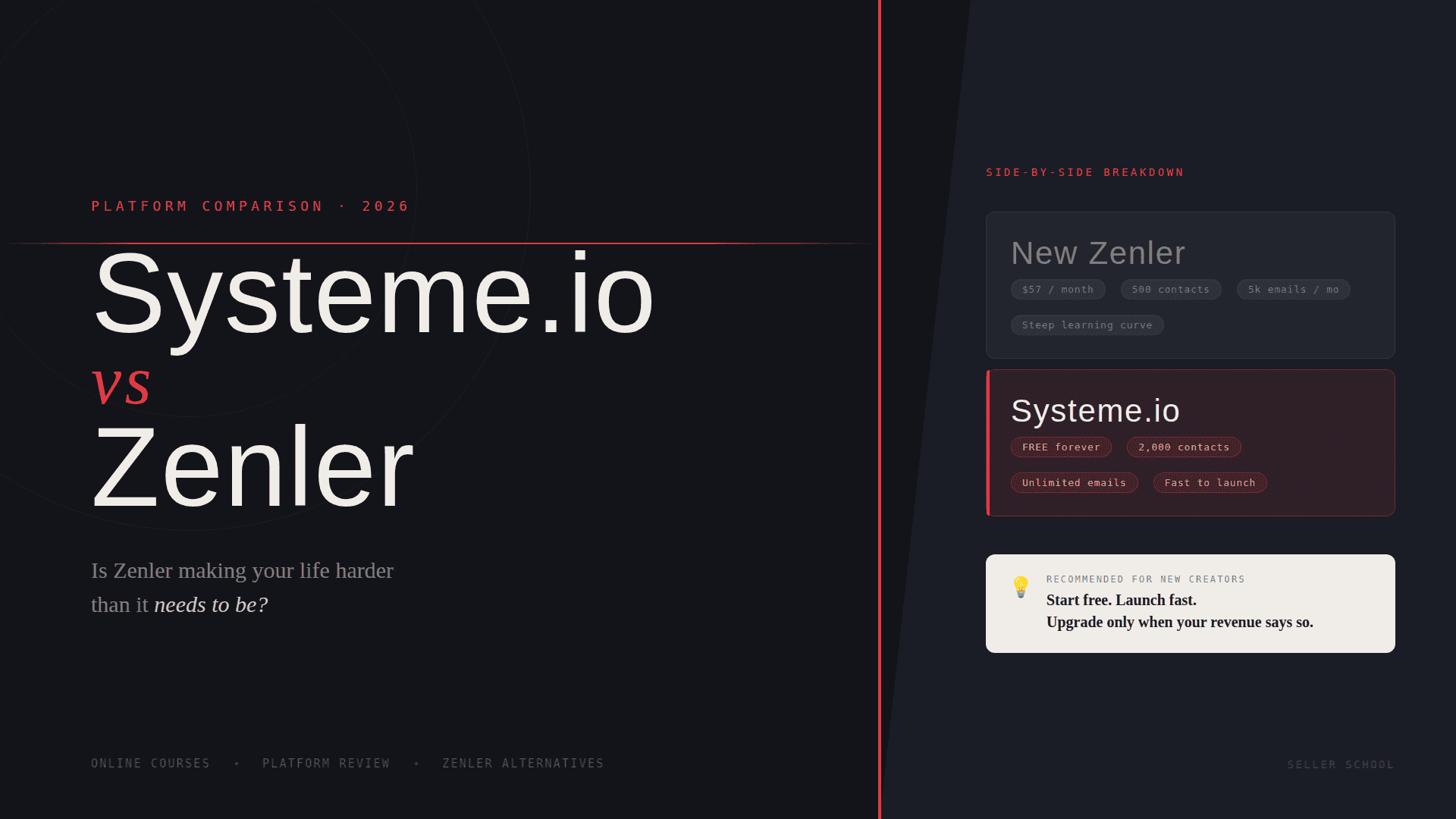
That's not a good reason to spend money. The free plan is a genuine starting point — a course, funnels, and email marketing for a couple of thousand contacts, with no transaction fees. For a first launch, that's everything you need.
I'd stay on the free plan until a specific, concrete limit — the contact ceiling, the course cap — was an actual constraint I was hitting. Not a hypothetical one I was anticipating. Upgrade when you hit the wall, not before you can see it.
I'd build the course before I built the sales page
Early on, I spent time getting the sales page right — copy, structure, positioning — before I had a complete course to put behind it. That's the wrong order.
Nobody can buy what doesn't exist. A sales page for an incomplete course is a source of pressure and guilt, not a useful marketing asset. Build the course first. Build the page when there's something real to sell.
The practical version: don't start on your funnel until you have at least the first two modules recorded and uploaded. Knowing the course exists makes writing the sales page far easier anyway — you're describing something real rather than something you intend to build.
How to Set Up Systeme.io Step by Step
I'd tell people sooner
There's a pull — I had it, most course creators I work with have it — to get everything ready before you tell anyone it exists. The perfect launch. The complete course. The polished page representing the best possible version of what you've built.
What I've learned is that telling people early — even before the course is finished — does two things that waiting does not.
It creates accountability. Once you've told ten people your course is coming, it becomes much harder to quietly abandon it — and the temptation to abandon things in the difficult middle stages is real.
And it tells you quickly whether anyone wants what you're building. This is the more important of the two. If you describe your idea to ten people and none of them light up, that's information you want in week two, not week twelve. The earlier you learn whether the idea resonates, the less time you pour into the wrong direction.
I'd have that conversation with potential students in the first week — not to sell them something unfinished, but to ask whether the outcome I was describing was one they genuinely wanted. That conversation is free. And it saves you from building something in perfect silence that nobody was waiting for.
I'd worry less about the competition
I spent more time than was useful, early on, watching what others in my space were doing — their course structures, pricing, platforms, launch strategies. Some of it was useful context. Most of it was distraction dressed up as research.
Your audience is not choosing between you and every other course creator in your niche. They're deciding whether what you offer is worth their time and money — and that comes down almost entirely to whether they trust you and whether the outcome you're promising matters to them.
Trust is earned by showing up consistently, being genuinely useful, and being honest — not by having a slightly more polished platform than the person next to you.
I'd launch before I felt ready
This is the one I'd press hardest on. Not something sloppy, not something half-hearted — but something real, that genuinely helps someone, even if it isn't everything you eventually want it to be.
The gap between "ready" and "launched" is almost always smaller than it feels from the inside. And the only way to find that out is to cross it.
Why I'd Still Choose It Today
If I were starting again tomorrow, I'd land on Systeme.io again — and I'd get there faster, because I'd waste less time on the comparison spreadsheets.
I'd choose it for what it is rather than what it isn't. It's a complete, reliable, all-in-one system that handles the core functions of a course business — hosting, selling, marketing, and communication — from one platform, at a price that makes sense at every stage of growth.
The free plan is a genuine starting point. The paid tiers step up in a way that a growing course business can comfortably fund from its own revenue, and the upgrade path is the right shape: you scale the investment as the income grows, you never pay for more than you need, and you're never stuck at a tier that's too small. (See the costs block above for current figures — and check the live page before committing.)
That's the platform I'd recommend to someone starting out. It's the platform I use. And based on the results I've seen — in my own business and in the businesses of the creators I coach — it's a recommendation I stand behind.
Systeme.io Free Plan — Everything You Actually Get
Start Where I Started
If there's one thing I'd take from this whole post, it's that the platform decision is not the thing standing between you and a course business. Starting is. And the lowest-friction way to start is the same way I did — a free account, no credit card, and something real built inside it within the week.
👉 Create your free Systeme.io account here: https://iosysteme.com
Set up the free account, record one lesson, and you'll have done more this week than most people do in a year of comparing tabs.
What Comes Next on Seller School
This post is the last in our first series — eight weeks covering the platform question in depth.
The next series goes a layer deeper: pricing strategy for course creators, how to get your first students without a large audience, the mechanics of a first launch, and what building a sustainable course business looks like beyond the first sale.
If that's useful to you — if you're building something and you want honest, practical guidance from someone who's been through it — subscribe to the Seller School notifications and you'll hear about new content as it lands.
And if you've already started — set up an account, recorded a lesson, made a first sale — I'd love to hear where you are. Get in touch and let me know. Are you pre-launch, mid-build, or already selling?
The Full Series
If you've arrived here without reading the rest of the series, here's everything we've covered:
- Systeme.io Free Plan — Everything You Actually Get
- Kajabi vs Systeme.io 2026 — Full Cost Comparison
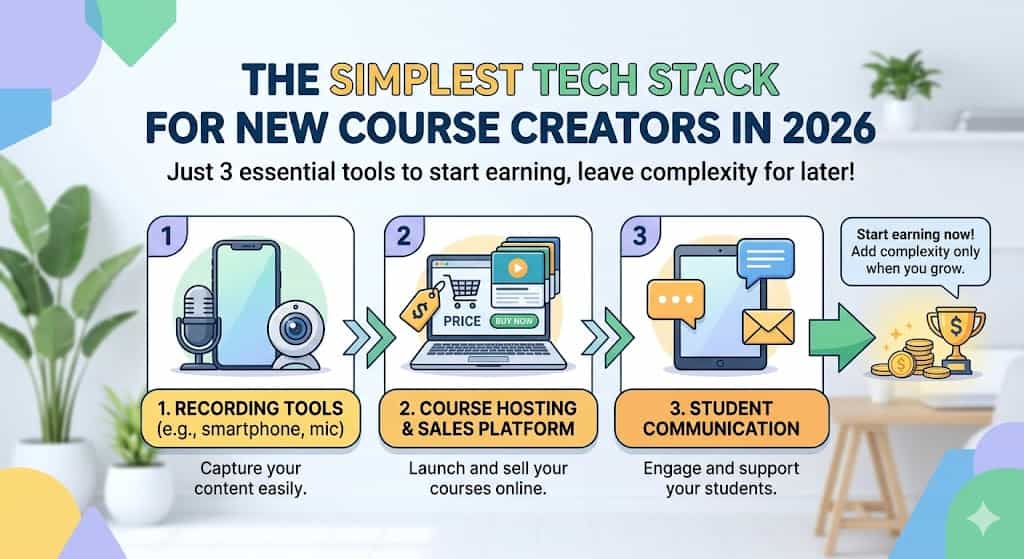
- The Simplest Tech Stack for New Course Creators
- How to Set Up Systeme.io Step by Step
- Teachable vs Systeme.io 2026 — Which Is Better for Beginners?
- How to Launch Your First Course in 7 Days
- Thinkific vs Systeme.io 2026 — Which Should You Choose?
Disclosure: The Systeme.io link in this post is an affiliate link. If you sign up, we earn a small commission at no extra cost to you. We only recommend tools we use ourselves.