





If you're starting your first course or coaching programme, what's the best Kajabi alternatives that's simpler, cheaper and quicker? You don't need the most expensive platform — you need the one that gets you earning fastest.
~12 min read · Based on years of real-world platform spending (and mistakes)
Let me be honest with you from the start: I've spent years paying for online platforms I only half-used. I've upgraded when I didn't need to. I've been seduced by feature lists that looked impressive until I realised I was using maybe 20% of what I was paying for.
If you're reading this, you're probably at a similar crossroads. You know you want to sell a course or a coaching programme. You've heard of Kajabi — maybe you're already using it and wondering if the price tag is worth it. Or you're doing your research before signing up for anything, which is exactly the right thing to do.
This guide is written for you: the person who wants to get their knowledge online, start generating an income — maybe working towards that first £/$10,000 milestone — without overcomplicating things or overspending from day one.
The uncomfortable truth about most platform comparisons: They're written by people who want you to click through to the most expensive option, because that's what pays the highest affiliate commission. This one isn't. I'll tell you what I actually think is best for where you are right now.
The 5 Mistakes Course Creators Make When Choosing a Platform
Before we look at the alternatives, let's talk about how people go wrong — because if you can avoid these, you'll save yourself months of frustration and hundreds of pounds or dollars.
- 1Choosing the platform with the longest feature list.More features does not mean a better business. It usually means a steeper learning curve, a bigger monthly bill, and a longer runway before you earn your first penny.
- 2Signing up for the "professional" plan before they've made a sale.There is no reason to pay for 10,000 contacts or unlimited courses when you haven't launched your first one yet. Start lean.
- 3Choosing based on what established creators use.Of course big influencers use Kajabi or Teachable. They're earning tens of thousands a month and have teams. You're not there yet — and that's fine. Different stage, different tools.
- 4Not factoring in the total cost of all the tools they'll need.Some platforms look cheap until you add email marketing, a sales funnel builder, an affiliate system, and checkout pages. Suddenly you're paying for four separate tools.
- 5Paralysing themselves with research instead of launching.This one is the most expensive mistake of all. Every week you spend comparing platforms is a week you're not selling. Good enough and live beats perfect and delayed every time.
What Actually Matters When Choosing a Platform
Based on years of using, paying for, testing, and occasionally regretting these tools, here is what genuinely matters for someone in your position:
- Can I sell from day one? The platform needs to let you take payments without jumping through fifty hoops.
- Does it include email marketing? You will need to email your audience. If the platform doesn't include it, you'll be paying for it separately.
- Can I build a basic sales funnel? A landing page, an opt-in, a sales page, and a checkout. That's it. That's all you need to start.
- What happens when I grow? Does the pricing scale reasonably, or does it suddenly jump to £300/month when you hit 1,000 students?
- How long will it take to learn? You're not a developer. The platform should take hours to learn, not weeks.
- Is support actually helpful? When something breaks on a launch day (and it will), you need to reach someone quickly.
Keep those criteria in mind as we work through the alternatives below.
Why So Many Course Creators Are Moving Away From Kajabi
Let's give Kajabi its due: it's a genuinely powerful, polished platform. For someone earning £30,000 or more per month from their courses, it probably makes perfect sense. The tools are robust, the community is strong, and there's a certain status that comes with saying "my courses are on Kajabi."
But for beginners and intermediate creators? There are three very real problems.
1. The Cost Has Become Hard to Justify
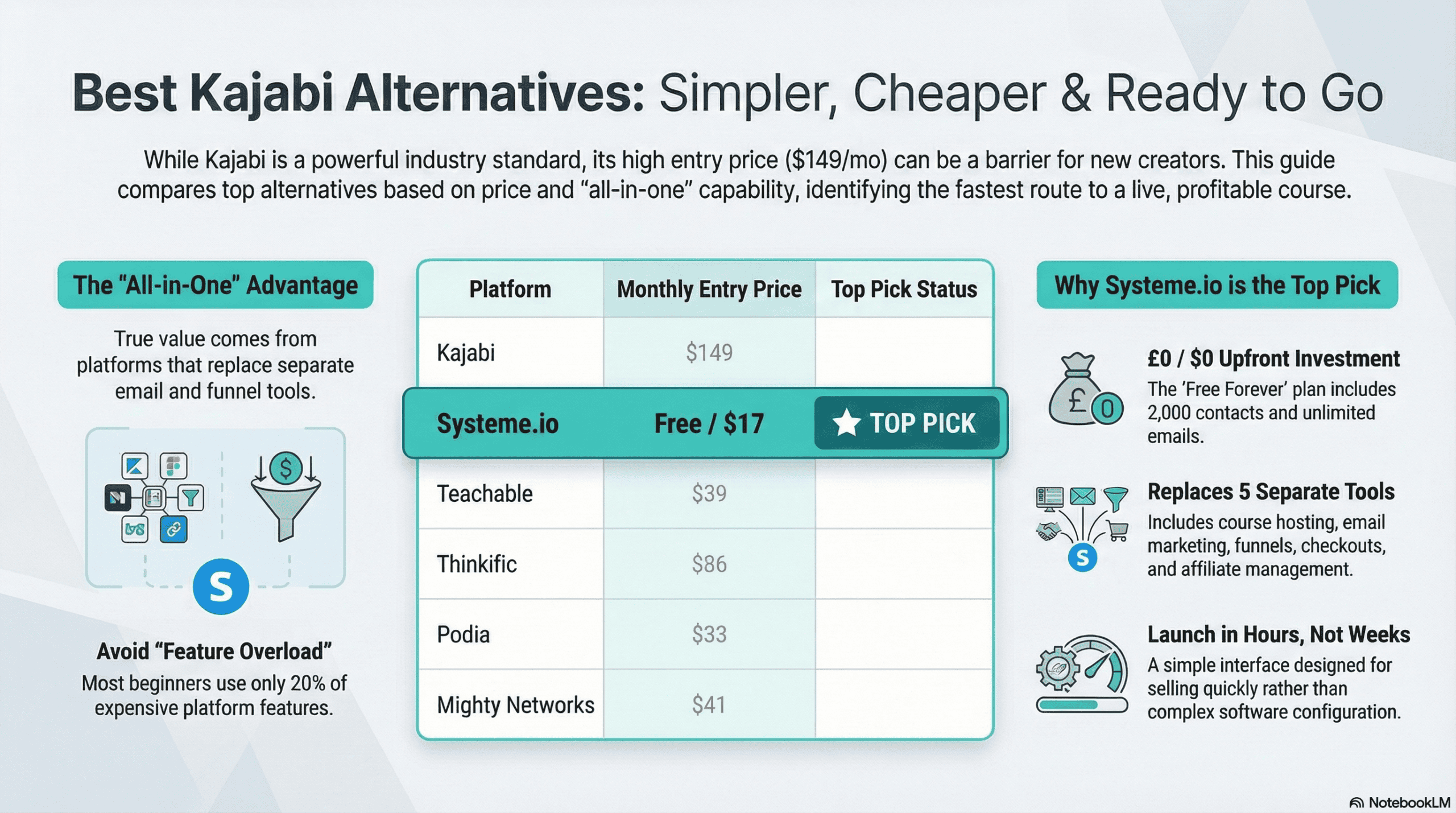
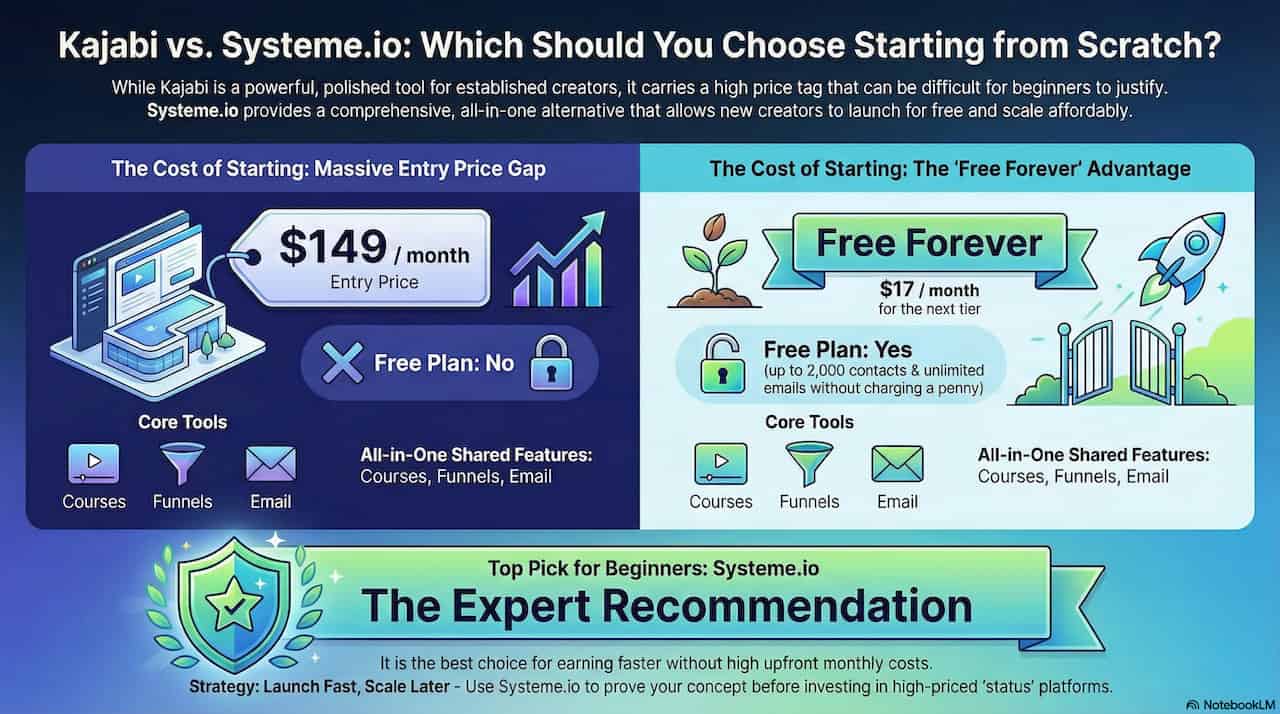
Kajabi's entry-level plan currently sits at around $149 per month — that's roughly £118, or over £1,400 per year before you've necessarily made a single sale. The next tier up is $199/month. These are serious numbers when you're just getting started.
If your course sells for £297, you need to sell five of them every single month just to break even on the platform fee. Before marketing costs, before payment processing fees, before anything else.
2. The Feature Overload Is Real
Kajabi includes podcasting tools, community features, advanced analytics, coaching products, a website builder, and more. These are impressive on a features page. In practice, most creators use a fraction of them — and the complexity of having so much available actually slows you down when you're starting out.
I've spoken to dozens of creators who spent their first three months "setting up Kajabi" rather than selling anything. That's not a Kajabi problem specifically — it's a feature-overload problem. When a platform can do everything, it's tempting to try and configure everything before launching. Don't.
3. You're Paying for Features You'll Never Touch
Do you need a built-in podcast player? Probably not. Multiple membership tiers with advanced drip content scheduling? Not yet. A fully customisable website builder that competes with Squarespace? You just need a sales page.
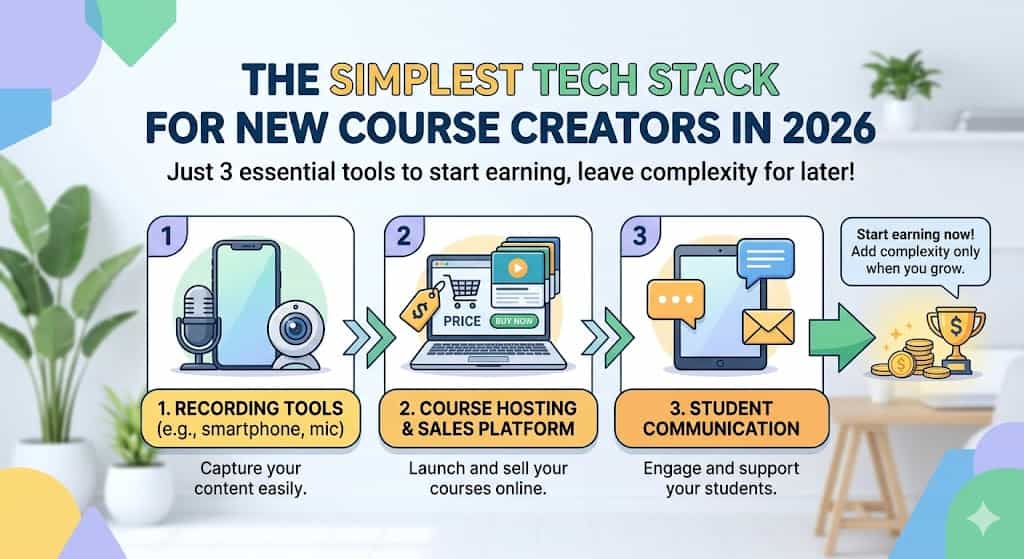
The features that matter when starting out are: course delivery, email marketing, payment processing, and a basic funnel. That's it. Everything else is noise until you're earning consistently.
My honest take after years of this: Most platform features exist to justify pricing, not to help you succeed. The best platform is the one you'll actually use, not the one that impressed you in a YouTube demo.
The Best Kajabi Alternatives in 2026
Here are the platforms worth your serious consideration — chosen based on value for money, ease of use, and real-world usefulness for course creators and coaches at the beginning-to-intermediate stage.
1. Systeme.io - Top Pick
Free forever plan available · Startup from $17/month · Webinar plan $47/month · Unlimited $97/month
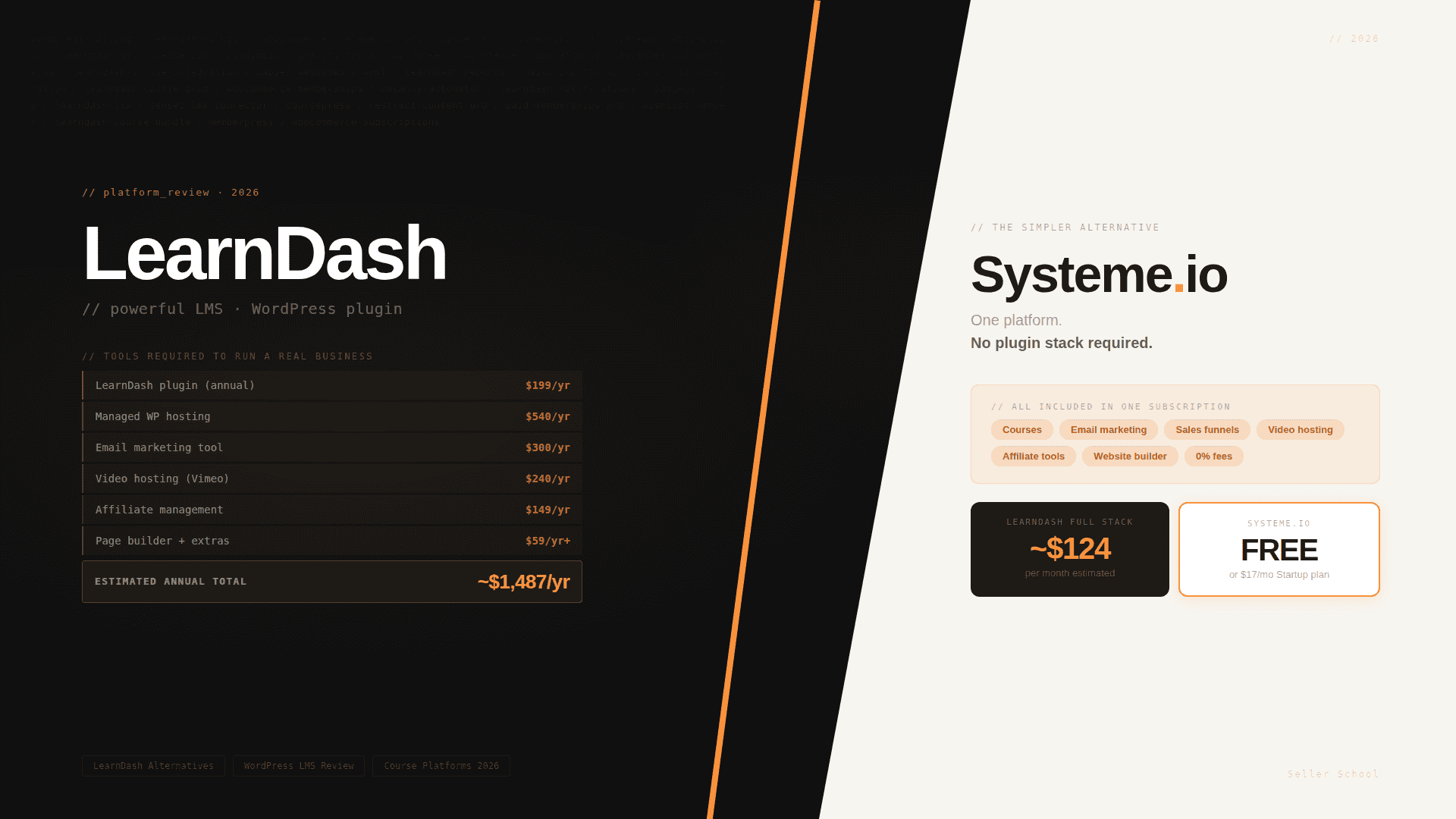
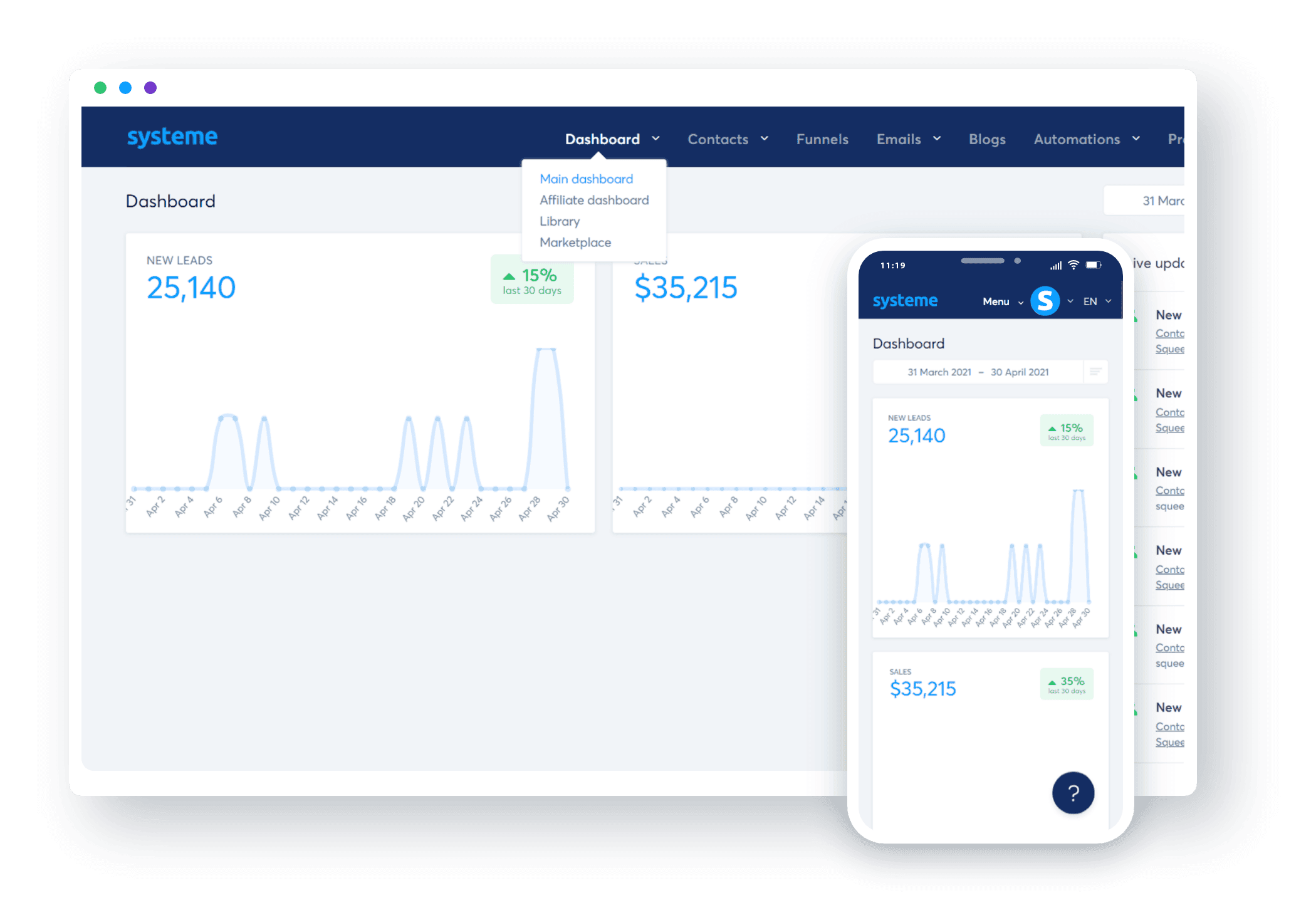
If I were starting again today, this is where I'd begin. Systeme.io is a genuinely all-in-one platform that covers courses, email marketing, sales funnels, affiliate management, and basic automation — all from a single dashboard, at a price that doesn't require you to have already built a successful business to afford it.
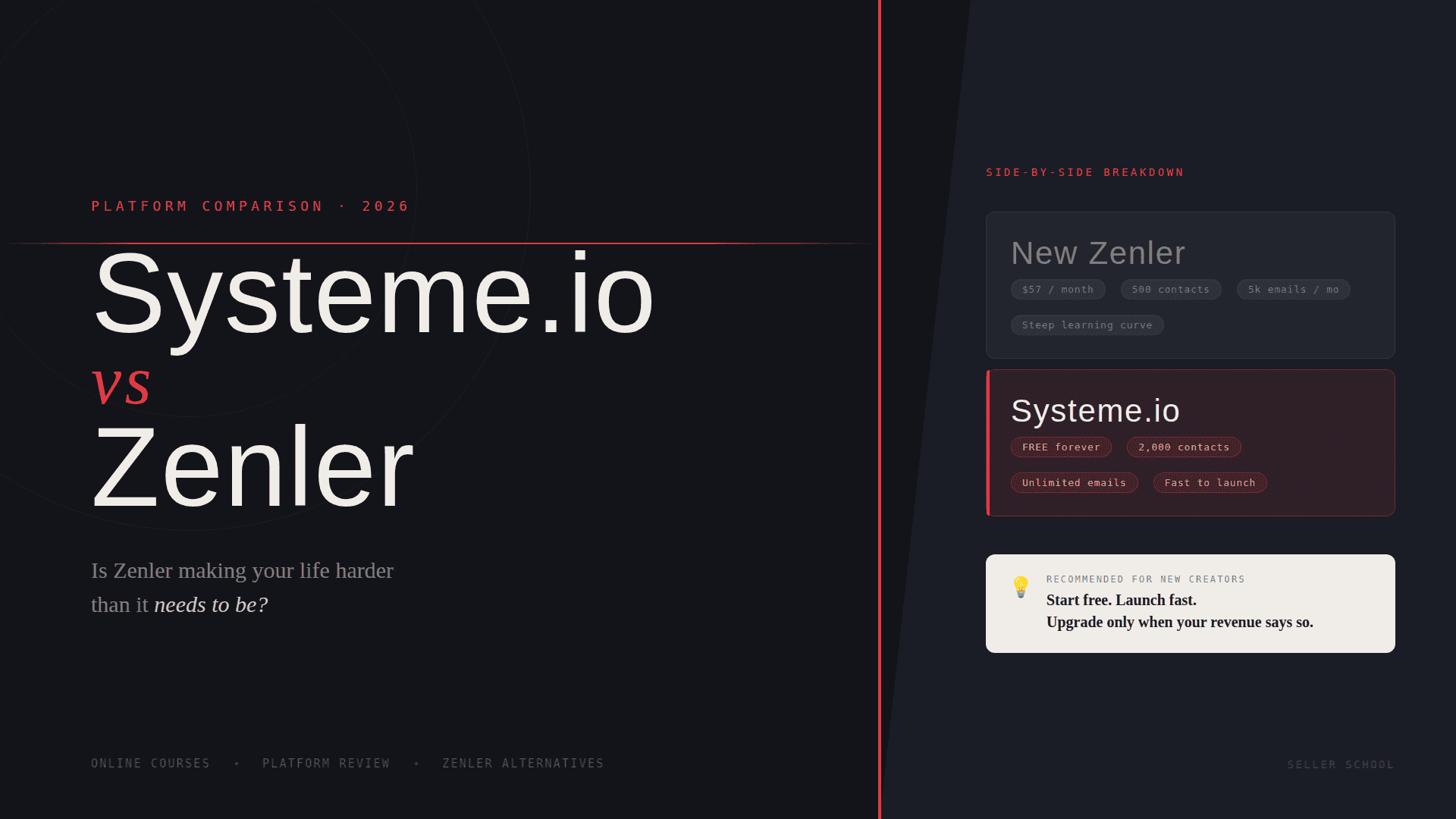
The free plan is surprisingly generous: up to 2,000 contacts, 3 sales funnels, 1 course, unlimited emails, and payment integration. For most beginners, this is everything you need to make your first few sales and prove your concept before spending a penny.
What I particularly respect about Systeme.io is that it doesn't try to be everything to everyone. It's designed to get you selling, and the interface reflects that. There's no "spend three weeks configuring your account" phase — you can have a functional funnel and course live within a day.
- Genuinely free plan to start
- All-in-one (no extra tools needed)
- Clean, easy-to-learn interface
- Affordable paid plans from $17/month
- Built-in affiliate programme
- Funnel builder included
- Less visually polished than Kajabi
- Community features are basic
- Fewer native integrations
- Course interface less customisable
Best for: Beginners who want to launch fast without spending money upfront, or anyone who wants a complete all-in-one solution at a fraction of Kajabi's price. If your goal is your first $10k and you want to get there without burning money on tools, start here.
👉 Start your free Systeme.io account here
2. TeachableSimple
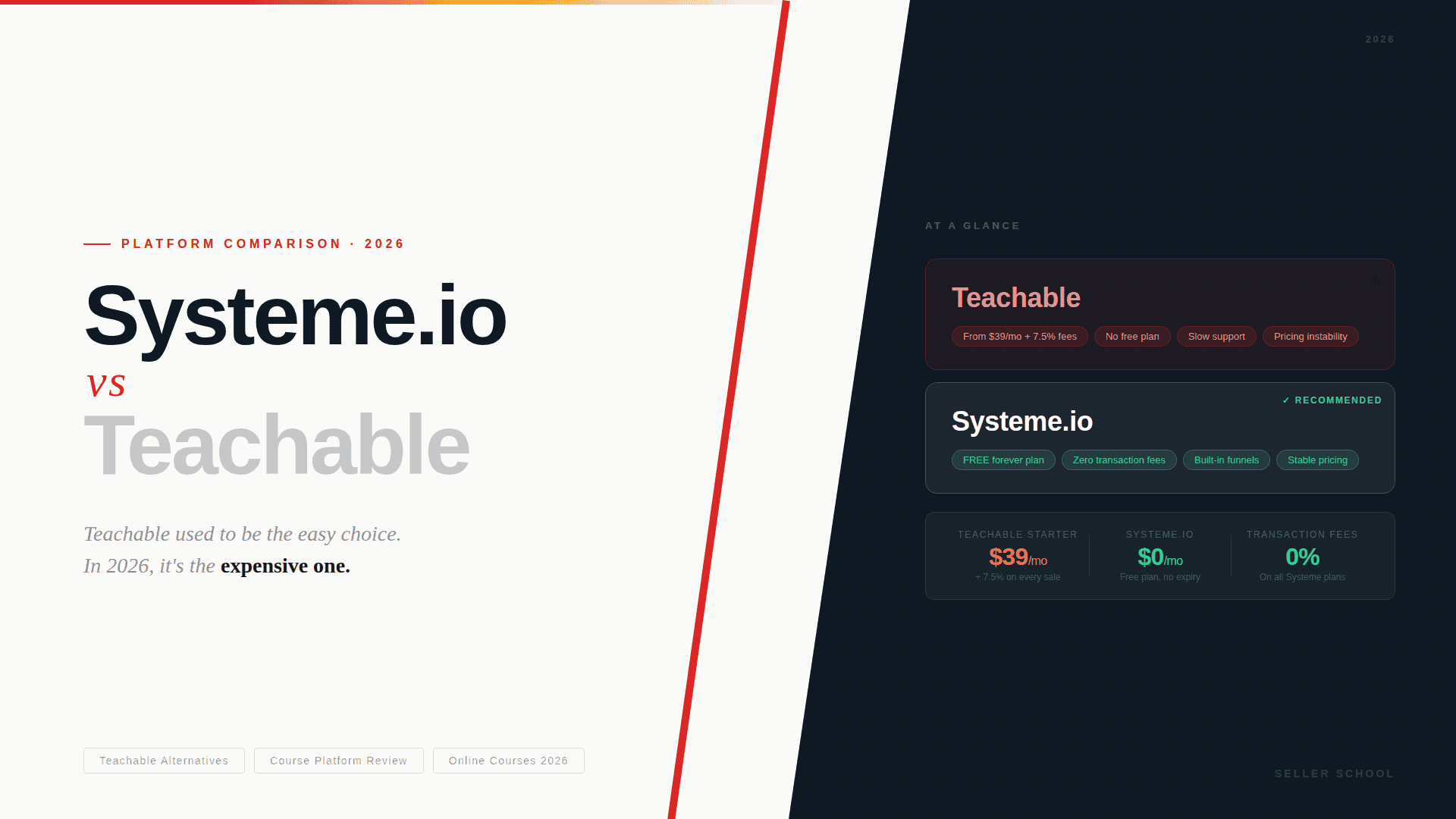
Free plan (with transaction fees) · Basic from $39/month · Pro $119/month
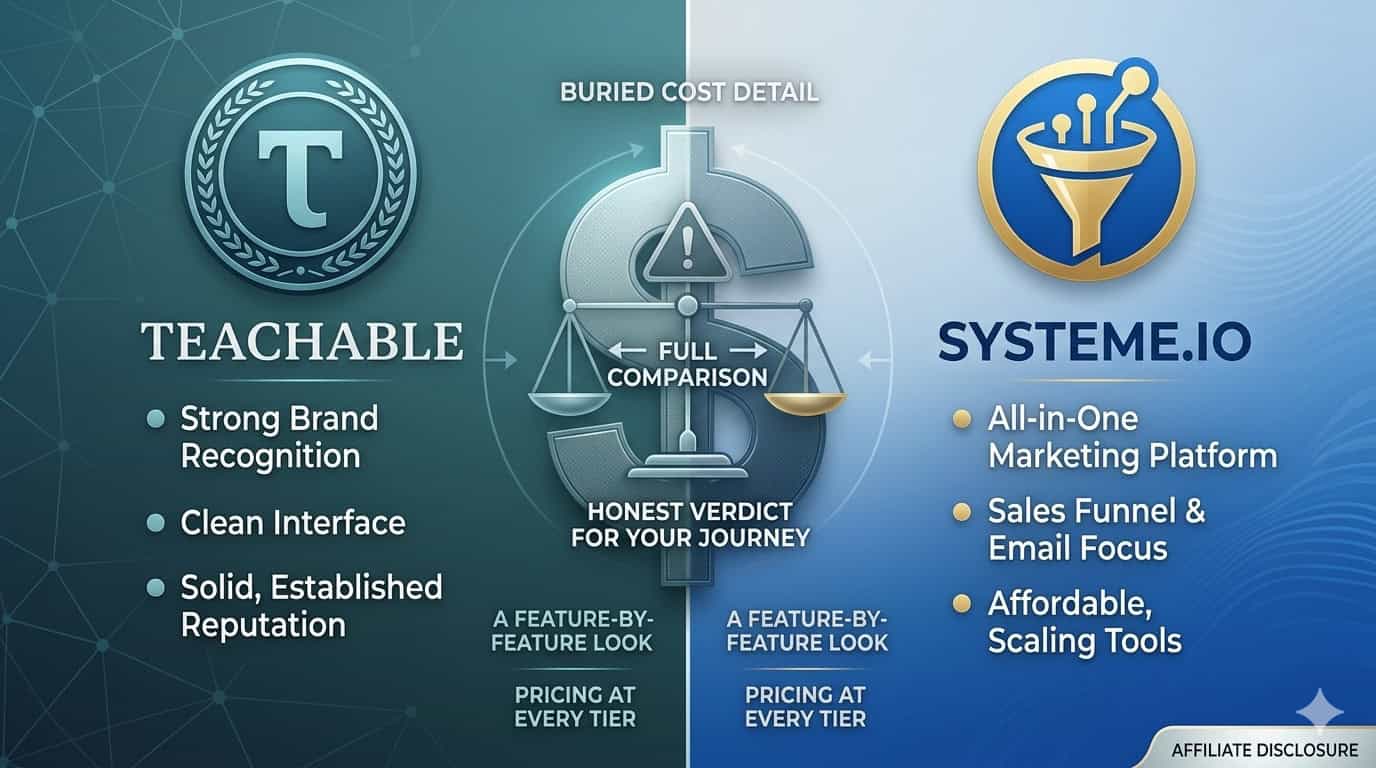
Teachable is one of the most established course platforms around, and it earns its place on this list because of how clean and intuitive it is. The course-building experience is excellent — uploading content, creating lessons, and organising your curriculum is genuinely straightforward.
The main drawback is that Teachable is a course platform, not an all-in-one tool. You'll still need a separate email marketing service and funnel builder if you want to build a proper sales machine. Once you factor those in, the price comparison with Systeme.io becomes less favourable.
- Excellent course delivery UX
- Very beginner-friendly
- Strong student experience
- Good payment options
- No built-in email marketing
- No funnel builder
- Transaction fees on lower plans
- Total cost rises quickly with add-ons
Best for: Creators who want to focus purely on course delivery and are already using (or happy to pay for) a separate email tool like Mailchimp or ConvertKit.
3. ThinkificSimple
Free plan · Basic $36/month · Start $74/month · Grow $149/month
Thinkific competes directly with Teachable in the mid-market and is a solid, reliable choice. The platform has a free tier that doesn't charge transaction fees, which is genuinely useful when you're getting started. The course builder is clean, the student experience is professional, and the interface doesn't overwhelm you.
Like Teachable, though, it's a course platform rather than a full business platform. As your needs grow — automated email sequences, funnel pages, affiliate management — you'll be adding tools and costs on top.
- No transaction fees (even free plan)
- Clean, professional interface
- Good free tier to start
- Reliable and well-supported
- Email marketing not included
- Limited funnel capabilities
- Advanced features require higher tiers
Best for: Creators who want a dedicated, no-fuss course platform with no transaction fees while they're getting started.
4. PodiaBudget-Friendly
Free plan (8% transaction fee) · Mover $33/month · Shaker $75/month
Podia is a genuinely likeable platform that covers courses, digital downloads, memberships, and coaching products — and it includes basic email marketing. The interface is clean and the pricing is reasonable. It's a platform that clearly cares about its users and has strong customer support.
Where it falls slightly short for ambitious creators is in the funnel-building and automation capabilities. The email marketing is basic rather than powerful. But for someone who wants to keep things simple and consolidated, Podia is a very decent option.
- Clean, accessible design
- Includes basic email marketing
- Courses + digital downloads + memberships
- Strong customer support reputation
- Email automation is limited
- No proper funnel builder
- Transaction fee on free plan
5. Mighty NetworksCommunity-First
Courses plan $41/month · Business plan $99/month
Mighty Networks occupies a different niche from the others on this list. It's built primarily around community, with courses as an important but secondary feature. If your business model relies heavily on peer interaction, group accountability, or building a paid community as its own product, Mighty Networks is genuinely excellent.
For straightforward course delivery or coaching, though, it's more complex and more expensive than it needs to be. The community features you're paying for may simply not be relevant to your model yet.
- Best-in-class community features
- Native app for members
- Strong engagement tools
- Good for cohort-based courses
- Pricey for solo course delivery
- No email marketing included
- Overkill if community isn't central
Quick Comparison: Kajabi vs the Alternatives
| Platform | Entry Price | Free Plan | Email Marketing | Funnel Builder | Affiliate System |
|---|---|---|---|---|---|
| Kajabi | $149/mo | ✗ | ✓ | ✓ | ✓ |
| Systeme.io ⭐ | Free / $17 | ✓ | ✓ | ✓ | ✓ |
| Teachable | $39/mo | ✓* | ✗ | ✗ | ✗ |
| Thinkific | Free / $36 | ✓ | ✗ | ✗ | ✗ |
| Podia | Free / $33 | ✓* | Basic | ✗ | ✗ |
| Mighty Networks | $41/mo | ✗ | ✗ | ✗ | ✗ |
* Free plans with transaction fees or feature limitations
Why I Recommend Systeme.io for Most Beginners (and Many Intermediates)
I want to be clear that I'm not anti-Kajabi, anti-Teachable, or anti any of the platforms in this list. Each of them serves a purpose for the right creator at the right stage.
But if your primary goal right now is to get your course or coaching programme live, start bringing in income, and not burn through savings on platform fees while you're building — Systeme.io is, in my honest experience, the best place to start.
Here's why it maps so directly to where you are:
You don't pay anything until you're ready to scale. The free plan genuinely covers everything a beginner needs. 2,000 contacts is plenty for your first several months of list building. Three funnels is enough to test your offer, run a lead magnet, and process sales. One course is — well — one course, which is all you should be building if you're jut getting started or trying it out.
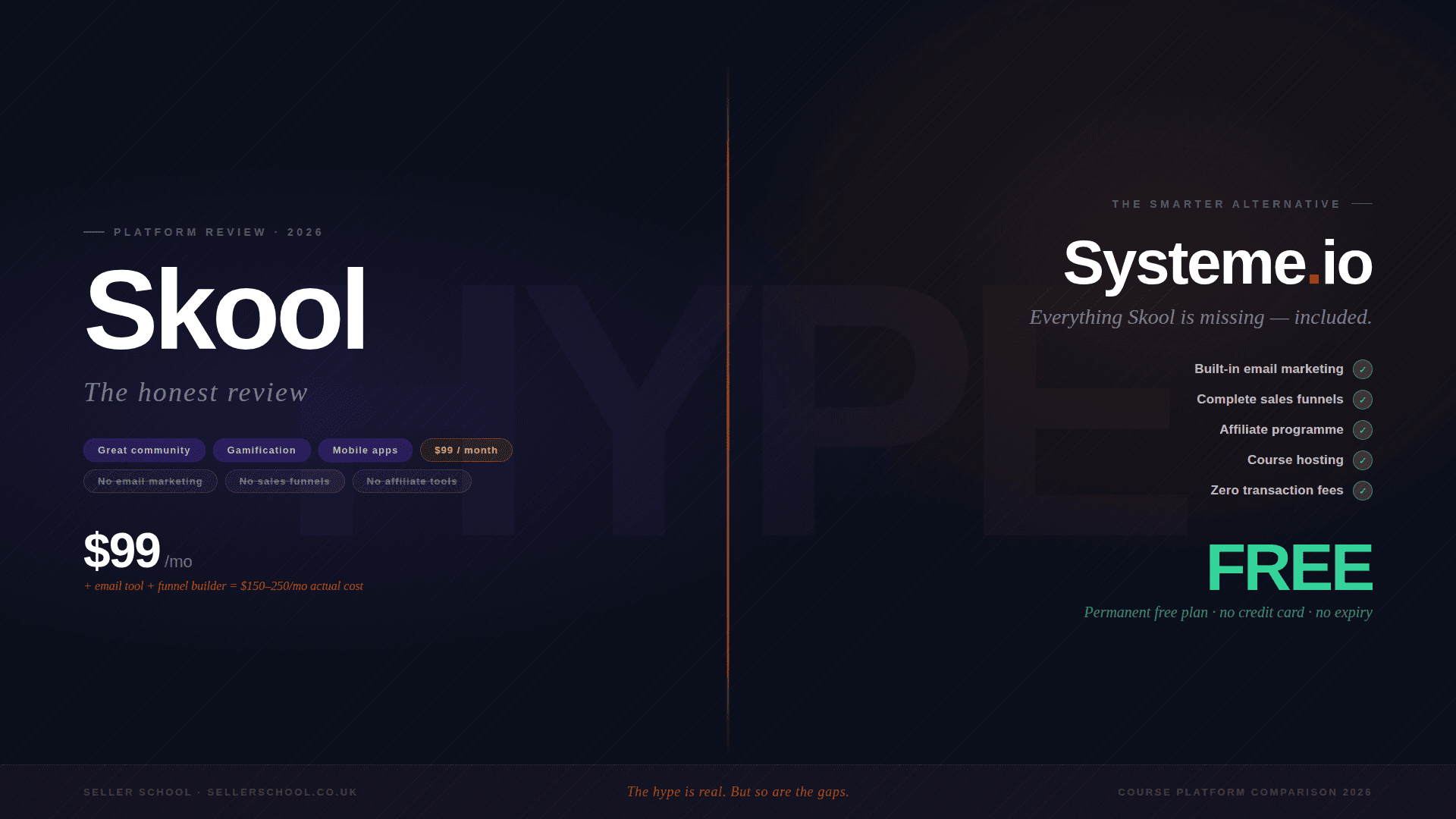
It genuinely replaces four or five separate tools. On Systeme.io's free plan, you get the course platform, the email marketing, the funnel builder, the payment processing, and an affiliate system. The cost of replacing those individually with the "best" tool for each job would easily run to £100–£200 per month. Systeme.io consolidates them at no cost to start, and just $17/month on the Startup plan when you're ready to grow.
The learning curve is measured in hours, not weeks. I've helped people set up their first Systeme.io account and have a working funnel live within a single afternoon. The interface is designed for people running a business, not for people who enjoy configuring software.
You're not locked in. If you outgrow it — if you build a six-figure business and decide you want Kajabi's polish and power — nothing is stopping you from making that move later. But most people who are worried about outgrowing Systeme.io never actually do. It's more capable than it gets credit for.
A word on the affiliate disclosure: Yes, the Systeme.io link in this article is an affiliate link. If you sign up, I earn a small commission at no extra cost to you. But I was recommending this platform before the affiliate programme existed, and my opinion hasn't changed. I'd rather tell you something true and useful than recommend something expensive to earn a bigger commission.
When Systeme.io Might Not Be the Right Choice
I want to be balanced here, because no platform is universally right for everyone.
If you are already earning consistently and have a large, engaged audience, Kajabi's polish and depth may genuinely justify the cost. The student experience is arguably better, the branding more refined, and the ecosystem more mature.
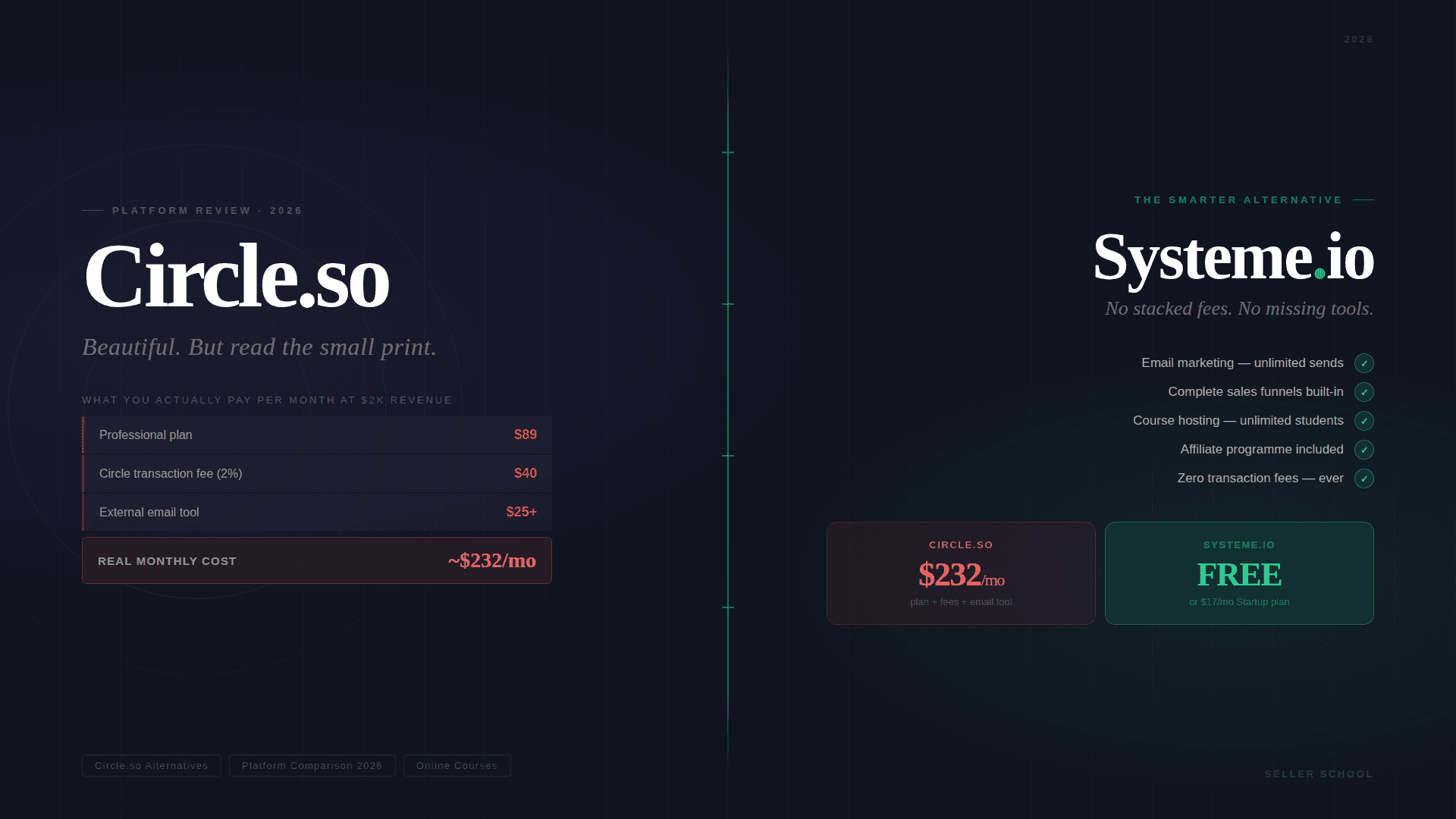
If community is the absolute core of your offering — if what you're selling is primarily access to a group rather than content — then Mighty Networks or Circle.so might serve you better.
And if you've been building on Teachable for three years, have your workflow dialled in, and it's working for you, there's no compelling reason to switch platforms mid-flight. Stability matters too.
But if you're starting fresh? Or if you're currently on Kajabi and questioning whether the cost is justified at your current stage of business? Try Systeme.io's free plan for an unlimited time. You'll have your answer quickly.