


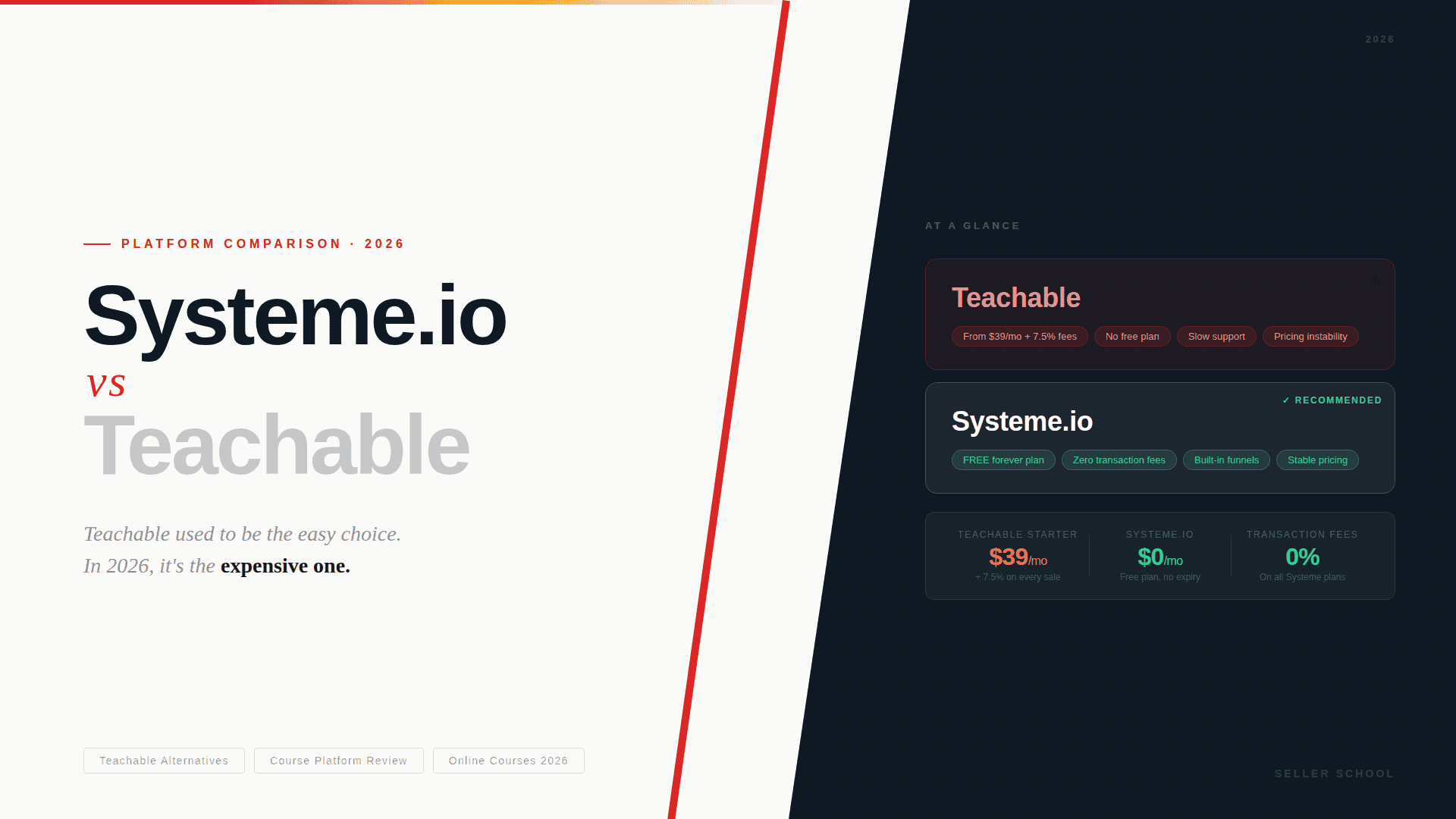



Thinkific has scrapped its free plan.
If you researched course platforms a year or two ago and pencilled Thinkific in as "the one with the genuinely good free option," that option no longer exists. What's there now is a 30-day free trial — and then a monthly bill, whether or not you've made a sale.
That single change reshapes the entire Thinkific vs Systeme.io question. It's no longer "which free plan is better?" It's "is Thinkific worth paying for from day one — and how does it compare to a platform that still has a genuinely free plan?"
That's the question this post answers, properly.
Before we begin: we have an affiliate relationship with Systeme.io and earn a small commission when someone signs up through our link. Thinkific is not an affiliate relationship. We're leading with that because transparency matters — and because knowing it should make you expect us to work harder to be fair to Thinkific than a less transparent comparison would bother to be. That's what we've aimed for. Thinkific genuinely wins in several areas, and we'll show you exactly where.
One more thing worth saying upfront. Platform pricing in this space changes frequently — Thinkific's own pricing has shifted more than once recently. Every figure in this post was checked against live sources in July 2026, and we've dated them clearly. If you're reading this later, verify the current numbers on the platforms' own pricing pages before you commit. That advice applies to every comparison you read, including ours.
If you'd rather watch than read, the full video comparison is above.
The Big Change: Thinkific's Free Plan Is Gone
For years, Thinkific's free plan was one of its strongest selling points — a genuinely functional free tier with no transaction fees that let creators host a course indefinitely without paying.
That's over. Thinkific retired its free plan, and their own pricing FAQ now states it plainly: new users get a 30-day free trial of the full platform, after which every tier is paid.
To be fair to Thinkific, a 30-day full-platform trial is the most generous trial period among the major course platforms — Teachable's, by comparison, is seven days. Thirty days is enough time to build a real course and genuinely evaluate the platform.
But a trial is not a free plan. A trial has a countdown clock. It means the question "can I afford this platform?" arrives before the question "is my course actually selling?" — which, for a pre-revenue creator, is exactly the wrong order.
If you're wondering whether the same is true elsewhere: yes.
Teachable also no longer offers a free plan — we covered that in
detail in our updated Teachable comparison.
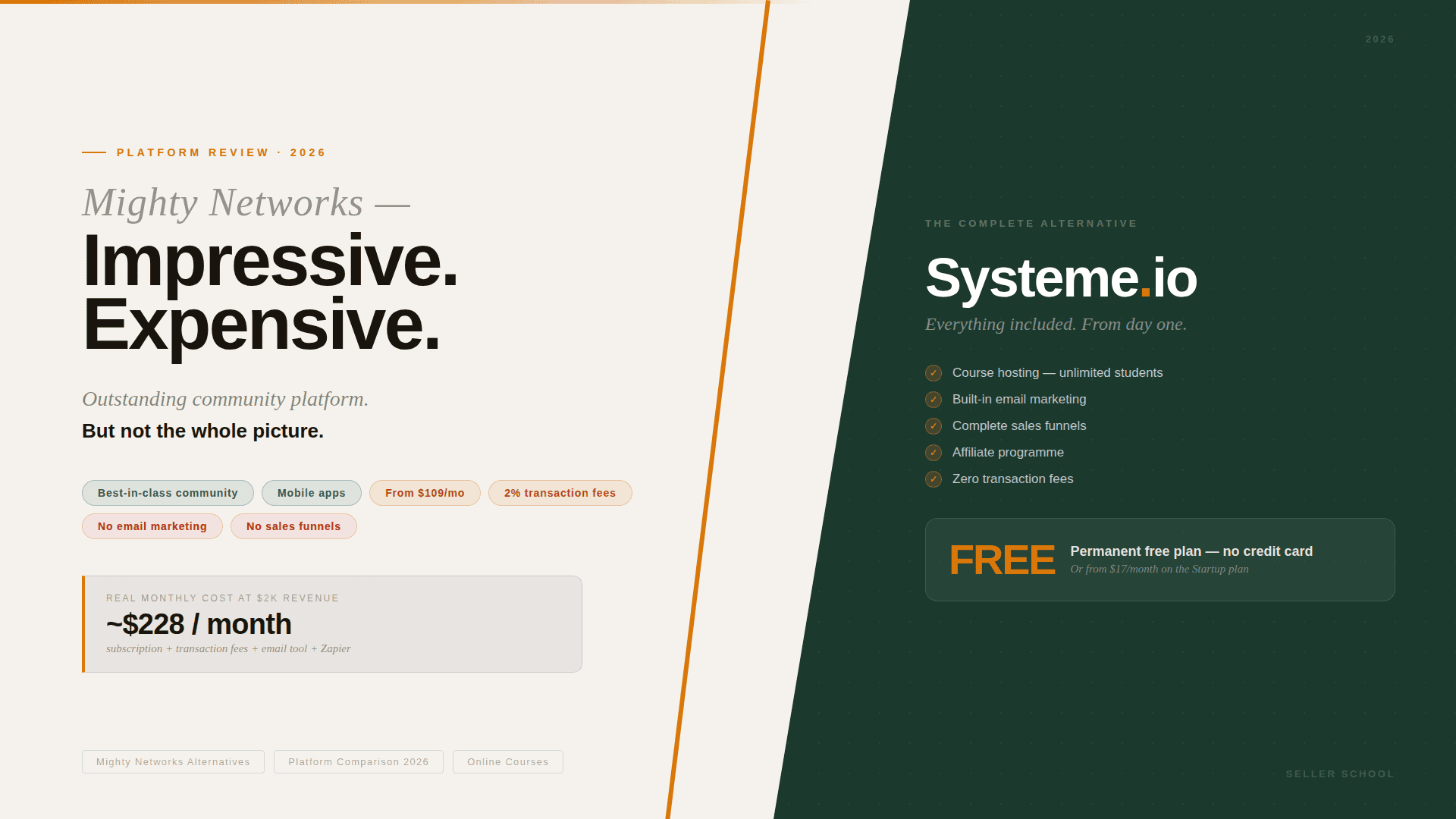
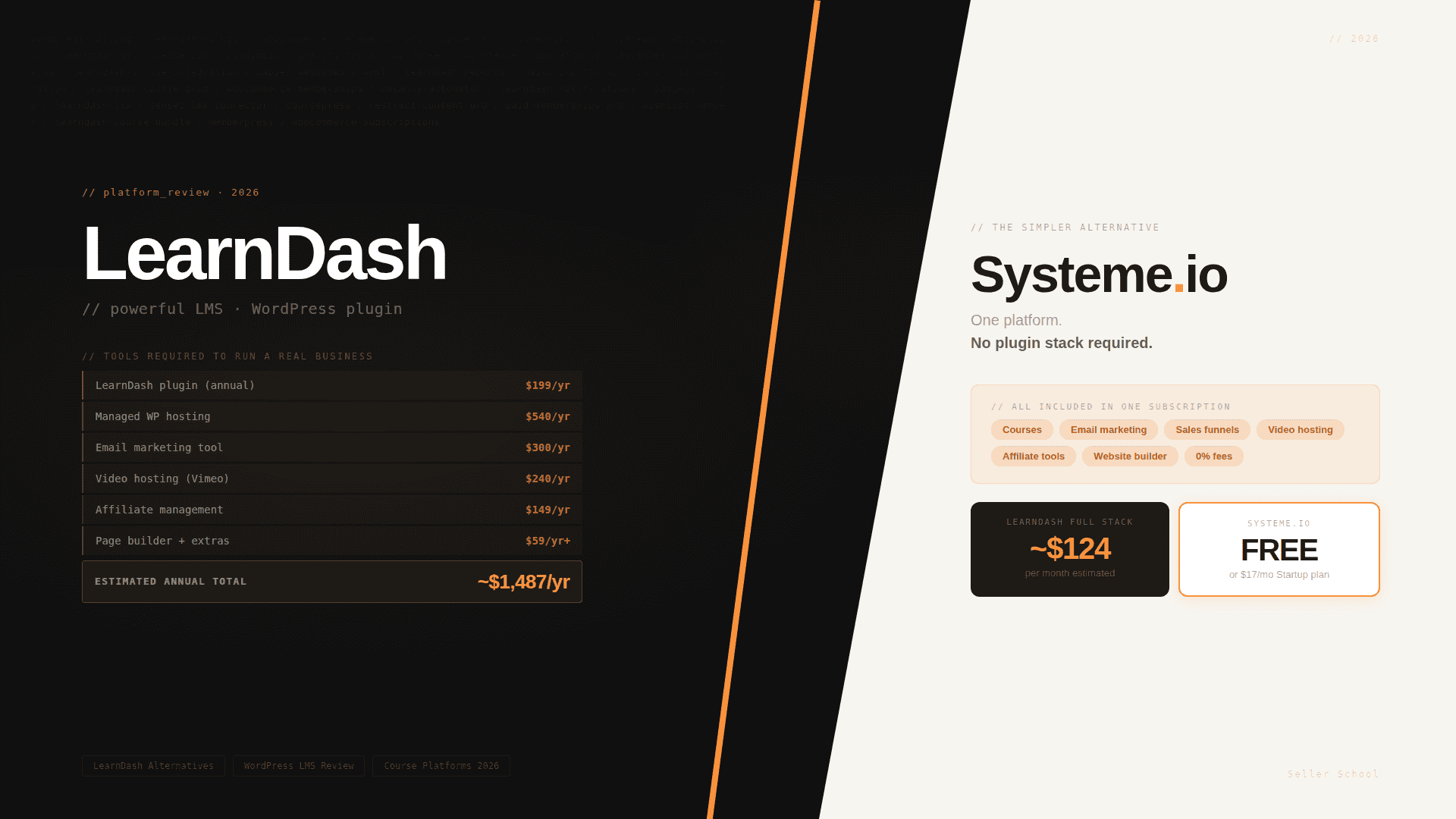
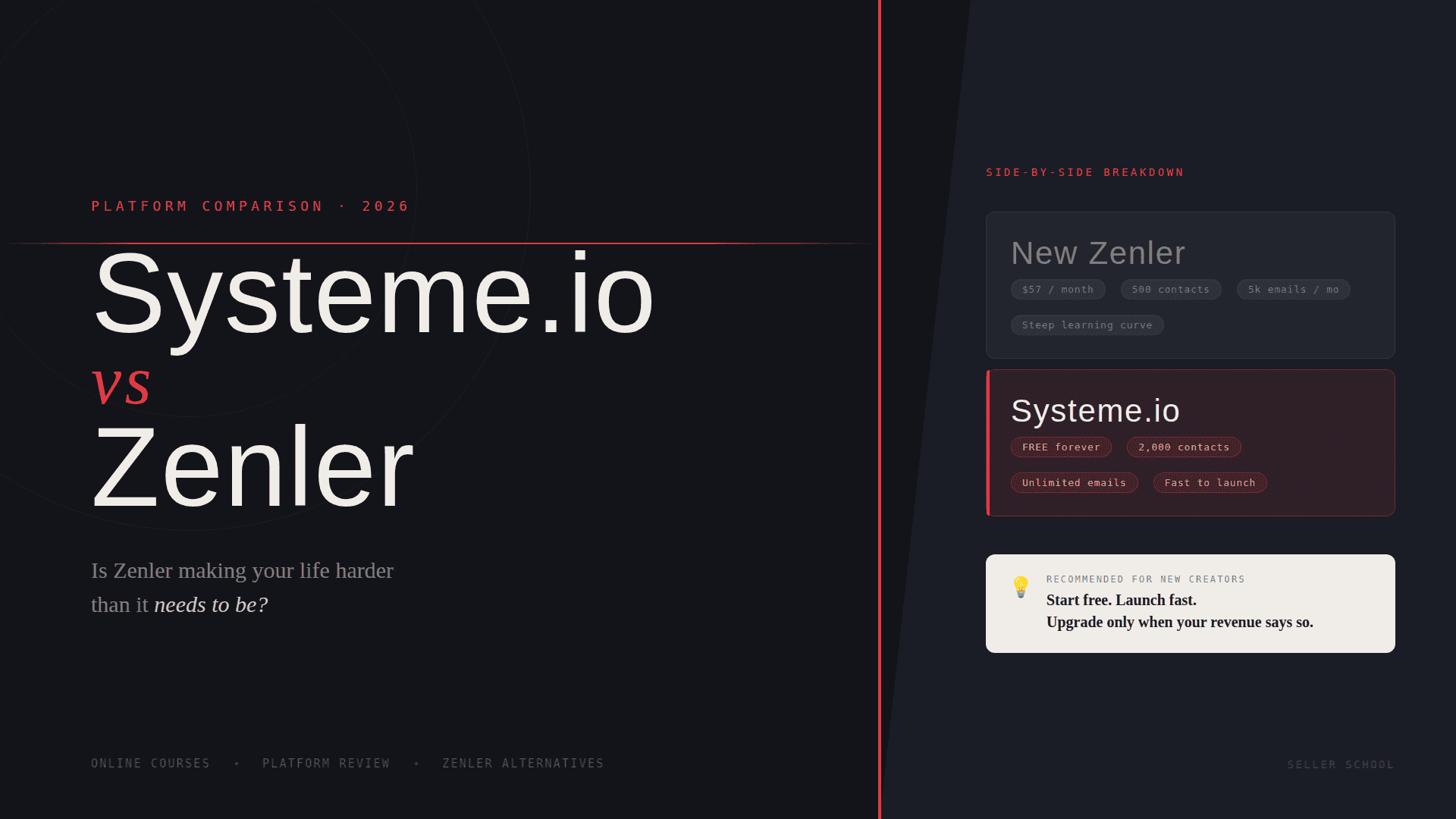
Systeme.io, at the time of writing, still offers a genuinely free plan with no time limit and no transaction fees. In a market where the major dedicated course platforms have both withdrawn their free tiers, that's become a bigger differentiator than it was a year ago.
Thinkific Pricing in 2026: Every Tier Explained
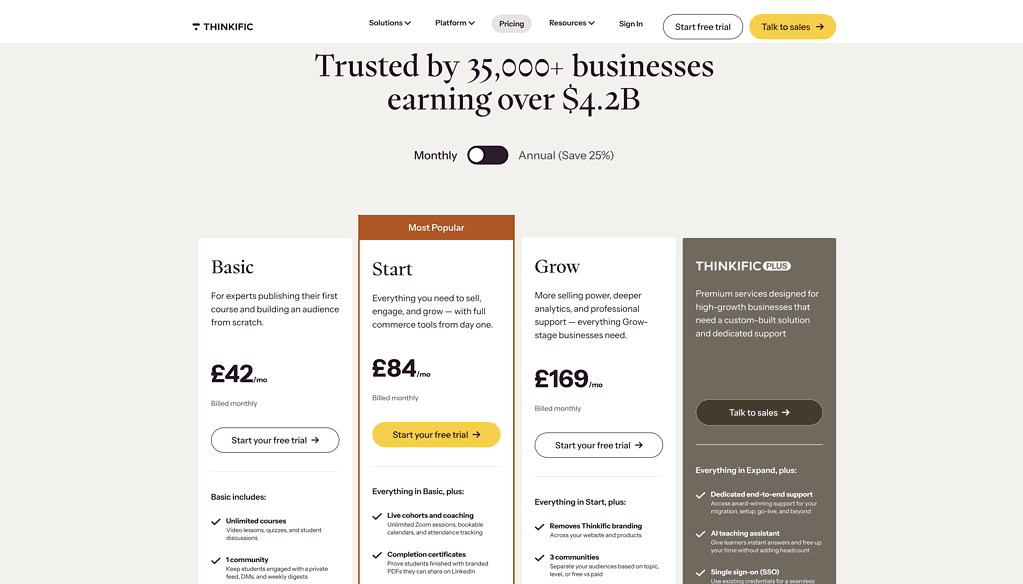
Basic Plan — $49 per month (roughly £42), or $36 per month (roughly £31) billed annually
Unlimited courses — a genuinely generous inclusion at the entry tier. Custom domain. Drip content scheduling. Coupons and discounts. Email and live chat support. One administrator account.
What Basic doesn't include matters just as much: no completion certificates, no assignments, no memberships or payment plans, no course bundles. The features that most serious course creators want from Thinkific live one tier up.
Start Plan — $99 per month (roughly £78), or $74 per month (roughly £62) billed annually
Everything in Basic, plus the features Thinkific is actually known for: assignments with student submission and instructor feedback, completion certificates, live lessons via Zoom integration, course bundles and upsells, payment plans, and memberships and subscription products.
Realistically, this is the plan most committed course creators on Thinkific end up on — because certificates, assignments, and memberships are the platform's distinctive strengths, and they all
unlock here.
Grow Plan — $199 per month (roughly £169), or $149 per month (roughly £127) billed annually
Everything in Start, plus removal of Thinkific branding, expanded community capacity, group orders and B2B selling tools, API access and webhooks, deeper engagement reporting, and phone and priority support.
Plus — custom pricing
Thinkific's enterprise tier, aimed at large organisations, is not relevant to most readers of this post.
The UK Detail Most Reviews Miss: Payment Gateway Fees
You'll see it repeated across the internet that "Thinkific has no transaction fees." That's true of Thinkific's own platform fee — but there's a caveat in Thinkific's own documentation that matters specifically to UK creators, and most reviews skip it entirely.
If you process payments through Stripe or PayPal on Thinkific, a third-party payment gateway fee applies in certain countries — and the United Kingdom is one of them. It's charged as a percentage of each transaction, on top of Stripe or PayPal's normal processing fees.
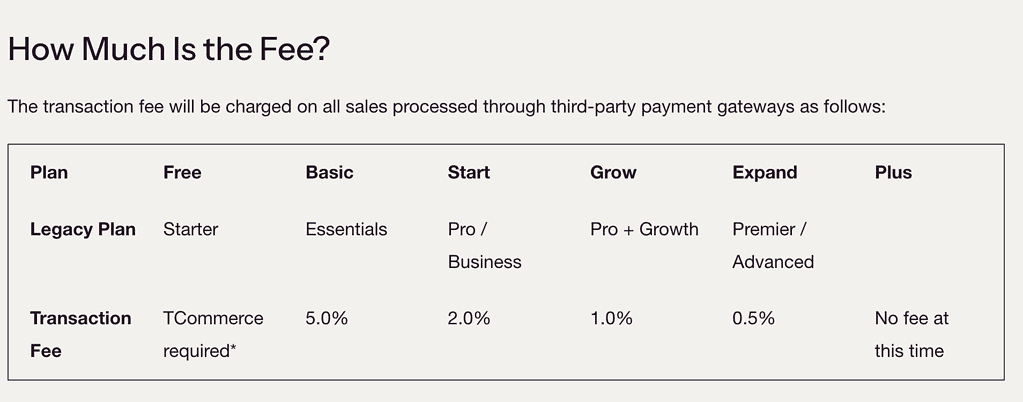
You can avoid it by using Thinkific Payments, the platform's own payment processor, which charges standard card-processing rates of around 2.9%. For many creators that's a perfectly workable answer. But if your plan was to run your existing Stripe account through Thinkific from here in the UK, budget for the additional gateway fee — or plan to migrate your payment processing.
Systeme.io charges no platform transaction fees on any plan, and connects to your own Stripe or PayPal account without an additional platform-imposed gateway fee. Standard Stripe and PayPal processing rates apply on both platforms, as they do everywhere.
We're giving this its own section because it's exactly the kind of detail that doesn't show up until your first payout is smaller than you expected. Now you know before you commit, not after.
Systeme.io Pricing in 2026: Every Tier Explained
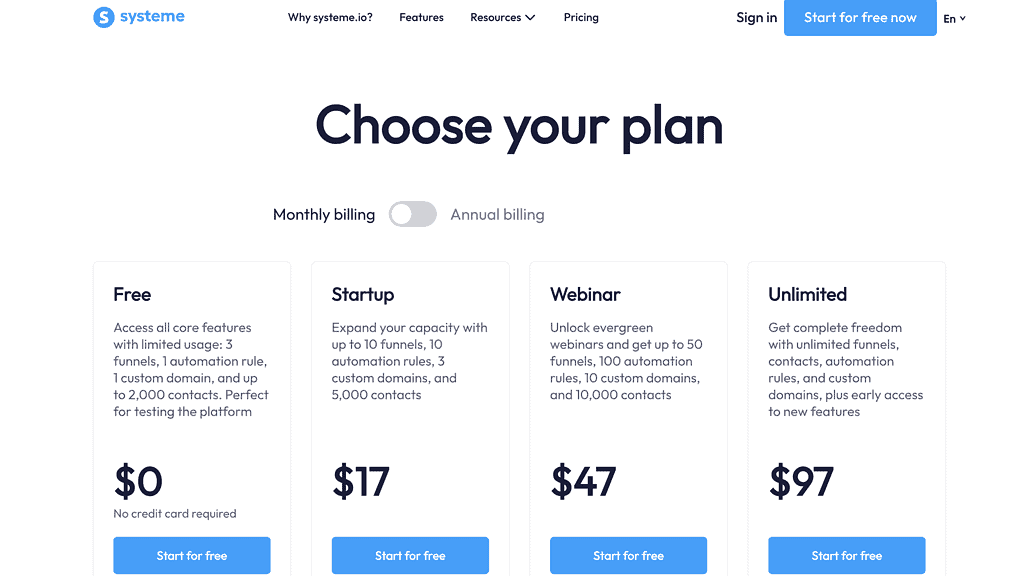
Free Plan — £0
One course with unlimited student enrolments. Three sales funnels. Email marketing for up to 2,000 contacts with unlimited sends. One automation rule. Basic blog. No transaction fees — and no time limit. No credit card required to start.
Startup — $17 per month (roughly £13)
Five courses. Ten sales funnels. 5,000 contacts. Five automation rules. Custom domain.
Webinar — $47 per month (roughly £35)
Fifty courses. Three hundred funnels. 10,000 contacts. Ten automation rules. Native webinar functionality. This is the plan we use at Seller School.
Unlimited — $97 per month (roughly £72)
Unlimited courses, funnels, contacts, and automation rules.
The Price Comparison at a Glance
| Thinkific | Systeme.io | |
|---|---|---|
| Free plan | No — 30-day trial only | Yes — no time limit |
| Entry paid tier | ~£42/mo | ~£13/mo |
| Mid tier | ~£84/mo | ~£35/mo |
| Top standard tier | ~£169/mo | ~£72/mo |
| Platform transaction fees | 0%, but UK gateway fee on Stripe/PayPal | None on any plan |
| Webinars | Via Zoom integration (Start+) | Native (Webinar plan) |
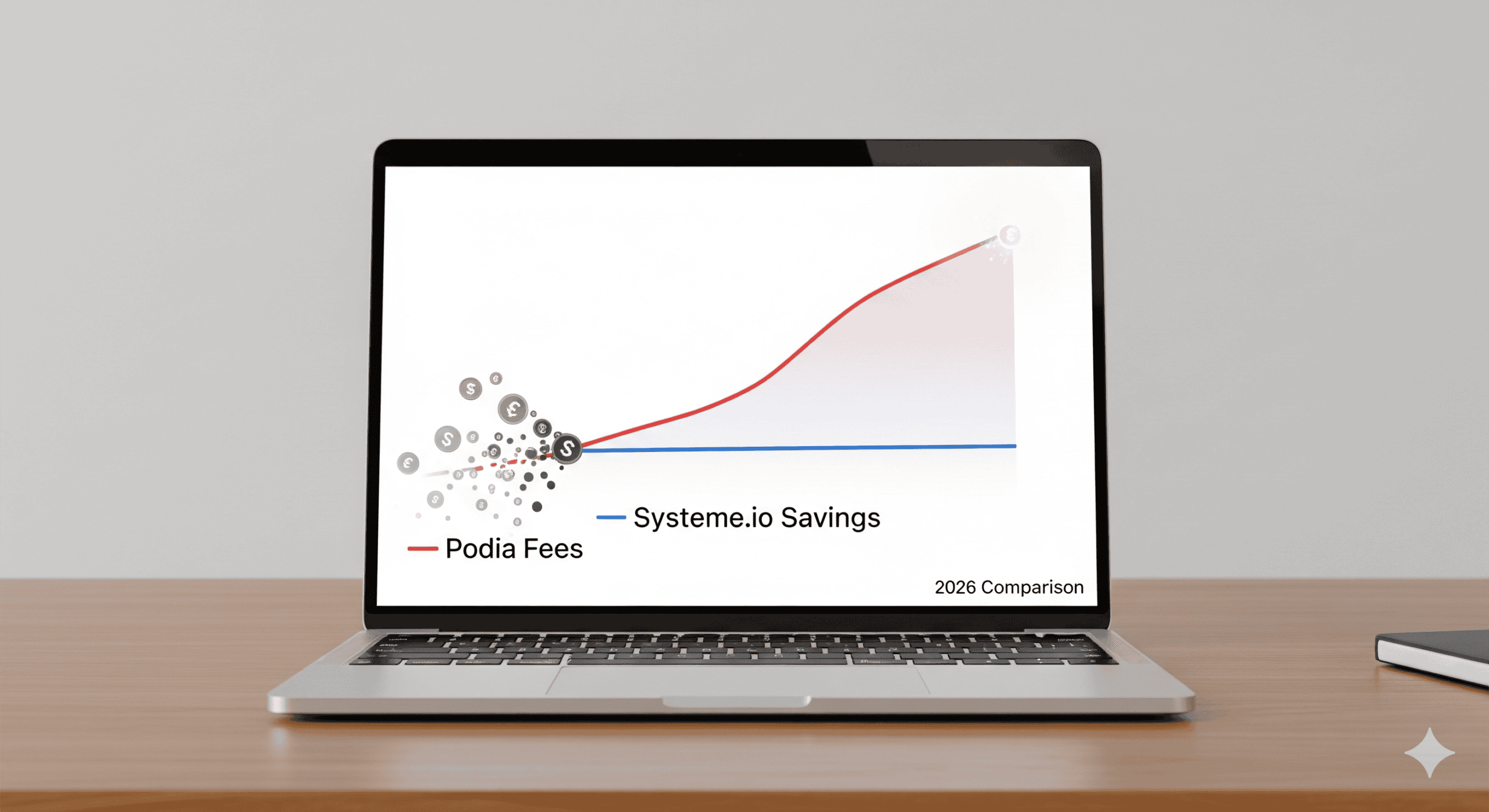
The pattern is consistent: Systeme.io's most expensive plan costs less than Thinkific's middle tier. And with Thinkific's free plan gone, the entry-point gap has widened from "£0 vs £0" to "£0 vs around £42 a month" — or roughly £84 a month if the features you actually want live on the Start plan, which for most creators they do.
Pricing checked July 2026 against live sources. Exchange rate conversions approximate. Always verify current pricing on the platforms' own websites before purchasing.
Feature Comparison: What Matters Most
Course Building and Student Experience
Thinkific's course builder remains one of the best in this space — that hasn't changed. The interface is clean and intuitive, and the student-facing experience is polished enough that students perceive it as a premium learning environment from the moment they log in.
Lesson variety is a genuine strength: video, text, audio, PDF downloads, quizzes, and surveys, all built in. And on the Start plan and above, assignments — students submit work through the platform, and you review and give feedback inside Thinkific. For courses where accountability and feedback are central to the learning experience — writing courses, coaching programmes, skills-based curricula — that's a feature that genuinely enhances what you can deliver.
Completion certificates (Start plan and above) are well implemented and matter in any niche where credentials carry weight.
Systeme.io's course builder handles the core requirements reliably: modules, lessons, video embedding, drip scheduling, student access management. The student interface is functional and clear, but it doesn't match Thinkific's polish, and there's no native assignment submission.
Verdict: Thinkific builds a better classroom. If the learning experience itself is a meaningful part of what you're selling —
particularly at a premium price — that's a real advantage. Just note that the features driving it live on the ~£78/month Start plan.
Communities
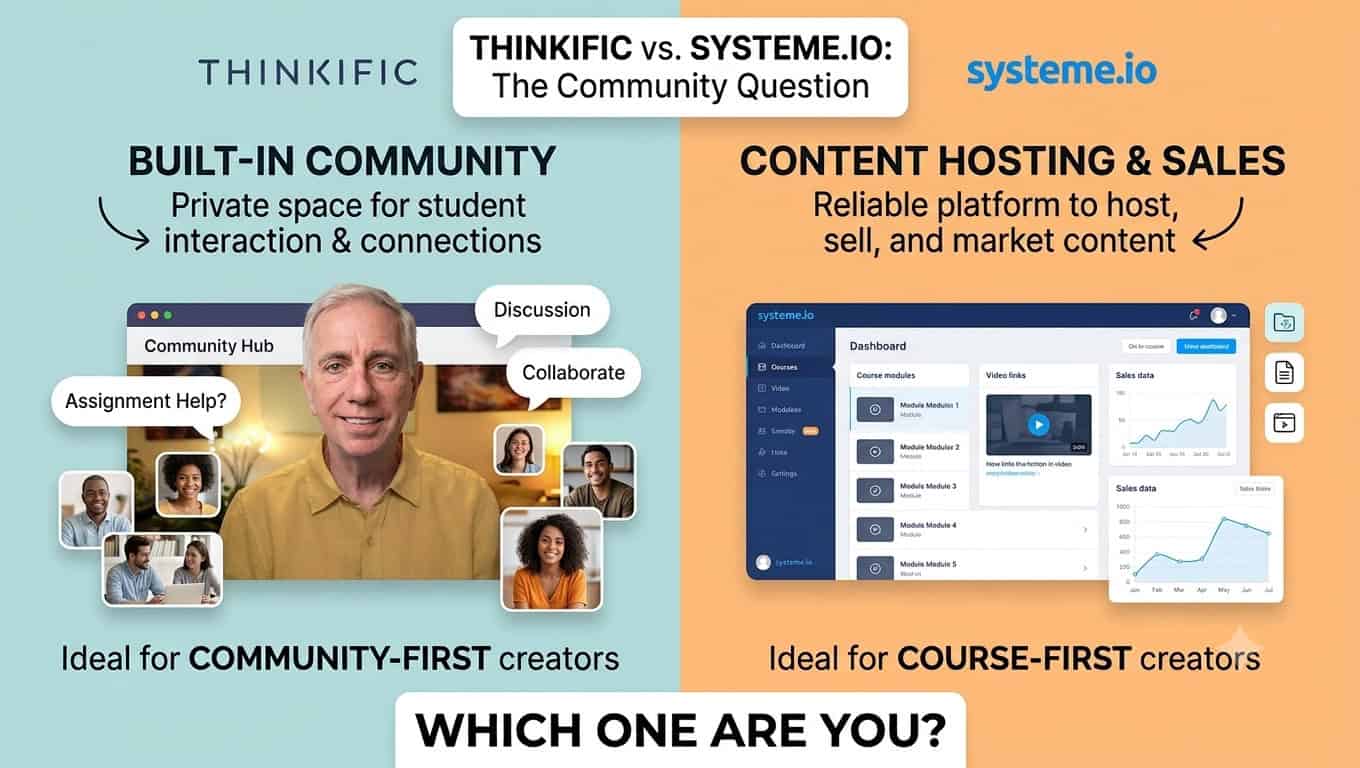
Thinkific includes a built-in communities feature — a private, structured space attached to your course where students can interact,
ask questions, and build connections.
Systeme.io has no comparable native community feature at the time of writing. If community is a core part of your offer — not a nice-to-have, but something students are paying for — this remains one of the strongest reasons to choose Thinkific.
Verdict: Thinkific wins, clearly.
Marketing Tools and Funnels
This is where the comparison shifts most decisively — and where Thinkific's higher prices buy you the least.
Thinkific has been adding marketing capability — email automation and landing pages are now part of the platform — but the architecture hasn't changed: it's a course platform with marketing features attached. There's no full funnel builder. The email tools are lighter than a dedicated platform's. Serious marketing on Thinkific still generally means integrating external tools — ConvertKit, Mailchimp, ActiveCampaign — at additional monthly cost.
Systeme.io is built the other way round: a marketing platform first. Sales funnels, email marketing, automations, and affiliate management are native, connected, and included on every plan — including the free one. When someone opts in, buys, or completes a module, the platform responds automatically without any external integration.
Verdict: Systeme.io wins clearly. For a creator who needs to build an audience and convert it — which is every creator — this is the structural difference between the two platforms.
Webinars
Thinkific runs live sessions through Zoom integration on the Start plan and above — so you're managing Zoom alongside the platform. Systeme.io includes native webinar functionality on its Webinar plan at roughly £35 a month, less than half Thinkific's Start tier.
Verdict: Systeme.io, on both capability and price.
Memberships and Subscriptions
Thinkific handles memberships and subscription products well on the Start plan and above — recurring access to content libraries with smooth subscription management. Systeme.io can run subscription products but the membership experience is less purpose-built.
Verdict: Thinkific, for subscription-led business models.
Analytics
Thinkific's reporting — student progress, completion rates, engagement data — is deeper, particularly on Grow. Systeme.io covers
the business essentials: sales, revenue, funnel performance, list growth.
Verdict: Thinkific for optimising an established course; Systeme.io covers what a new creator actually needs.
Where Thinkific Wins
Being fair — properly fair — Thinkific is the better platform in several areas.
The course building and student experience is superior. The assignment feature, the lesson variety, the polished interface — if the learning environment is your differentiator, Thinkific is built for that in a way Systeme.io isn't.
The community feature is strong and native. If peer interaction, accountability groups, or belonging are core to your offer, it's a meaningful advantage.
Unlimited courses on every plan is genuinely generous — even the entry tier removes a ceiling that most platforms impose.
The 30-day trial is the most generous evaluation window among the major platforms — long enough to build something real before paying. And the membership tools and analytics depth serve established, subscription-led businesses well.
If community, assignments, and a premium student experience are central to what you sell — and your revenue comfortably supports roughly £78 a month for the Start plan where those features live — Thinkific deserves serious consideration.
Where Systeme.io Wins
For most creators at the beginning of the journey — pre-revenue, building a first course, needing a complete system rather than the best possible classroom — Systeme.io wins on the measures that matter most at that stage. And with Thinkific's free plan gone, the gap has widened.
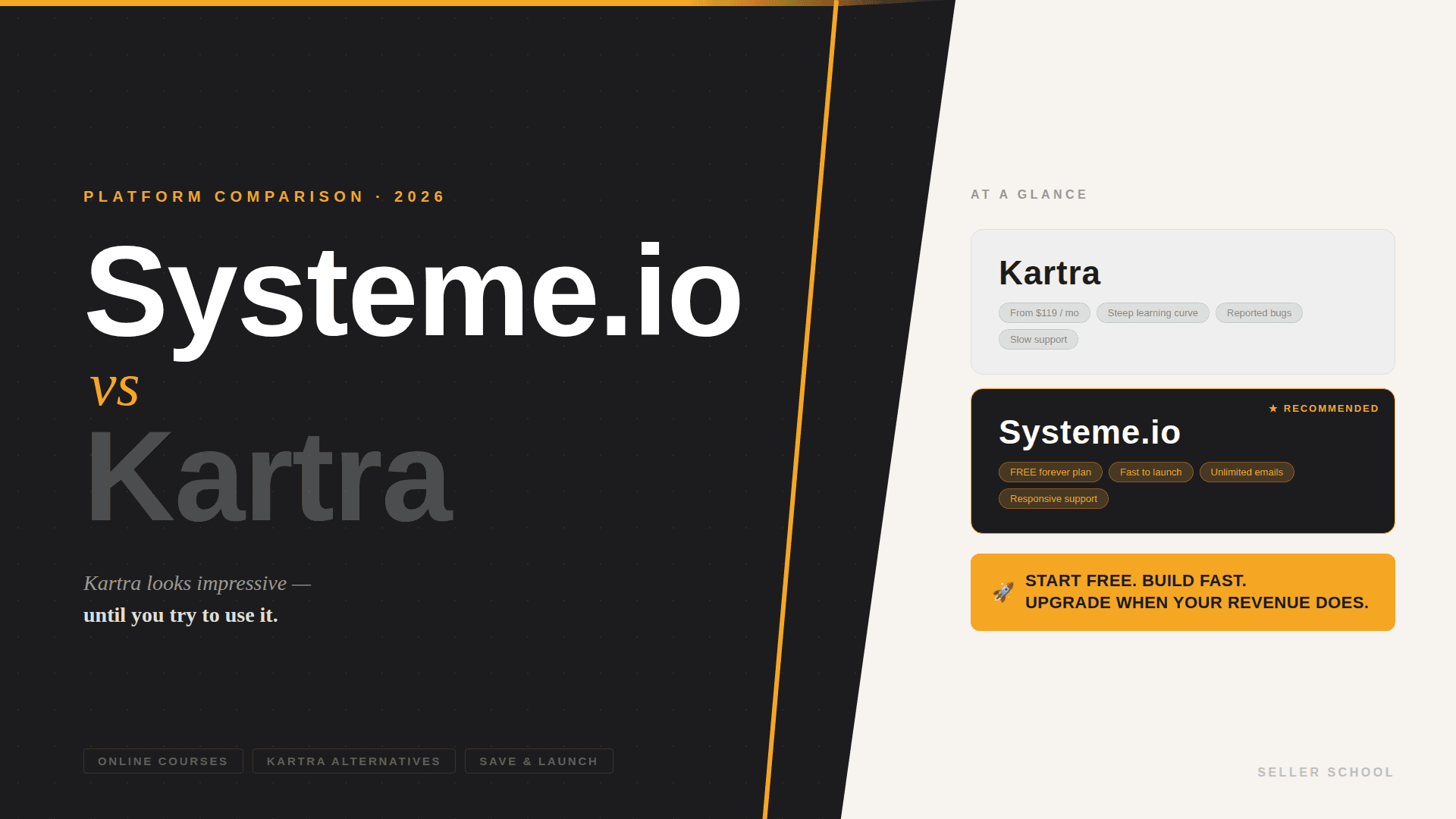
There is still a genuinely free starting point. Course, funnels, email marketing, and checkout — live and selling, for nothing, with no countdown clock. Thinkific's cheapest route in now costs real money every month from day one.
The all-in-one marketing infrastructure is more complete. Funnels, email, automations, and affiliates are native on every plan. On Thinkific, serious marketing means external tools and extra subscriptions.
The payments answer is simpler — no platform transaction fees and no UK gateway fee complication.
Webinars are native, at a lower price than Thinkific's Start tier.
And the upgrade path is proportionate: free, £13, £35, £72. You scale the cost as revenue grows — not before it exists.
The Honest Verdict
Choose Thinkific if: the learning experience is your core differentiator, assignments and student interaction are central to how you teach, community is a fundamental part of your offer, and your revenue supports the Start plan — because that's realistically the tier where Thinkific's distinctive value lives. Use the 30-day trial properly: build a real course in it and pressure-test the platform before the first bill arrives.
Choose Systeme.io if: you're building your first course and need a complete system, you want marketing infrastructure built in rather than bolted on, you'd rather start free and pay as you grow, or committing £39-plus a month before your first sale isn't where you want your money going — which, at the beginning, it shouldn't be.
The honest summary hasn't changed, even though the prices have:
Thinkific builds a better classroom. Systeme.io builds a better business around the classroom. What's changed in 2026 is that Thinkific now charges admission from day one — and that makes the decision simpler for anyone who hasn't yet made their first sale.
If you're not sure which description fits you, you're probably at the beginning. Start with Systeme.io, free. Build the course. Make the first sales. If your business grows into the specific things Thinkific does better, you'll be making that decision with revenue behind you rather than in front of you.
👉 [Create your free Systeme.io account here: https://iosysteme.com]
Further Reading on Seller School
- Get Your Free Platform Guide
- Systeme.io Free Plan — Everything You Actually Get
- Kajabi vs Systeme.io 2026 — Full Cost Comparison
- Teachable vs Systeme.io 2026 — Which Is Better for
Beginners? - How to Set Up Systeme.io Step by Step
Disclosure: The Systeme.io link in this post is an affiliate link. If you sign up, we earn a small commission at no extra cost to you. Thinkific is not an affiliate relationship. This comparison is editorially independent.
Pricing checked July 2026. Platform pricing changes frequently — always verify on the platform's own website before purchasing.
═══════════════════════════════════════════════════════════════════
PRE-PUBLISH CHECKLIST (delete before publishing):
- Open thinkific.com/pricing — resolve the Basic-tier question and
fix the three ⚠ editorial notes above - Verify USD→GBP conversions against the live exchange rate
- Confirm the UK gateway fee still applies (Thinkific support docs:
"Third-Party Payment Gateway Fee FAQ") - Confirm Systeme.io tiers at systeme.io/pricing
- Replace [EMBED] and [INTERNAL LINK] placeholders with live URLs
- Update "Pricing checked July 2026" to the actual publish date
═══════════════════════════════════════════════════════════════════
Word count: approximately 2,700 words — at target length.