






Teachable is where a lot of course creators start.
It has strong brand recognition, a clean interface, and a polished student experience. If you've spent any time researching course platforms, you've almost certainly come across it — and you've probably seen it recommended by creators whose work you respect.
There's a reason for that. Teachable is not a bad platform. It does what it promises, it's been around long enough to have earned genuine trust, and for certain types of course creators it remains a solid choice.
But Teachable changed significantly in 2025 and 2026, and a lot of the advice you'll find online hasn't caught up. The free plan people used to recommend is gone. The plan names have all changed. And there's a transaction fee sitting on the entry tier that most people don't notice until it starts costing them real money.
A comparison that doesn't address those changes upfront isn't doing its job. So let's address them upfront.
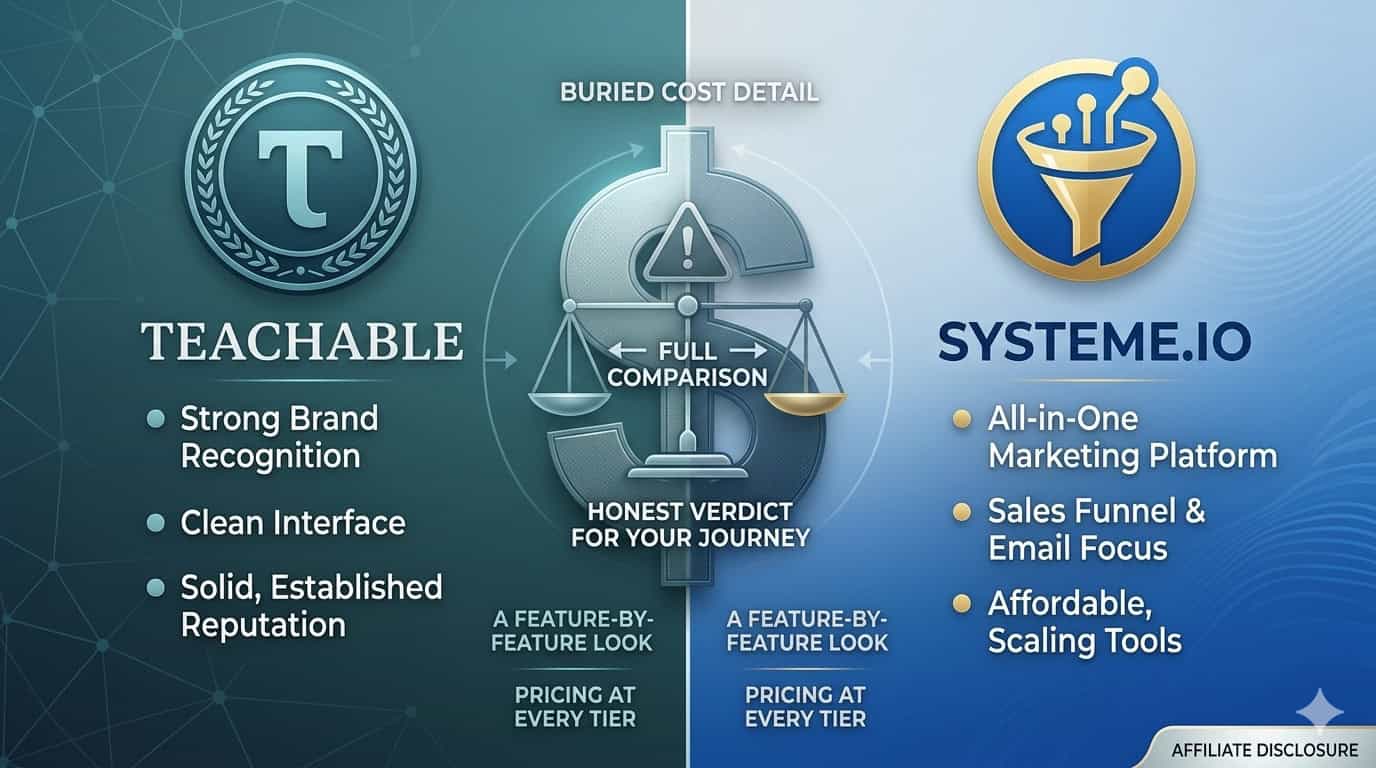
This post will give you the full picture — Teachable's current pricing at every tier, Systeme.io's pricing at every tier, a feature-by-feature comparison of what matters most to course creators, and an honest verdict on which platform is right depending on where you are in your journey.
A quick note before we begin: we have an affiliate relationship with Systeme.io, which means we earn a small commission when someone signs up through our link. Teachable is not an affiliate relationship. We're telling you this because we think you should know — and because it means you should expect us to work harder than usual to be fair to Teachable. We will be.
A note on prices: both platforms set their pricing in US dollars, so that's what we use throughout. If you're in the UK or elsewhere, you'll be billed the local equivalent, which moves with the exchange rate — check the current figure on each platform's own pricing page before you commit.
If you'd rather watch than read, the full video comparison is embedded above.
---
First, What Changed at Teachable
If you've researched Teachable before — even a few months ago — some of what you remember is now out of date. Here's what's different in 2026, because it changes the comparison considerably.
The free plan is gone. Teachable retired its free tier in early 2025. There's no longer a way to run a live course on Teachable without paying. New users get a 7-day free trial on a paid plan, and there's a 30-day money-back guarantee, but the days of launching for nothing on Teachable are over.
The plan names changed. The old Basic, Pro, and Pro+ structure is gone. The current line-up is Starter, Builder, Growth, and Advanced, with a custom enterprise tier above that.
The transaction fee moved. It used to sit on the old free plan. Now it sits on the entry paid plan — Starter — at 7.5% per sale. The higher tiers remove it.
New caps appeared. The 2026 structure introduced limits on published products and student numbers per plan, with overage charges if you exceed them. These didn't exist in the same way on the older plans.
With that established, let's look at the detail that matters most financially.
---
The Detail Most People Miss: The Starter Plan Transaction Fee
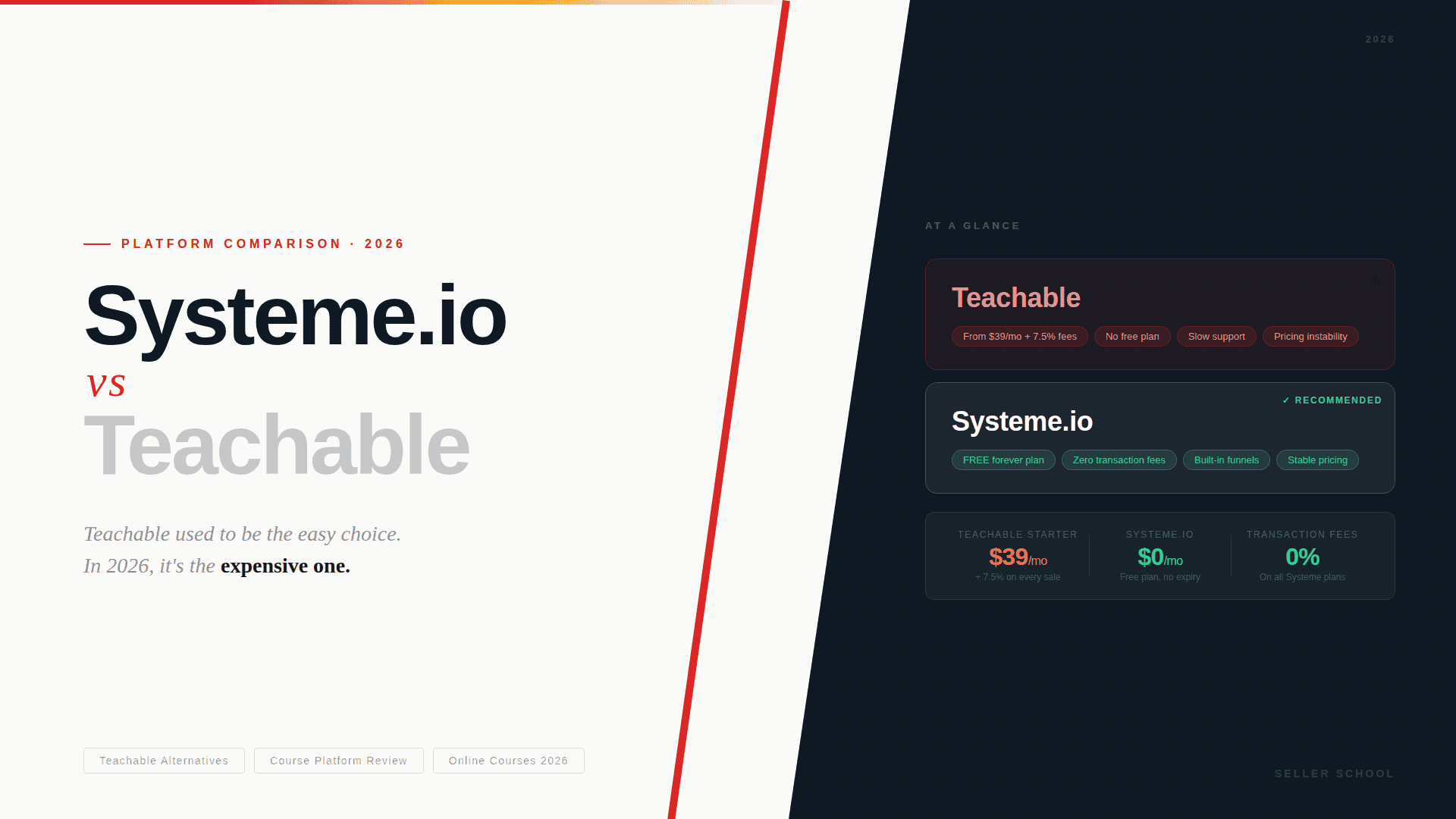
Teachable's cheapest paid plan — Starter — charges a 7.5% transaction fee on every sale you make.
That means every time a student buys your course on the Starter plan, Teachable takes 7.5% of the sale price before you receive anything. And that's on top of the standard payment processing fees from Stripe or PayPal, which every platform charges. The 7.5% is Teachable's own cut, and it stacks.
Let's put that in concrete terms. If you sell a $200 course on the Starter plan:
- Ten sales = $2,000 in revenue. Teachable's transaction fee takes $150.
- Twenty-five sales = $5,000 in revenue. Teachable's transaction fee takes $375.
- Fifty sales = $10,000 in revenue. Teachable's transaction fee takes $750.
These are not trivial amounts, and they compound quickly once your course starts selling. (Those figures are the 7.5% platform fee alone — processing fees from Stripe or PayPal come off on top.)
Now — Teachable will correctly point out that this fee disappears on the Builder plan and above. That's true. So the choice on Teachable's lower tiers is this: give Teachable 7.5% of every sale, or move up to a pricier plan to stop doing that. There's even a rough break-even point — once your monthly revenue climbs past a few hundred dollars, the 7.5% fee costs more than the price gap to Builder, and upgrading becomes the cheaper option.
Neither of those is inherently wrong. But you should understand the choice before you make it.
Systeme.io charges no transaction fees on any plan — including the free plan. Every dollar your students pay you goes through your payment processor directly. Systeme.io takes nothing from your revenue.
That single difference changes the financial picture of a first course launch considerably. With that context established, let's look at the full comparison.
---
Teachable Pricing: Every Tier Explained
*All figures are monthly billing; annual billing is meaningfully cheaper, roughly 22–26% across the board.*
Starter — $39/month ($29/month billed annually)
The entry point. Publish 1 product, enrol up to 100 students. Includes course creation tools, unlimited video storage, the mobile app, quizzes, and certificates.
The catch: a 7.5% transaction fee on every sale. This works for low-volume selling or for validating an idea, but it gets expensive as sales grow.
Builder — $89/month ($69/month billed annually)
This is where Teachable becomes genuinely functional as a course business. 0% transaction fees. Up to 5 published products and 1,000 students. Adds email marketing tools, custom domains, the affiliate programme, and upsells. For most creators who are actually selling, removing the 7.5% fee justifies the jump from Starter quickly.
Growth — $189/month ($139/month billed annually)
Built for established creators and small teams. Up to 25 products, unlimited students, advanced analytics, custom branding, white-labelling (removing Teachable branding), bulk import/export, and team permissions.
Advanced — $399/month ($309/month billed annually)
For larger academies and teams. Up to 100 products, unlimited students, full branding control, SSO, and advanced administration. Above this sits a custom enterprise tier priced on consultation.
*A useful nuance: communities, memberships, and bundles don't count toward the published-product limits — only courses, coaching offers, and digital downloads do. So the product caps are less restrictive than the raw numbers suggest.*
---
Systeme.io Pricing: Every Tier Explained
Free — $0
No monthly cost. No credit card required. Never expires. Includes 1 course with unlimited students, 3 sales funnels, email marketing for up to 2,000 contacts with unlimited sends, 1 blog, 1 affiliate programme, 1 custom domain, and 1 automation rule. No transaction fees.
Startup — $17/month
5,000 contacts. More funnels and courses (up to 5 courses), expanded automation, and the platform's branding removed. Everything from the free plan, with the limits raised.
Webinar — $47/month
10,000 contacts, expanded funnels and courses, and native automated webinar functionality. This is the plan we use at Seller School.
Unlimited — $97/month
Unlimited contacts, funnels, courses, automation rules, and sub-accounts, plus free migration. Everything Systeme.io offers, with no caps.
*Annual billing on Systeme.io saves roughly two months across the paid tiers. The free plan, of course, stays free.*
---
The Price Comparison at a Glance
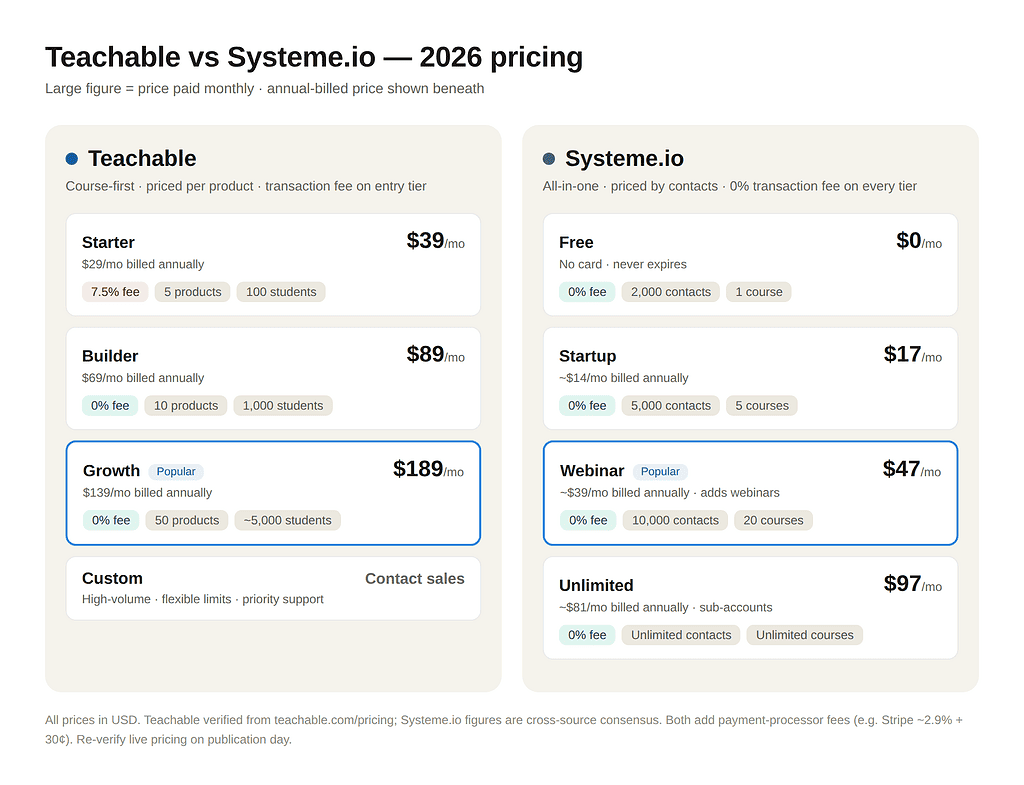
Systeme.io is substantially cheaper at every comparable tier, and it still offers a genuine free plan where Teachable no longer does. Its most expensive standard plan ($97) costs roughly the same as Teachable's Builder plan — and far less than Teachable's Growth or Advanced/Custom tiers.
*Pricing in USD, monthly billing, correct as of June 2026. Both platforms bill non-US customers in local equivalents that vary with exchange rates. Verify current figures on each platform's pricing page before committing.*
---
Feature Comparison: What Matters Most
Course Building and Student Experience
Teachable's course builder is clean, well designed, and produces a polished student-facing experience. The interface is intuitive for students to navigate, content delivery is smooth, and the overall feel of being a Teachable student is professional.
Teachable also has strong completion tools — course completion certificates, student progress tracking, and graded quizzes are all well implemented, and certificates are now available across all plans including Starter. For creators in niches where credentials matter — professional development, skills certification, continuing education — these features add genuine value.
One area where Teachable stands out is its coaching product. Course creators can sell one-to-one coaching sessions through the platform, with scheduling and session management. If coaching is a significant part of your revenue model alongside or instead of courses, Teachable's coaching functionality saves time compared to cobbling together a booking tool, a payment processor, and a video call platform separately. *(If you're recording the video walkthrough: confirm the current coaching feature set live on teachable.com, as the post-2025 restructure changed several plan details.)*
Systeme.io's course builder handles the core requirements reliably. Modules, lessons, video embedding from YouTube or Vimeo, file uploads, drip scheduling, and student access management all work as expected. The student-facing interface is more basic than Teachable's — functional and clear without being polished.
What Systeme.io's course builder doesn't have is the depth of student engagement tools Teachable offers. There's no native assignment submission, the completion certificate options are more limited, and there's no native equivalent to Teachable's coaching product — selling coaching is possible but requires manual workarounds.
The verdict on course building: Teachable produces a better learning environment. For a premium-priced course where the student experience is central to the perceived value, that matters. For a first course at an accessible price point, Systeme.io's course builder is entirely adequate.
Marketing and Funnels
This is where the comparison shifts significantly in Systeme.io's favour.
Teachable is a course platform that has added marketing functionality over time. You get email tools, coupon codes, upsells, and an affiliate programme from the Builder plan upward. But the marketing tools are supplementary to the core course delivery product — they're not the reason you'd choose Teachable.
If you want to build proper sales funnels, run sophisticated email sequences, or create a structured marketing system around your courses, you'll typically connect Teachable to external tools. That means additional monthly costs and the overhead of managing integrations.
Systeme.io is built as a marketing platform first. Sales funnels, email marketing, automations, and affiliate management are core features, not add-ons. Everything is connected natively — your funnel knows about your course, your email list knows about your funnel, your automation knows about all of it.
On the free plan alone, you get three sales funnels and email marketing for 2,000 contacts. On the Startup plan at $17 a month, you get more funnels and 5,000 contacts. The marketing infrastructure Systeme.io includes as standard would cost significantly more to replicate by bolting tools onto Teachable.
The verdict on marketing: Systeme.io wins clearly. If building an audience, running email sequences, and converting traffic through structured funnels matters to your business — and it should — Systeme.io is built for that in a way Teachable isn't.
Email Marketing
Teachable offers email functionality on its paid plans — announcements to your student list and simple sequences, often supplemented with a dedicated email tool like ConvertKit or Mailchimp. Many serious Teachable users add a separate email platform alongside it.
Systeme.io includes full email marketing across all plans, including free. Unlimited sends, broadcast emails, automated sequences, tagging, and basic segmentation are all native. For a beginning course creator, the email tools inside Systeme.io remove the need to pay for a separate email service provider entirely.
The verdict on email: Systeme.io wins on availability and value. Teachable's email tools are adequate for student communication but thinner for audience building and marketing.
Affiliate Management
Teachable includes an affiliate programme from the Builder plan upward — not on Starter.
Systeme.io includes affiliate management on all plans, including free. You can create an affiliate programme, set commission rates, generate affiliate links, and track referrals from day one, at no cost. (Note: Systeme.io recently removed its public affiliate *marketplace*, so affiliates can no longer browse and pick products from a directory — but running your own programme is unaffected.)
The verdict on affiliates: Systeme.io wins on availability. Core feature sets are broadly comparable.
Completion Certificates
Teachable offers completion certificates across all plans, including Starter — well implemented and customisable. Students receive a certificate on completion, which they can share or download.
Systeme.io has more limited native completion certificate functionality at the time of writing.
The verdict on certificates: Teachable wins here. If completion credentials matter to your audience — professional development, corporate training, skills certification — this is a genuine advantage.
Reporting and Analytics
Teachable's analytics are solid and grow stronger on Growth and above. Revenue tracking, student progress, video engagement, quiz results, and course completion rates are all available and clearly presented. The depth of student-level reporting is useful for optimising an established course.
Systeme.io's analytics cover the business essentials — sales, revenue, funnel performance, and contact growth — but student-level reporting is more limited. You'll know how many people bought and how much you made more easily than you'll know where students are getting stuck inside your course.
The verdict on analytics: Teachable wins on depth, particularly for creators optimising completion rates and engagement. For a first course, Systeme.io's reporting covers what matters.
Custom Domain
Both platforms include a custom domain. Teachable includes it from the Starter plan at $39/month. Systeme.io includes a custom domain even on its free plan — so you can look professional from day one without spending anything. That's a meaningful difference if you're launching on a budget.
Support
Teachable offers email support across plans and faster support on higher tiers, with comprehensive documentation.
Systeme.io offers email support, an active help centre, and a community forum, plus a knowledge base. Response times are reasonable, though some reviewers report slower replies. For most routine questions, the documentation is sufficient.
---
Where Teachable Wins
Let's be straightforward about the situations where Teachable is the right choice.
The student experience is more polished. If you're positioning your course at a premium price point and the learning environment is part of the value, Teachable's interface is more refined than Systeme.io's.
Completion certificates are well implemented — and now available on every plan. For niches where credentials matter, that's a meaningful feature.
The coaching product is genuinely useful. If one-to-one coaching is central to your offer, Teachable's native session management saves real time and removes the need to stitch together separate booking and payment tools.
The analytics depth is greater. For an established creator who wants granular insight into student behaviour and completion, Teachable's reporting is the more useful tool.
The brand recognition carries weight. In certain audiences and niches, Teachable is recognised and trusted. Some buyers associate it with quality — intangible, but real.
---
Where Systeme.io Wins
For the majority of course creators at the beginning of their journey — pre-revenue, building their first course, not yet sure whether their idea will sell — Systeme.io wins on the measures that matter most at that stage.
A genuine free plan, with no transaction fees. This is the headline advantage. Teachable no longer has a free plan at all, and its cheapest paid plan takes 7.5% of every sale. Systeme.io lets you launch for nothing and keep every dollar your students pay.
The all-in-one value is superior. One platform for courses, funnels, email marketing, automations, checkout, and affiliates. No integrations to manage. No additional subscriptions. One login, everything connected.
The price difference is significant and consistent. At every comparable tier, Systeme.io is substantially cheaper. Teachable's entry plan is $39/month *plus* a 7.5% fee; Systeme.io's entry paid plan is $17/month with no fee. Over a year, before your course has necessarily proven itself, that gap is real money.
The free plan is more complete for a first launch. Three funnels, email marketing for 2,000 contacts, a custom domain, and a course builder mean you can go from zero to live launch without spending anything — and without surrendering a percentage of every sale.
The marketing infrastructure is more developed. Building an audience, running email sequences, and creating sales funnels are core to Systeme.io in a way they aren't to Teachable. If those things matter to your business — and they should — that's a material advantage.
---
The Honest Verdict
Teachable and Systeme.io are solving slightly different problems, and the right choice depends on which is more relevant to where you are right now.
Choose Teachable if: you're at a premium price point where the student experience is central to your value, completion credentials matter to your audience, coaching is a significant part of your revenue model, or you have established marketing tools you want to keep and you just need a polished course-delivery platform alongside them.
If you're selling consistently, the Builder plan at $89/month with 0% transaction fees is the sensible Teachable entry point — the Starter plan's 7.5% fee tends to cost more than the upgrade once you're past a few hundred dollars a month in sales.
If you're on Teachable's Starter plan right now*— go and look at your recent sales and calculate what you've paid in transaction fees. Then ask whether moving up to Builder, or moving platforms entirely, would keep more of that money in your business.
Choose Systeme.io if: you're launching your first course and you need a complete system rather than a polished course builder, you want one platform that handles everything from course hosting to email marketing to checkout, you're pre-revenue or early-revenue and the price difference is material, or you want to start completely free without giving up a percentage of every sale.
For most people reading this post — people building something for the first time, who haven't validated their idea yet, who are trying to do this without unnecessary financial risk — Systeme.io is the more sensible starting point.
Start free. Make your first sales. Upgrade when the revenue justifies it.
That's the right order.
👉 Create your free Systeme.io account here: https://iosysteme.com
---
## Further Reading on Seller School
- Systeme.io Free Plan — Everything You Actually Get
- Kajabi vs Systeme.io 2026 — Full Cost Comparison
- How to Set Up Systeme.io Step by Step
---
*Disclosure: The Systeme.io link in this post is an affiliate link. If you sign up, we earn a small commission at no extra cost to you. Teachable is not an affiliate relationship. This comparison is editorially independent.*
*Pricing in USD, correct as of June 2026. Both platforms bill non-US customers in local currency at rates that vary. Always confirm current pricing on the official pages before committing.*