


If you've built an online course, launched it, and watched the sales dashboard stay stubbornly empty, this article is for you. So is it for you if you haven't launched yet and that exact silence is the thing you're quietly dreading. Because in almost every case I've seen, the reason a course doesn't sell is not the reason the creator thinks it is — and chasing the wrong reason is how good ideas get abandoned.
The moment nobody talks about honestly
There's a version of the course-launch story that gets told a lot: the polished, retrospective one. “It didn't go how I hoped, but here's what I learned, and here's how I bounced back.” It makes the disappointment sound like a planned chapter in a hero's journey.
Then there's the real version. You spent weeks — maybe months — building something you believed in. You told people it was coming. You pressed the launch button. And then you sat there, refreshing the dashboard, watching nothing happen. No sales. No notifications. Just a slow, sinking recalculation of everything you thought you knew.
If you've lived that, you already know it's a specific kind of deflating. And if you're about to launch for the first time, it's the outcome you're most afraid of. Either way, the instinct that kicks in next is the thing that quietly makes it worse.
The wrong diagnosis (and why it feels so right)
When a launch underperforms, most creators go straight into problem-solving mode. That part is healthy. The problem is where they point it.
Almost every fix that comes to mind lives on the surface of the launch: the sales page, the price, the email subject lines, the social posts, the launch timing, the thumbnail. And it makes complete sense that these are the first suspects — because they're the things you can see and change. A headline is fixable. A price is adjustable. A social post can be rewritten tonight. They feel like the right levers precisely because they're the levers within reach.
So the creator pulls them. They rewrite the headline, drop the price by fifty pounds, try a punchier hook in the launch emails. Then they relaunch — to the same audience, in the same way — and they're genuinely surprised when the result is almost identical.
I've had a version of this conversation more times than I can count, and there's one question that tends to move it. Before you launched, how many people actually knew this course was coming? Not the internet in general — people who know you, who open your emails, who had already told themselves “when this comes out, I'm in.”
The answer is almost always some version of: not many. Or: I don't really have an email list. Or: I posted about it, but I don't know if anyone saw it. And there it is. Not the headline. Not the price. The absence of a warm audience before the launch ever began.
Cold versus warm: the number that decides everything
The two words this whole thing turns on are “cold” and “warm,” and they get thrown around endlessly without being pinned down. So let me be precise.
Cold traffic is anyone who meets your course with no prior relationship with you. Someone who lands on your sales page from a Google search, an ad, or a link a friend dropped in a group chat. They don't know you. They have no particular reason to trust you yet. And they're being asked to evaluate you and your course in the same breath — which is a great deal to ask of a single page.
Warm traffic is the opposite. It's anyone who already knows you, has already received something useful from you, and has already made some small decision to follow what you do: your email subscribers, the people who watch most of your videos, the person who's been in your community for months and recognises your name.
Now the part most launch advice glosses over — the conversion reality. Across industries, a well-optimised sales page shown to cold traffic typically converts somewhere between one and three percent, and cold organic or paid-social traffic often sits at the lower end of that range. A warm audience — people who know you and have been waiting for the course — commonly converts in the region of ten to thirty percent, sometimes higher on a small, tight list. Those figures aren't a promise about your specific launch; they're the benchmark ranges reported across conversion-rate research, and the gap between them is the whole story.
Put real numbers on it and it clicks. Launch to a warm list of two hundred people — genuinely achievable in your first few months — at a fifteen percent conversion rate, and you make thirty sales. Launch to a cold audience of two thousand strangers at two percent, and you make forty. Slightly more sales, yes — but you needed ten times the audience, and far more time, money and luck, to get there.
Now hold that against what actually happens on most first launches: no email list, or a tiny one; a modest social following; a young channel. You're effectively launching to a cold audience of a few hundred people while unconsciously expecting the conversion rate only a warm audience produces. The maths simply doesn't work — and no amount of headline-rewriting changes the maths. You can polish a two-percent page until it gleams; it's still a two-percent page. The lever that moves the number isn't on the page. It's who's looking at it.
Why smart, hard-working people get this wrong
I want to be careful here, because this is not a failure of intelligence or effort. Some of the sharpest, hardest-working people I know have made exactly this mistake. It's a failure of the advice ecosystem around course creation — and once you see it, you can't unsee it.
Almost every piece of content about “launching a course” is actually about the launch itself: the sales page, the email sequence, the launch-week posts, the open-cart/close-cart mechanics, the countdown timers, the bonuses that expire at midnight. All of it is real, and all of it works — for people who already have a warm audience to launch to. That's the invisible asterisk nobody says out loud. The tactics assume the audience already exists.
But if you're launching for the first time without an established audience, those mechanics are almost irrelevant to you, because the launch is the last thing that happens. If the work that should have happened before it didn't happen, no launch tactic on earth retroactively fills the room.
So what's the work that should happen first? It's the slow work of building an audience: getting real people onto an email list, making content that attracts the specific kind of person your course is built for, and earning trust over weeks and months so that when you finally say “here's the thing I made,” people are already leaning in.
And here's the honest reason it gets skipped. That work is slow, quiet, and low on dopamine. Watching your list crawl from fifty subscribers to a hundred feels like nothing is happening. Pressing a launch button and watching a dashboard feels electric and real. So people skip the quiet part and sprint to the exciting part — then feel blindsided when the exciting part doesn't pay out. Large analyses of course-creator data keep circling the same finding: the creators who sell consistently almost always built an audience before they built a course. The course was the second thing, not the first.
The actual fix
There are two situations you might be in, and the fix is slightly different for each. Find yourself in one of them.
Scenario 1: You haven't launched yet
This is the best position to be in, because you still have time to do things in the right order. The sequence is simple to say and hard to be patient with: build the audience first, then launch to it.
That does not mean waiting until you have ten thousand subscribers. You don't need ten thousand — you need two hundred of the right people. A warm audience of two hundred subscribers who know you, have received value from you, and are expecting the course is more than enough to make a first launch genuinely worthwhile. And two hundred warm subscribers is realistic inside three to four months of consistent effort — faster if you have an existing network to draw on. That's not a five-year plan. It's a season.
What does that season look like in practice? It starts with an email list: a lead magnet that attracts your ideal student, a simple opt-in page, a welcome sequence that builds trust automatically, and a steady stream of traffic to that page from wherever your ideal students already spend their time. Alongside the list, you publish content that demonstrates what you know and quietly attracts the right person — videos, posts, articles — each piece aimed at the exact problem your course solves, each piece nudging people toward the list.
The compounding effect is the point. By the time you press launch, the people on your list have had three months of you. They know your name, they've seen how you think, and they already believe what you make is worth their time. That's who you want to launch to — and building it before you need it is the single most valuable thing you can do for the whole business.
Scenario 2: You've already launched, and it fell flat
This one is harder — not because it's unfixable, but because the fix asks for the thing you're least in the mood for after a bad launch: patience. The instinct is to relaunch fast, rewrite the sales page, try again next week, or throw ad spend at cold traffic to force the numbers. Resist it. You'd be optimising the wrong variable.
Instead, do the audience work you skipped the first time. Build the list. Make the content. Warm up the people who did show up last time, even if there were only a handful — they're not a failure, they're your first fans. Give it three months, then relaunch to a warmer room. In my experience, a second launch to a nurtured audience of even a few hundred people will almost always beat a first launch to thousands of strangers, because the relationship now exists. The course stops being “a thing a stranger wants me to buy” and becomes “a thing someone I respect is inviting me into.” Same course, completely different answer.
One more thing, because it comes up constantly. After a flat launch, many creators quietly conclude the idea itself is dead — nobody wants it, wrong niche, start over. Sometimes that's true. But before you bury a good idea, ask whether the people who didn't buy even knew it existed. If you launched to two hundred cold strangers and five of them bought, that isn't proof the idea is wrong; it may be proof the audience was cold. So go and ask. Talk to the people who didn't buy, and ask what held them back. Their answers will tell you whether you have an audience problem or an offer problem — two completely different problems with completely different fixes. Confusing them is one of the most expensive mistakes you can make.
The infrastructure behind all of this
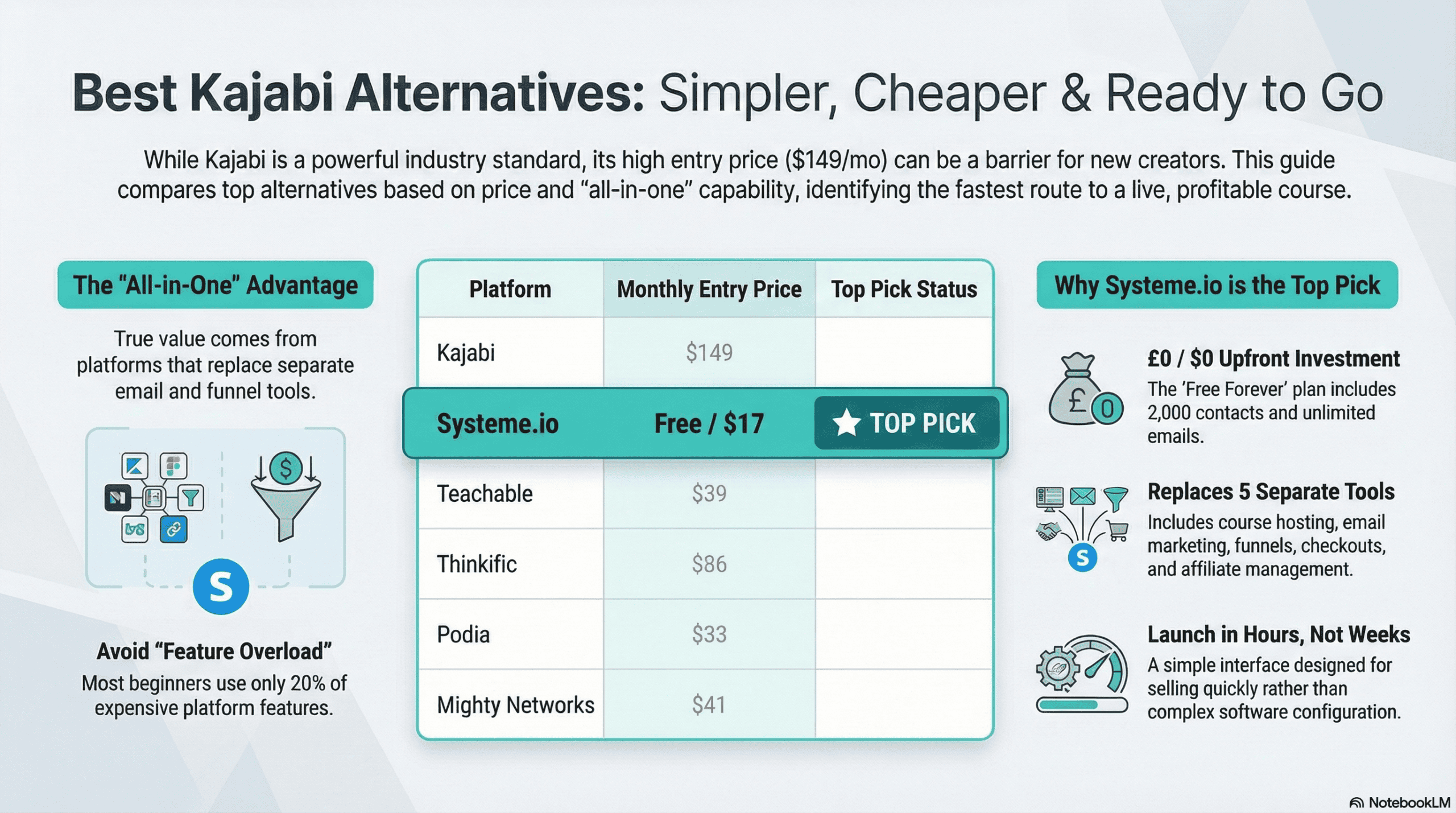
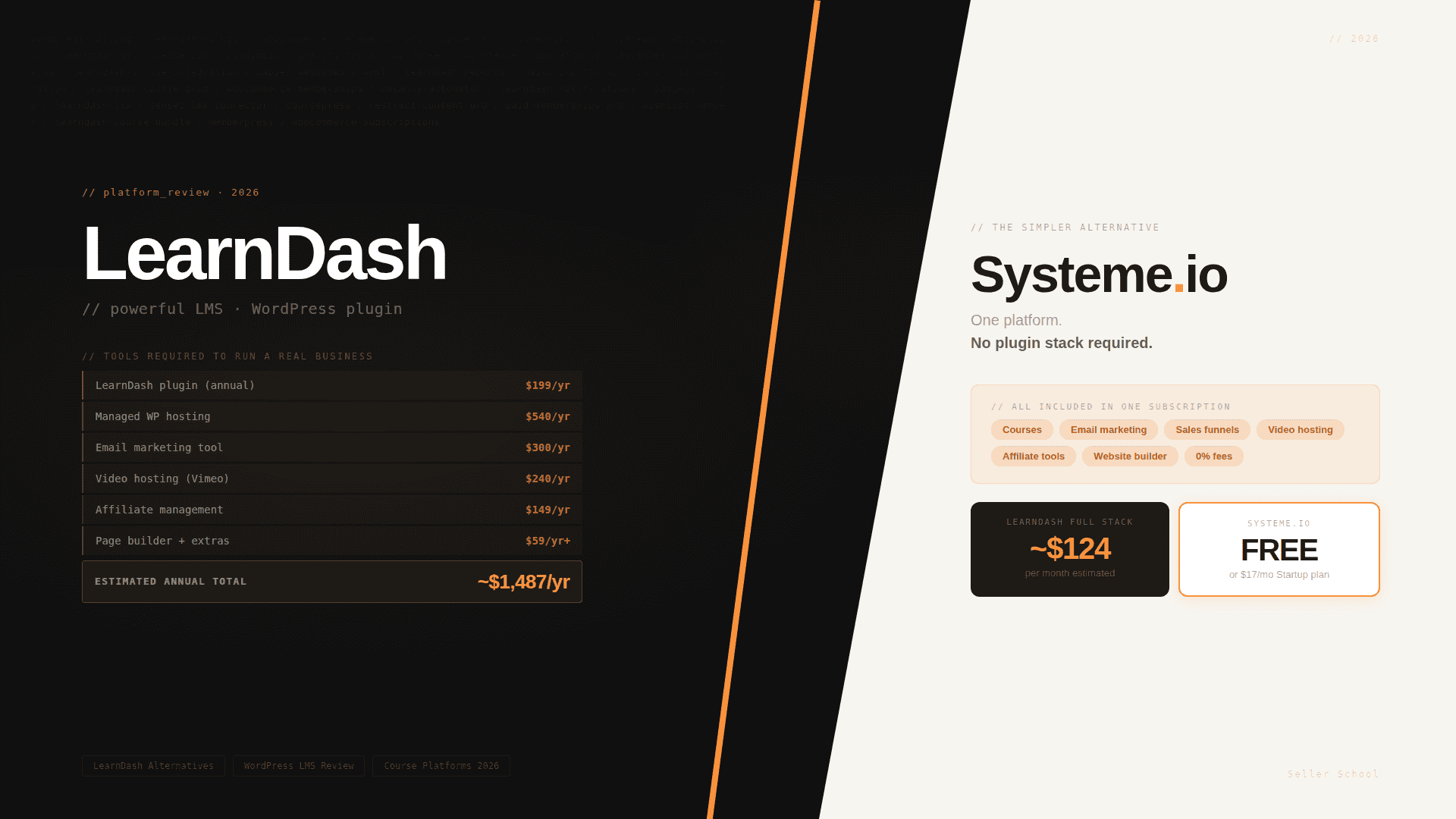
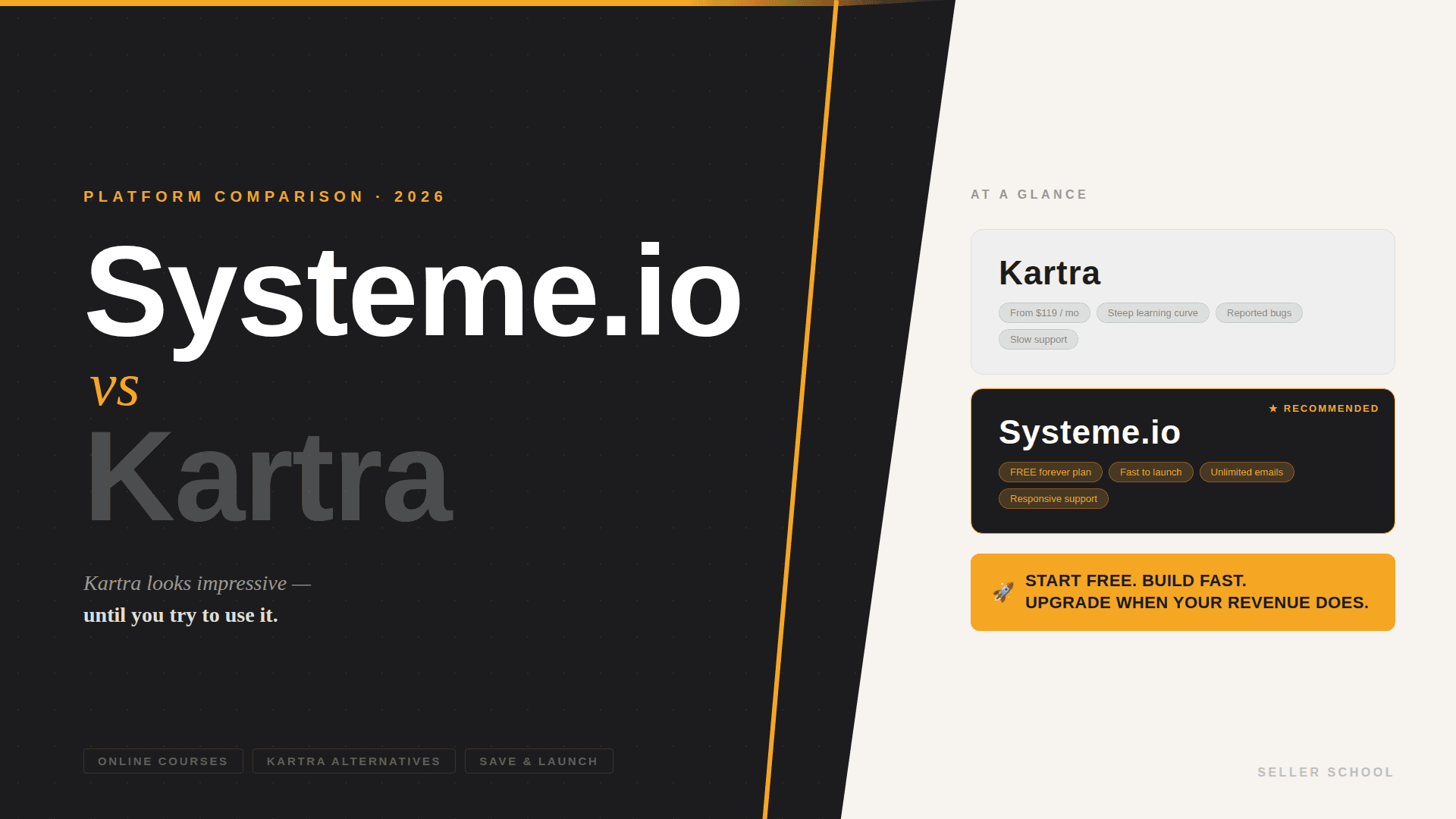
None of this has to be complicated or expensive, and I don't want it to float off as abstract advice — so here's the practical side. Everything I've described — the email list, the lead magnet, the welcome sequence, the opt-in page — can be built inside systeme io, with the whole thing in one login.
The free plan gives you what you need to start building a warm audience from zero: an opt-in funnel, email marketing for a couple of thousand contacts, and automated sequences that nurture subscribers while you sleep. No monthly fee to begin, and no card required.
This matters more than it sounds, because email is where the trust you build actually converts. Litmus' State of Email 2025 research put the average return on email marketing at around thirty-six dollars for every dollar spent — comfortably ahead of any other channel. That return doesn't come from the software; it comes from the warm relationship the software lets you build and keep.
If you want to start with the platform itself, you can create a free systeme io account here: iosysteme.com. Everything described in this article runs on the free plan, so there's genuinely no reason to wait before you begin building the audience your future launch depends on.
The real cost isn't money — it's consistency. Showing up with something useful, week after week, until you've built an audience worth launching to. That's the unglamorous version of course-creation success. It's also the accurate one.
The honest summary
Let me put it as plainly as I can. If your course isn't selling — or if you're lying awake worried it won't when you launch — the most likely explanation is not a weak sales page or the wrong price. It's that you don't yet have a warm enough audience to launch to.
So the fix isn't faster, cleverer, or a better headline. The fix is earlier. Build the audience before you need it. Get people onto your email list before you have anything to sell them. Make the content that attracts your ideal student before you're anywhere near ready to launch.
Three months of quiet, consistent work — a lead magnet, an opt-in page, a welcome sequence, and weekly content pointing at it — produces a fundamentally different launch than pressing go with an empty room behind you. Not a guaranteed launch, and not a perfect one. But one where the maths is finally working for you instead of against you. That's the thing worth building, and the earlier you start, the sooner it's already there when you need it.
Note on the figures above: conversion rates (roughly 1–3% cold, 10–30% warm) and the ~$36-per-$1 email ROI are widely reported industry benchmarks, not guarantees for any individual launch. Treat them as the shape of the landscape rather than a forecast of your specific results.