





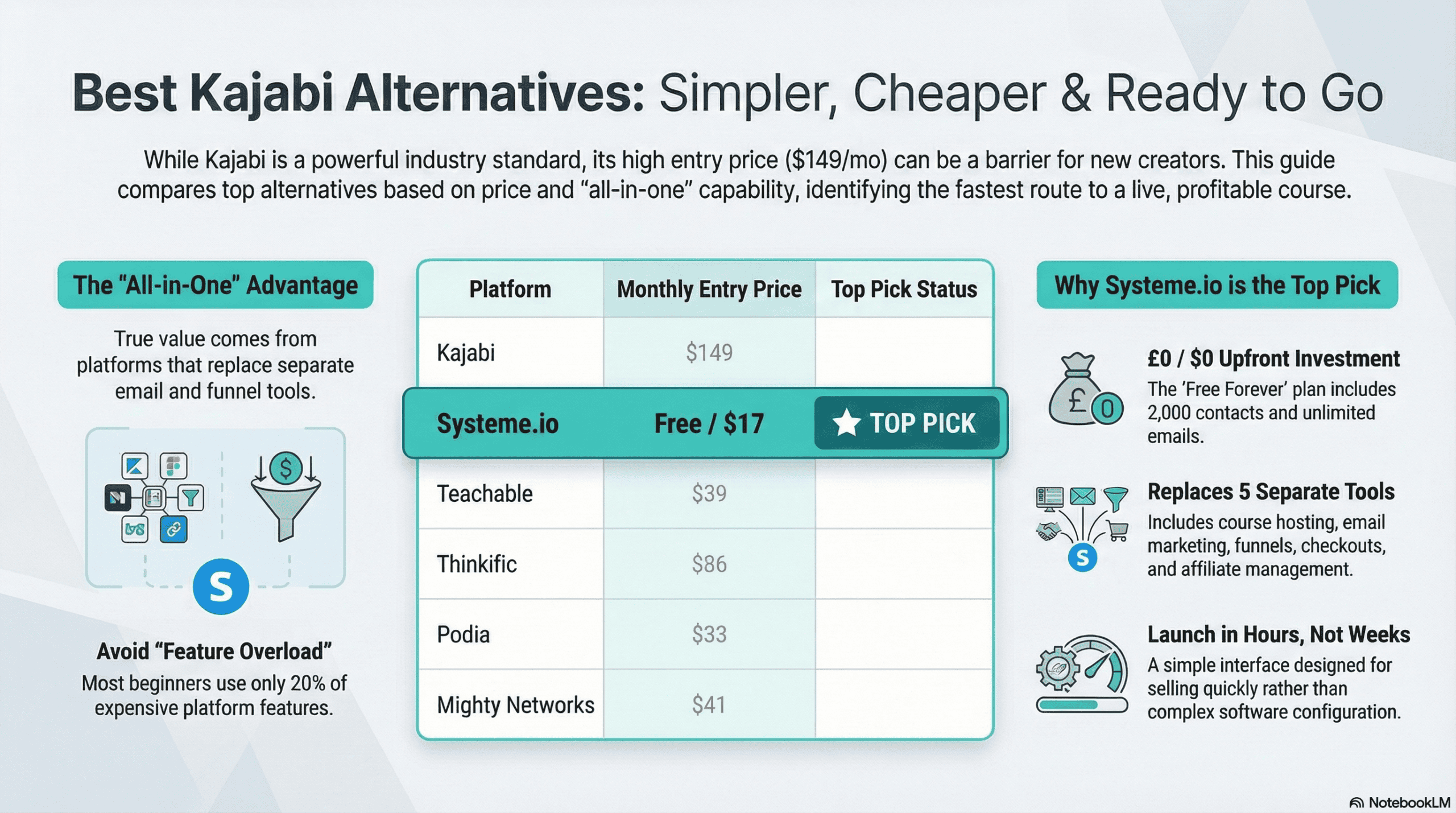

Kajabi is the most talked-about course platform on the internet right now.
Search for "best platform for online courses" and Kajabi will appear in almost every result. Watch YouTube videos about course creation and someone will recommend it. Join a Facebook group for course creators and it'll come up within the first few posts.
There's a reason for that. Kajabi is a genuinely well-built product with strong brand recognition and a loyal user base. We're going to give it a fair hearing in this post.
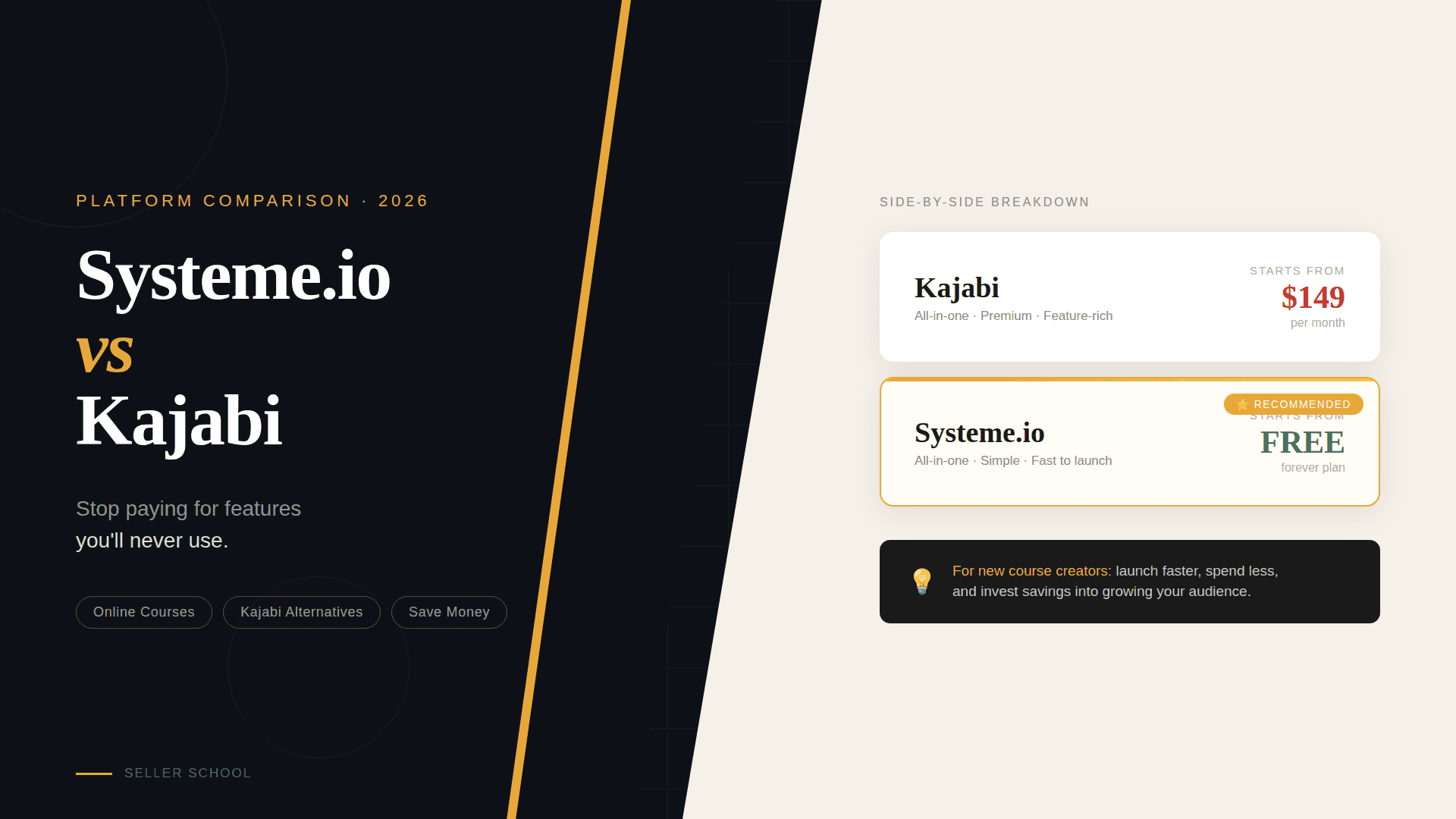
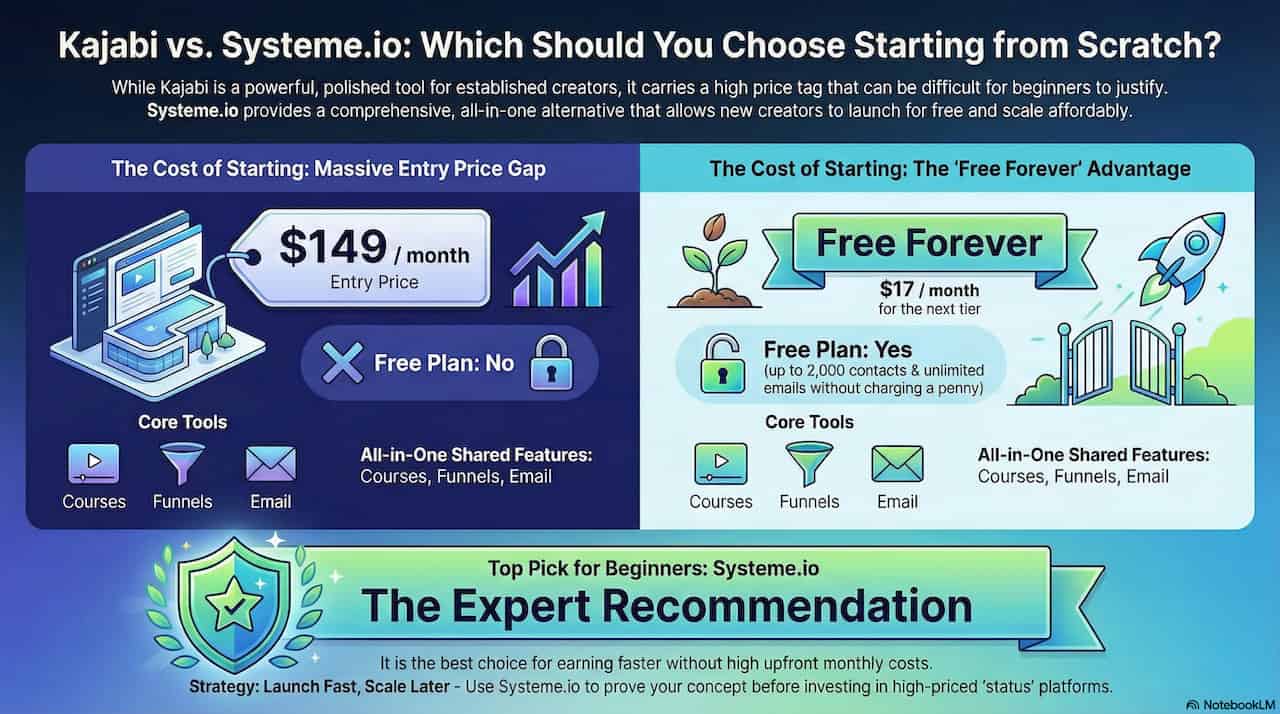
But there's something else that comes up in almost every conversation about Kajabi — the price. At £133 a month for the entry level plan, it's one of the most expensive platforms in this space. And for someone who hasn't yet made their first course sale, that's a significant financial commitment to make on faith.
So the question this post is going to answer is a simple one: is Kajabi worth it — and if not, what should you use instead?
We're going to compare Kajabi against Systeme.io across every meaningful dimension: pricing, course building, email marketing, funnels, community features, and more. We'll be honest about where Kajabi wins — because it does win, in certain situations — and equally honest about where the price difference is difficult to justify.
If you'd rather watch than read, the full video comparison is embedded below.
The Headline Numbers
Before we get into features, let's put the pricing side by side clearly.
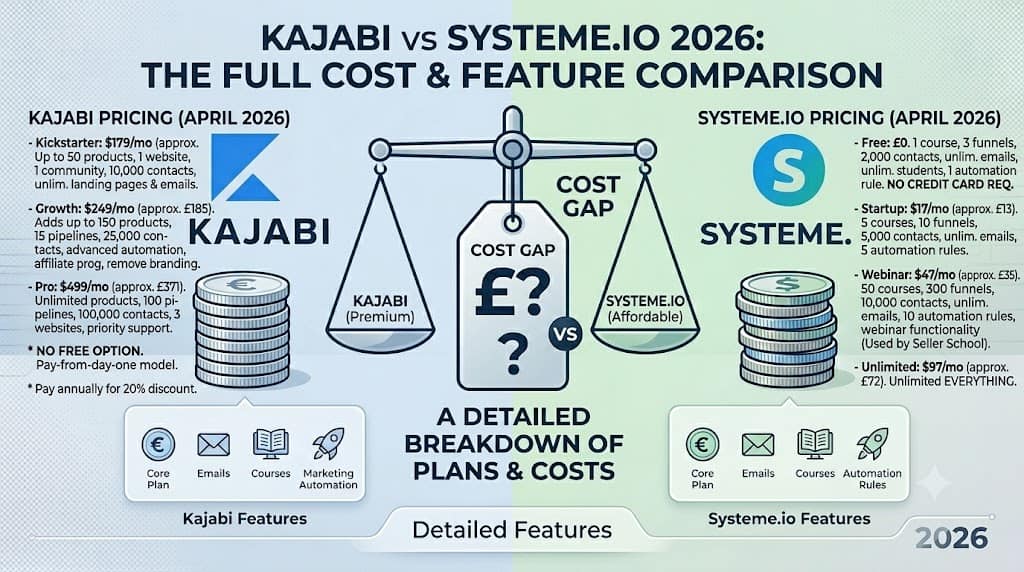
Kajabi Pricing (April 2026)
Kajabi offers three paid plans. There is no free option.
Kickstarter — $179 per month (approximately £133). This is the entry level. It includes up to 50 products, one website, one community, 10,000 contacts, and unlimited landing pages and marketing emails.
Growth — $249 per month (approximately £185). Adds up to 150 products, 15 pipelines, 25,000 contacts, advanced automation, affiliate programme, and the ability to remove Kajabi branding.
Pro — $499 per month (approximately £371). Unlimited products, 100 pipelines, 100,000 contacts, three websites, and priority support.
Paying annually reduces these prices by roughly 20%, but the commitment and upfront cost are significant. And again — there is no free plan. If you want to use Kajabi, you pay from day one.
Systeme.io Pricing (April 2026)
Systeme.io offers four tiers, starting at nothing.
Free — £0. One course, three funnels, 2,000 contacts, unlimited emails, unlimited students, one automation rule. No credit card required.
Startup — $17 per month (approximately £13). Five courses, ten funnels, 5,000 contacts, unlimited emails, five automation rules.
Webinar — $47 per month (approximately £35). Fifty courses, three hundred funnels, 10,000 contacts, unlimited emails, ten automation rules, webinar functionality. This is the plan we use at Seller School.
Unlimited — $97 per month (approximately £72). Unlimited everything.
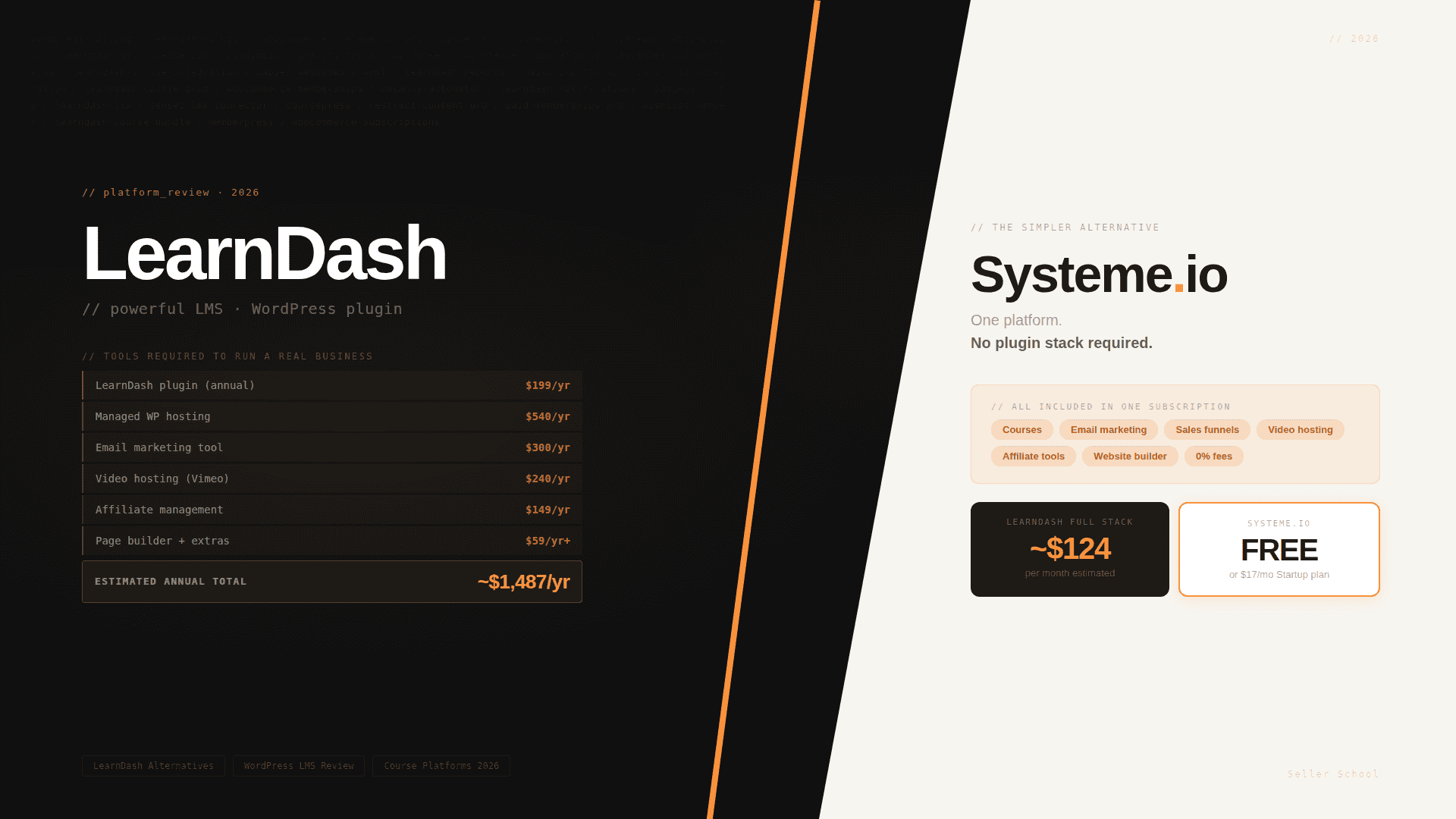
The contrast is stark. Systeme.io's most expensive plan — with unlimited courses, unlimited funnels, and unlimited contacts — costs less than half of Kajabi's cheapest plan. And Systeme.io's free plan gives you a functional course business infrastructure before you've spent a penny.
Prices correct as of April 2026. Exchange rates may vary.
Feature Comparison
Price is the starting point, not the whole story. Let's look at what you're actually getting on each platform.
Course Building
Kajabi has one of the strongest course builders on the market. The student-facing interface is polished and professional. Navigation is intuitive, content delivery is smooth, and the overall experience of being a Kajabi student feels premium. The course builder supports video, audio, PDF, quizzes, and assessments, and the drip scheduling tools are sophisticated.
For course creators who are positioning at a high price point — £500, £1,000, or more — the polish of the Kajabi learning environment contributes meaningfully to the perceived value of what students are buying. The platform itself is part of the product.
Systeme.io's course builder is more straightforward. It handles the core requirements well — modules, lessons, video embedding via YouTube or Vimeo, file uploads, quizzes, and student access management — but the student-facing interface is more basic. It does not have Kajabi's depth of assessment tools or the same level of polish in the learning environment.
For a first course at an accessible price point, Systeme.io's course builder is entirely adequate. For a premium course where the delivery experience is central to the value proposition, Kajabi's builder is the stronger product.
Sales Funnels
Kajabi calls its funnels "pipelines" and they are well built. You can create opt-in sequences, sales funnels, product launch sequences, and webinar funnels, all within the platform. The visual pipeline builder is one of Kajabi's stronger features.
Systeme.io's funnel builder is one of its genuine strengths and a core reason many creators choose it. The builder is intuitive and flexible, and the volume of funnels available at each tier is generous — three on the free plan, ten on Startup, and three hundred on the Webinar plan.
Both platforms handle funnels well. Systeme.io offers more volume at a lower price point; Kajabi's interface is more refined.
Email Marketing
Kajabi includes email marketing across all plans. You can send broadcasts, create automated sequences, segment your audience, and tag contacts based on behaviour. The email tools are clean, functional, and well integrated with the rest of the platform. The interface feels cohesive.
Systeme.io also includes email marketing across all plans, including free. Unlimited sends, automated sequences, tagging, and segmentation are all available. The interface is less refined than Kajabi's, but the functionality covers everything a course creator genuinely needs at any stage of their business.
For most beginners, both platforms do enough. Kajabi's email tools feel more premium. Systeme.io's are fully functional and meaningfully cheaper.
Community Features
This is one area where Kajabi has a meaningful and genuine advantage.
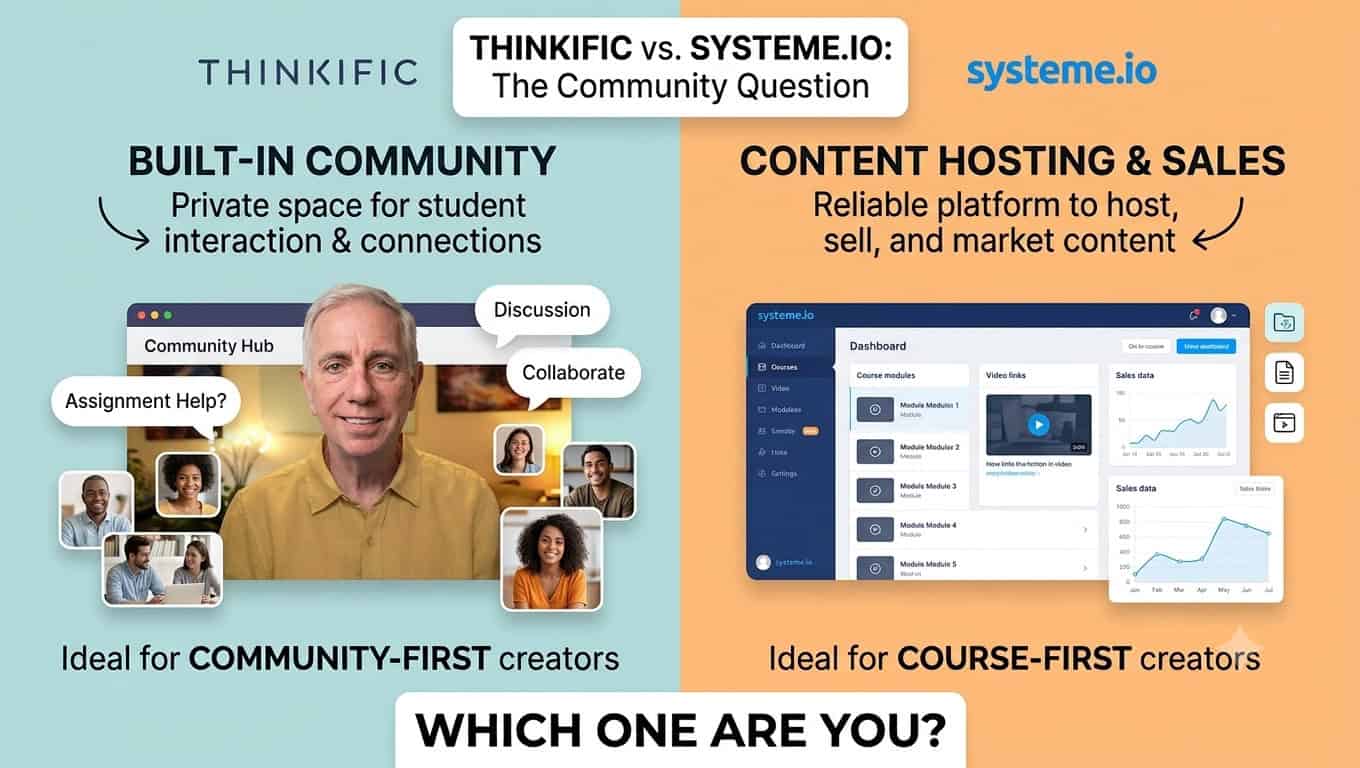
Kajabi has a built-in community feature — a private, structured social space attached to your course where students can interact, post, ask questions, and build connections with each other. It's well built and genuinely useful for course creators whose business model includes an ongoing community as a core part of the offer.
Systeme.io does not have a comparable native community feature at the time of writing. If community is central to what you're selling — not a nice-to-have but a fundamental part of the product — this is a real gap. You'd need to use a separate tool such as Circle or Facebook Groups to host your community alongside Systeme.io.
Webinars
Kajabi includes webinar functionality on its Growth and Pro plans — not on the entry level Kickstarter plan.
Systeme.io includes native webinar functionality on the Webinar plan at approximately £35 a month. That's still considerably less than Kajabi's Growth plan at £185.
If webinars are a core part of how you deliver value, Systeme.io covers this at a price point that's difficult to argue with.
Affiliate Management
Both platforms include affiliate management — the ability to create an affiliate programme and let others promote your courses for a commission.
Kajabi includes this from the Growth plan upwards — not on Kickstarter.
Systeme.io includes affiliate management on all plans, including the free plan.
Advantage Systeme.io on availability. The feature sets are broadly comparable.
Transaction Fees
Neither Kajabi nor Systeme.io charges transaction fees on their paid plans. Both integrate with Stripe and PayPal. You keep what your payment processor pays you.
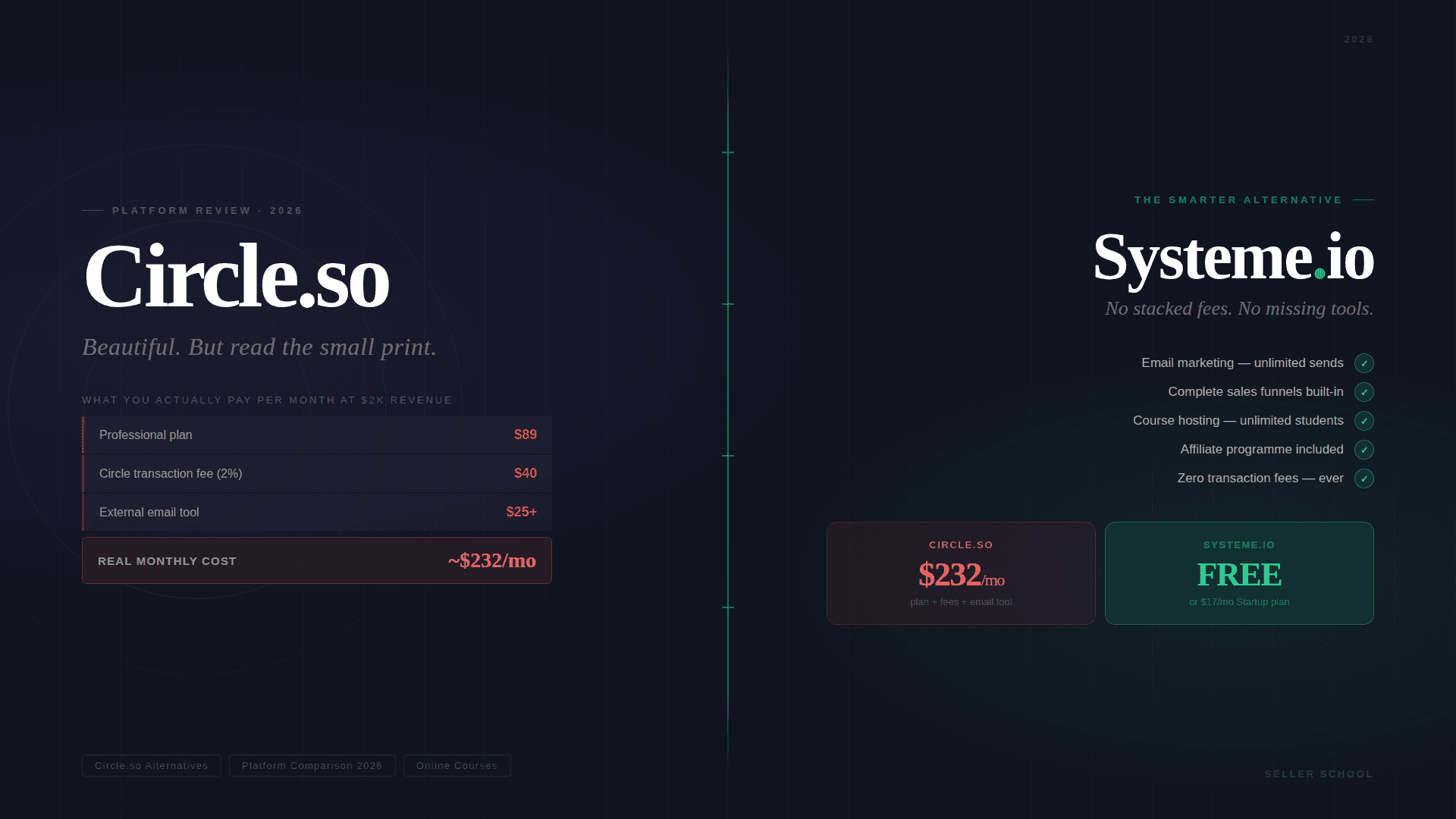
On Systeme.io's free plan, there are also no transaction fees — which puts it ahead of competitors like Teachable, whose free plan takes 10% of every sale.
Analytics and Reporting
Kajabi's analytics are strong and well presented. Revenue tracking, student progress, video engagement, funnel performance, and email open rates are all available and clearly displayed. On higher plans the depth of reporting is genuinely useful for optimising an established course business.
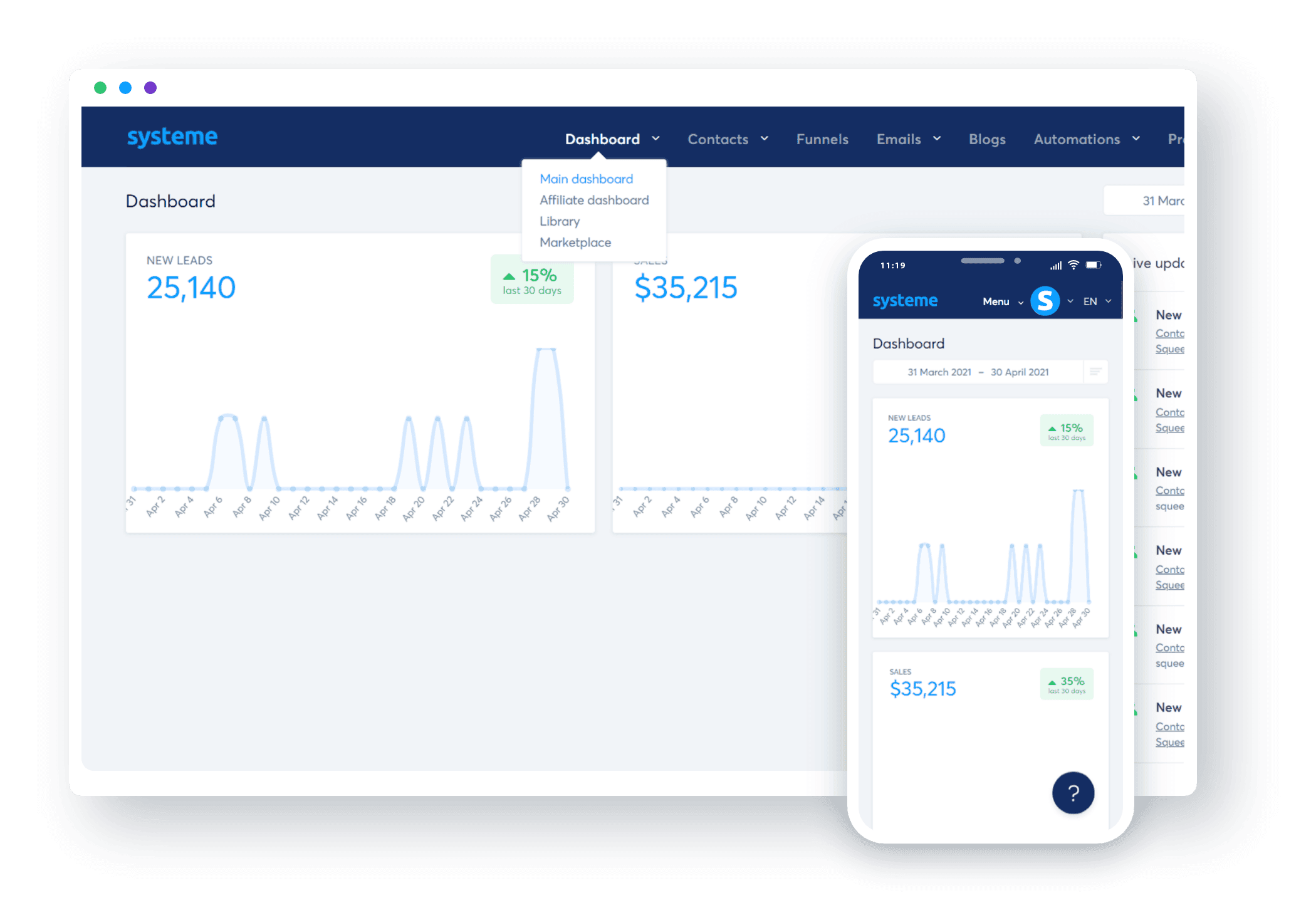
Systeme.io's analytics cover the business essentials — sales, revenue, contact growth, and funnel performance — but the depth of student-level reporting is more limited. For a beginning course creator who primarily wants to know how many people bought and how much they made, Systeme.io covers what matters.
Customer Support
Kajabi offers 24/7 live chat support on all plans, which is genuinely valuable. The response times are generally fast and the support quality is high. This is one of the areas where paying more gets you something tangible.
Systeme.io offers email-based support and has an active help centre and community forum. Response times are reasonable but not as immediate as Kajabi's live chat offering. This is worth factoring in if fast support access is important to your workflow.
Where Kajabi Wins
Let's be direct about the situations where Kajabi is the better platform. Because they exist, and pretending otherwise wouldn't be fair to you.
The student experience is genuinely superior. If you're charging a premium price for your course — £500, £1,000, or more — the polish of the Kajabi platform contributes to the perceived value of what your students are paying for. The interface is more refined, the learning environment feels more professional, and students who are accustomed to high-quality digital products will notice the difference.
The community feature is strong. If your business model centres on an engaged, ongoing community — not just a course, but a membership, a peer group, a space for connection — Kajabi's native community is a compelling reason to choose it. Building community on a separate platform adds friction and cost.
The support is better. Twenty-four-seven live chat is a meaningful advantage, particularly if you're running a launch or dealing with a technical issue that needs immediate resolution.
The analytics depth is greater. For an established creator who wants to optimise course completion rates, understand video engagement, and track student progress in detail, Kajabi gives you more to work with.
The brand carries weight. In certain niches and audiences, the Kajabi name is associated with quality and professionalism. That's intangible — but it's real, and it's worth considering if your target audience is familiar with the platform landscape.
The all-in-one ecosystem is more mature. Kajabi has been building its platform for longer and the integration between its component parts — courses, email, community, coaching, podcasts — is more seamless. If you want everything in one place and you're willing to pay for the most polished version of that, Kajabi delivers it.
Where Systeme.io Wins
For the majority of course creators who are at the beginning of their journey — who are pre-revenue or early revenue, who haven't yet validated their course idea, who are building their first funnel and their first email list — Systeme.io wins on almost every practical measure.
The price difference is transformative at the start. £133 a month versus £0, or £13, or £35 is not a marginal difference. It's £1,596 a year versus £156 a year versus £420 a year. That's real money that stays in your business while you're finding your feet — money that can go into marketing, into improving your course, or simply into your own pocket while you build.
The free plan is a genuine starting point. You can build a course, create a sales funnel, and email your list without spending anything. This is not a teaser — it's a functional platform for a first launch.
The all-in-one value is better at every price point. At £13 a month on the Startup plan, you get more than most platforms charge significantly more for. The ratio of functionality to price is simply better.
The marketing infrastructure is more developed for beginners. Funnels, email automation, and affiliate management are all more accessible and more fully featured relative to price than Kajabi's equivalent tools at a comparable spend.
No transaction fees on any plan, including free. This is a meaningful financial advantage, particularly on the free plan where competitors like Teachable take a percentage of every sale.
The upgrade path is gradual and proportionate. You move from free to £13 to £35 to £72 as your business grows. Each step is manageable and justified by what you gain. Kajabi's equivalent jumps — from £133 to £185 to £371 — are considerably more significant.
The Honest Verdict
Kajabi is not an overpriced product. It's a premium product at a premium price, and there are legitimate reasons why established creators choose it and stay on it.
But here's the question worth asking honestly: are you at the stage of your course business where a premium platform is the right investment?
If you are generating consistent revenue, you're positioning at a high price point, and a polished student experience and built-in community are genuinely central to your offer — Kajabi deserves serious consideration. Go in with clear eyes about the cost and make sure the revenue is there to support it.
If you're launching your first course, you're pre-revenue or early revenue, and you need a complete, reliable platform that lets you build and sell without a significant monthly commitment — use Systeme.io. Start on the free plan. Upgrade to Startup at £13 a month when you need more room. Invest the money you save back into your business.
The worst position to be in is paying £133 a month for a platform you chose because someone recommended it, while you're still trying to make your first sale. That financial pressure is real and it's unnecessary.
Start with what fits where you are. Scale up when the numbers justify it.
👉 [Create your free Systeme.io account here: https://iosysteme.com]