




There's a version of Kartra that looks genuinely compelling. The marketing is polished, the feature list is long, and the testimonials from power users paint a picture of a sophisticated platform that handles everything your online business could possibly need. If you've been researching platforms for your course or coaching business, you've probably come across it.
But there's another version of Kartra — the one that shows up in the reviews people write after months of frustration. The one where bugs in the page builder and email editor have been present since beta. The one where support tickets take days, sometimes a week, to get a useful response. The one where a new creator spends weeks building their funnel and membership site, only to find the checkout pages aren't processing correctly — and nobody at support can fix it.
Both versions are real. And which one you encounter depends largely on how technically experienced you are, how much time you have to invest in learning the platform, and how forgiving you are when things don't work as advertised.
If you're a course creator or coach who is just getting started — or who has tried Kartra and found yourself hitting walls — this comparison is for you. I've spent years building on platforms like these, paying for tools that turned out to be the wrong fit, and gradually developing a clear sense of what actually matters when you're trying to launch a course business. I'll give you the honest picture, so you can make the right call the first time.
The Platform Decision Nobody Tells You to Think About Carefully Enough
Most creators approach the platform decision like a shopping trip. They compare feature lists, watch a few YouTube demos, read a review or two, and pick the platform that looks most impressive. I did this myself in the early days. It's an expensive way to learn.
Here's the question nobody asks loudly enough: what do you actually need right now, versus what do you think you might need eventually?
That distinction matters more than any feature comparison, because every feature you don't currently need adds complexity to your interface, cost to your bill, and friction to your launch. Platforms like Kartra are built for experienced marketers who have complex funnels, large email lists, sophisticated automations, and teams helping them manage it all. That's their audience — and they're honest about it if you look closely enough.
If that's not where you are yet, you need a different tool. Not a worse one — a more appropriate one. A platform that gets you moving quickly, costs less while you're finding your feet, and doesn't punish you with a steep learning curve when you're trying to focus on creating your course and reaching your first students.
My view, after years in this space: simplicity and speed matter more than feature depth at the beginning. Choose tools that get out of your way.
What Is Kartra? The Honest Assessment
Kartra is an all-in-one marketing and sales platform built by Genesis Digital — the same company behind WebinarJam and EverWebinar. It's been around since 2018 and has a substantial user base, predominantly among experienced online marketers and established course creators.
Its feature set is genuinely impressive: page builder, sales funnels, email marketing and automation, membership sites and course hosting, video hosting, affiliate management, a support helpdesk, calendars and bookings, A/B testing, and analytics. Very few platforms at any price point can match the breadth of what Kartra offers on paper.
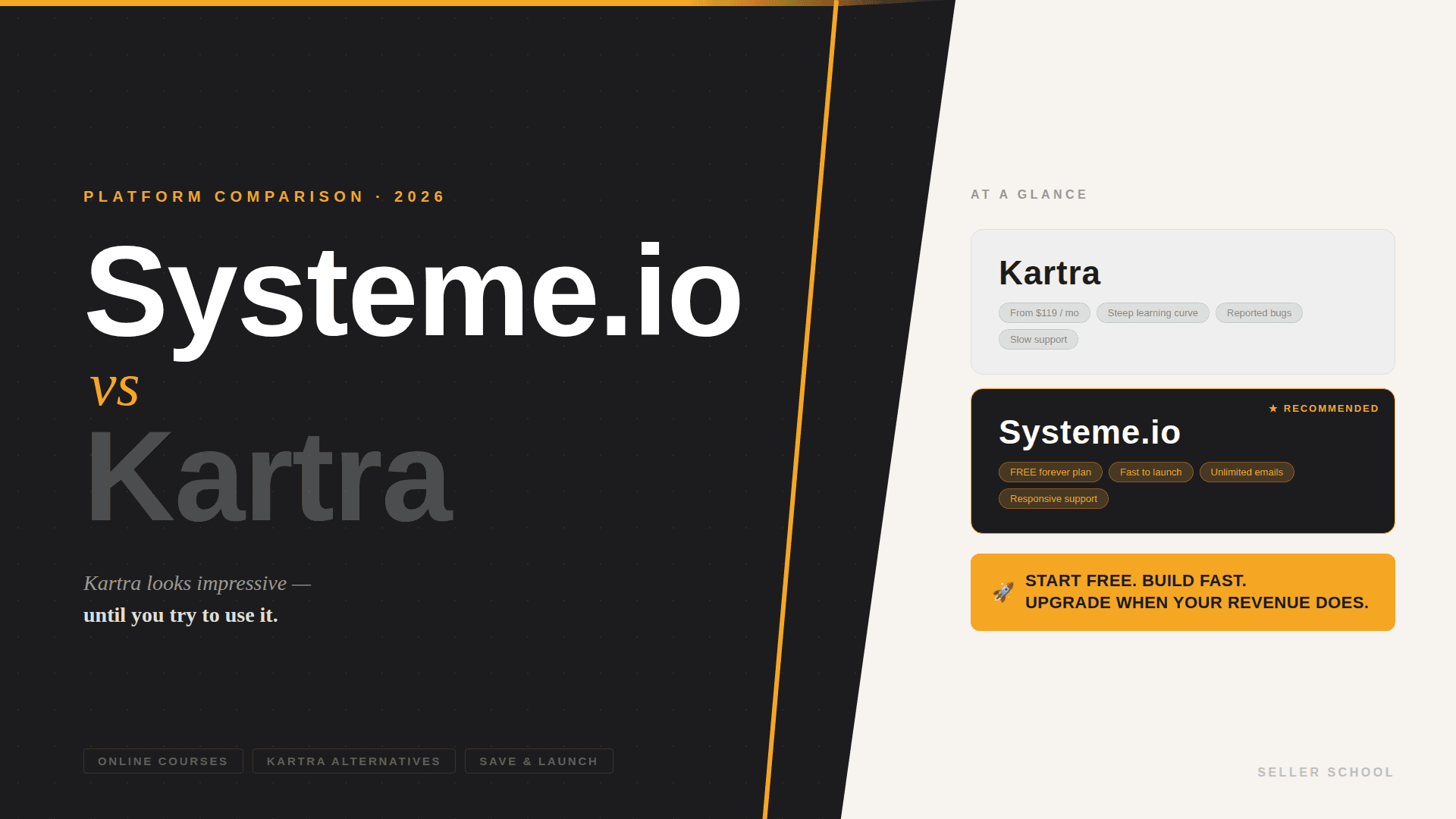
Pricing starts at $119 per month for the Starter plan, rising to $229 for Growth and $549 for Professional. There is no free plan, though a 30-day free trial is available. The Starter plan caps contacts at 2,500 and does not include webinar features.
For the right user — someone with an established business, technical confidence, and specific needs that require Kartra's advanced capabilities — it can be an excellent platform. Several long-term users describe it as the best tool they've found for managing complex marketing operations.
But Kartra also has a consistent pattern of complaints that is hard to ignore. Across Trustpilot, Capterra, G2, and similar review platforms, the same themes emerge repeatedly: bugs in core builders that have persisted for years, support that is slow and sometimes unhelpful, and a learning curve that is genuinely steep even for people with marketing experience. One Trustpilot reviewer, after six years of use, described it as the platform they most regret choosing. Another described it as feeling "coded by a group of high-school kids" — with constant logouts, a malfunctioning page builder, and updates that add surface polish without fixing underlying problems.
These aren't one-off complaints. They're a pattern. And for a beginner who can't afford to spend weeks troubleshooting or waiting for support, they represent a real risk.
What Is Systeme.io? Why It Deserves Serious Consideration
Systeme.io is a French-built all-in-one platform that has grown rapidly over the past few years, largely on the back of an exceptional value proposition: everything a new or growing course business needs, starting completely free.
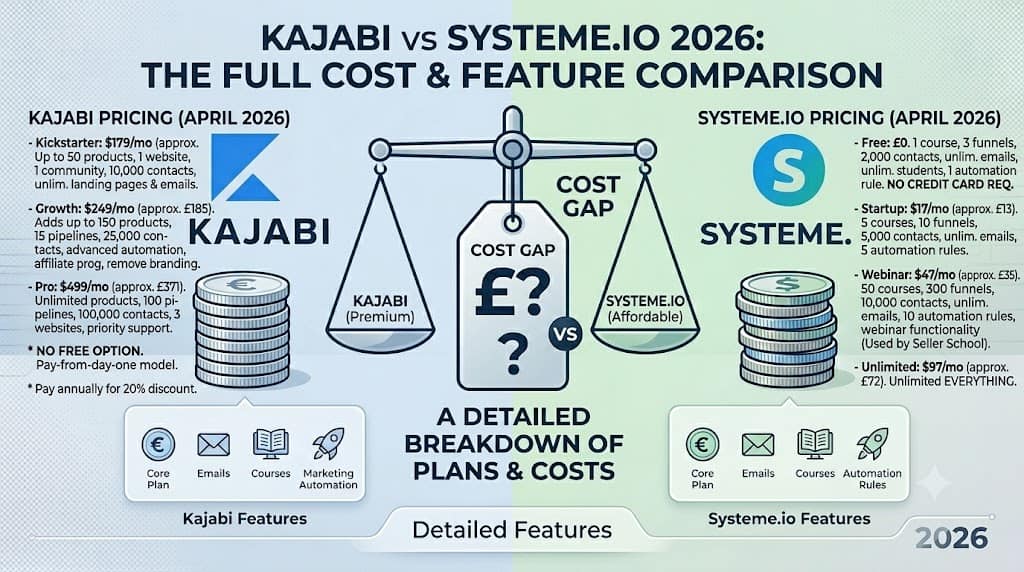
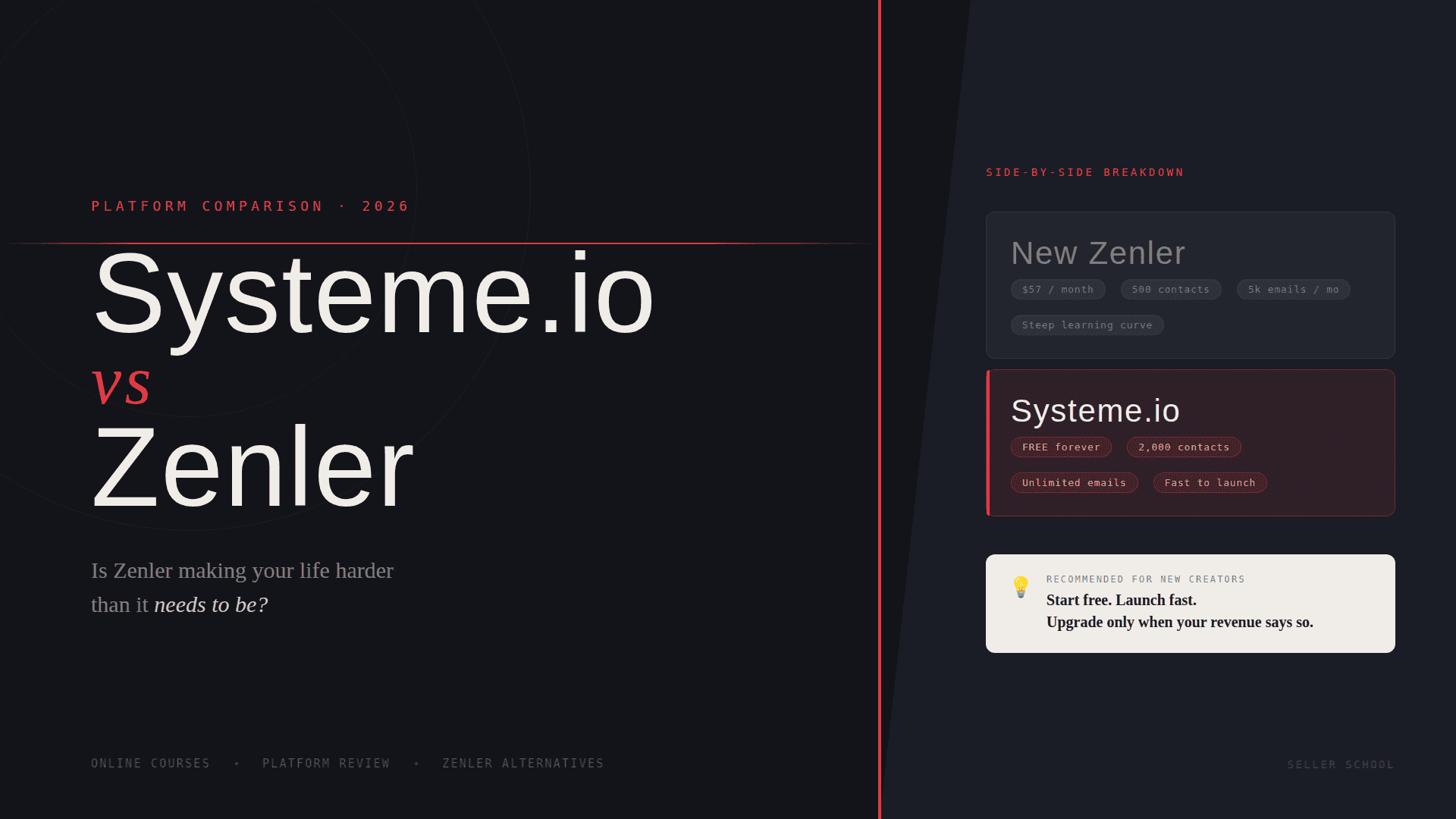
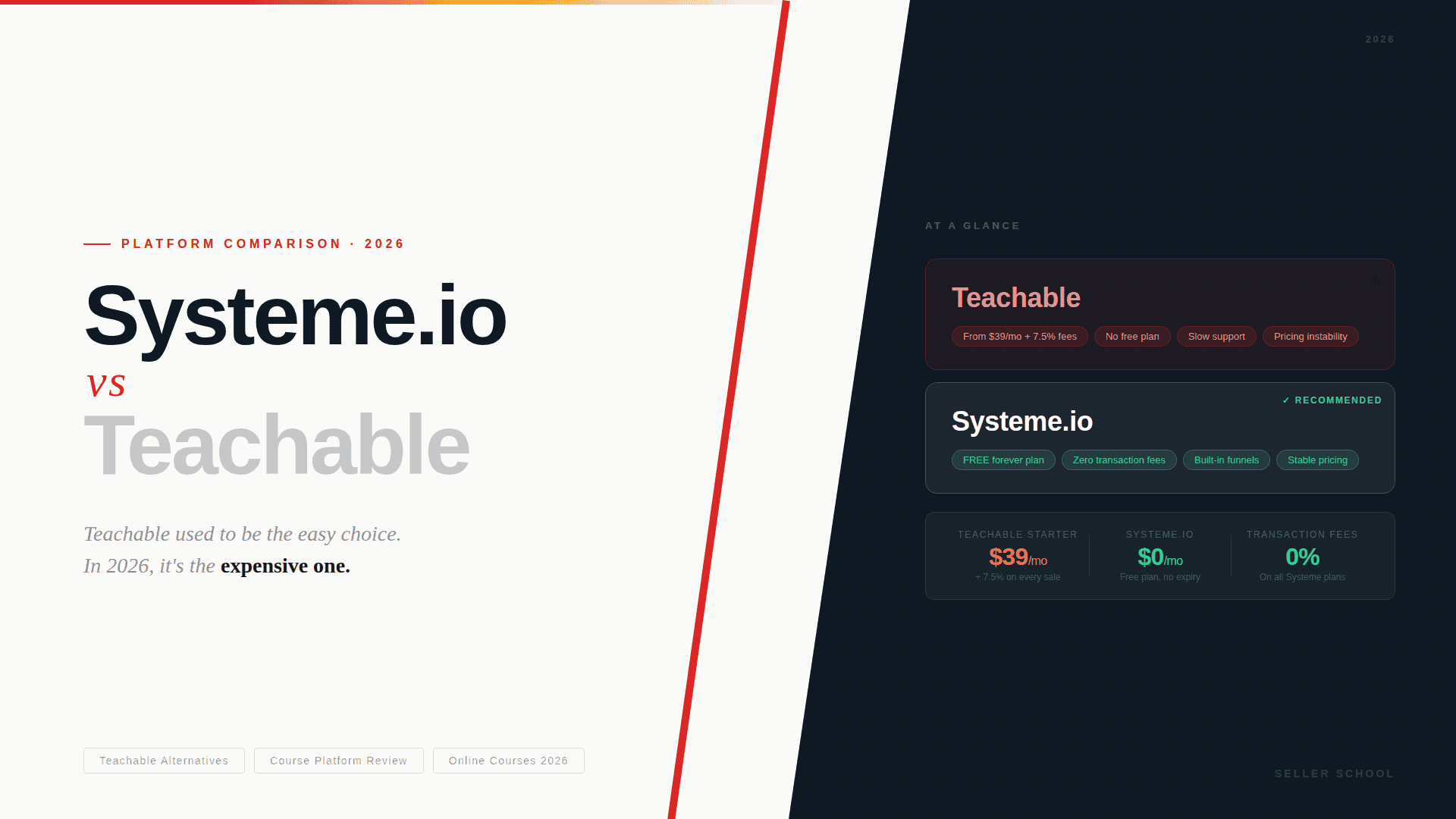
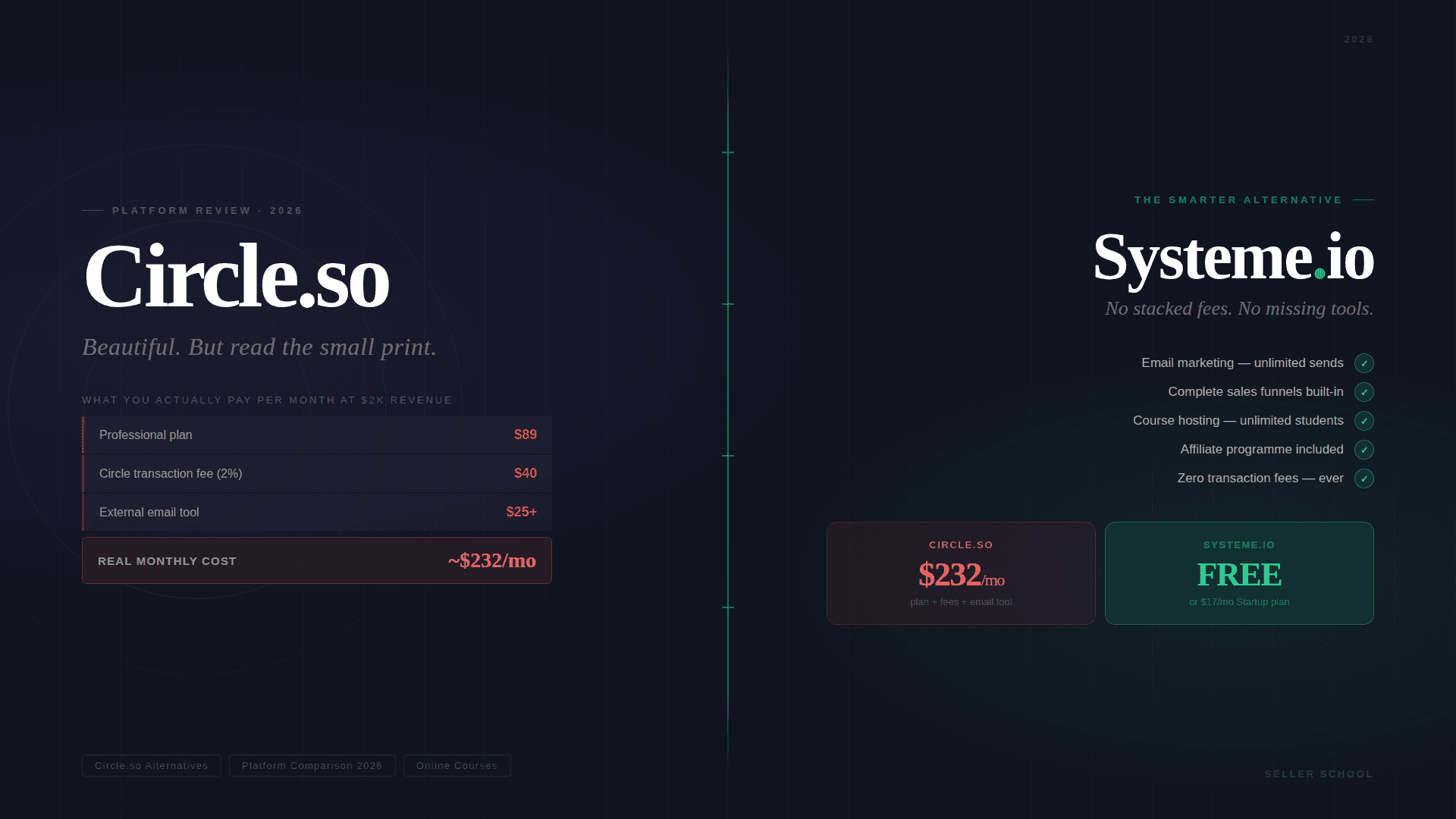
The free plan — not a trial, a permanent free account — gives you three courses, 2,000 contacts, unlimited email sends, three sales funnels with upsells and order bumps, an affiliate management programme, a website builder, and basic automation. Paid plans start at $17 per month, with the Unlimited plan at $97 per month. At every tier, Systeme.io is substantially cheaper than Kartra while covering the features most creators actually use.
The interface is intentionally approachable. Navigation is logical, terminology is plain, and most of the core tasks — building a course, creating a funnel, setting up an email sequence — can be completed by a complete beginner without needing a tutorial. That's a deliberate design philosophy, not an accident.
Systeme.io doesn't have the depth of Kartra's advanced marketing automation or the sophistication of its analytics. For experienced marketers with complex needs, those gaps may matter. For a course creator who wants to get their first course live and start generating revenue, they almost certainly don't.
Feature by Feature: What Actually Matters for Course Creators
Ease of Use
Kartra's learning curve is well-documented and consistently flagged — even in reviews that are broadly positive about the platform. The navigation is non-intuitive in places; to configure course settings, for example, you cannot jump between sections but must click sequentially through every step, even when you only need to change one thing. The terminology is unusual — what most platforms call a "membership site" is what Kartra calls a "membership," and what most people would call a membership site is what Kartra calls a "portal." These are small things individually, but they accumulate into a genuine time cost when you're new to the platform.
Systeme.io is built around the opposite philosophy. The interface is designed for non-technical users who want to move quickly. Creators regularly report being able to build and launch their first course or funnel within a day or two of creating an account. There is no equivalent of Kartra's Kartraverse training portal — because the platform is designed not to need one.
Verdict: Systeme.io wins clearly. The gap is significant and particularly important for beginners.
Course Hosting and Delivery
Kartra's course builder is genuinely capable. Because it works like a simplified page builder, you have considerable design flexibility — more than most dedicated course platforms, and certainly more than Systeme.io. You can create visually varied lesson pages, mix content types freely, and build multi-course membership portals. The student experience can be excellent if you invest the time in building it well.
The downside is the same as with every other part of Kartra: it's fiddly. G2 reviewers note bugs in the membership builder that slow down the course creation process. Video hosting also depends on which plan you're on, and real-time upload processing can be slow.
Systeme.io's course builder is straightforward and clean. You can build a well-structured, professional-looking course with modules, lessons, videos, PDFs, and drip scheduling without any technical knowledge. The student experience is functional rather than flashy. For most self-paced courses, it's entirely adequate.
Verdict: Kartra has more design flexibility. Systeme.io is faster to build and less prone to issues. For most beginners, Systeme.io is the more practical choice.
Sales Funnels and Landing Pages
This is Kartra's strongest area. The funnel builder is sophisticated, the page builder has extensive template options, and advanced features like A/B testing, deadline funnels, upsells, downsells, and Funnel Simulator are all genuinely powerful tools for optimising revenue.
For an experienced marketer who knows exactly what they want to test and why, Kartra's funnel capabilities are hard to beat at any comparable price point.
For a beginner, however, that sophistication can be overwhelming rather than helpful. Systeme.io's funnel builder covers every essential step — opt-in, sales page, checkout, upsell, thank-you page — in a clean, logical interface. Templates are provided. The process is designed to get you live quickly, not to offer infinite customisation.
Crucially, Systeme.io includes upsells and order bumps from the free plan. These are real revenue-boosting tools that require no extra configuration or plan upgrade. Kartra includes them too, but the overall funnel-building process is considerably more complex to set up correctly.
Verdict: Kartra wins on depth and sophistication. Systeme.io wins on speed and accessibility. For a beginner, Systeme.io is the smarter starting point.
Email Marketing and Automation
Kartra's email and automation capabilities are genuinely strong. Behaviour-based automations, sophisticated tagging, conditional logic, and sequence branching are all well-implemented. For businesses with complex customer journeys, this is one of Kartra's most defensible advantages.
The caveat, again, is the email builder itself — which has documented bugs that make the editing process slower and more frustrating than it should be.
Systeme.io's email tools are clean and well-suited to beginner and intermediate needs. Broadcasts, automated sequences, tagging, and event-based triggers all work reliably. The automation builder is simple and visual. Unlimited email sending is included on every plan, including the free tier — no contact caps on sends, only on your total list size.
Verdict: Kartra wins on automation depth for advanced users. Systeme.io is more than sufficient for most creators getting started, with the advantage of unlimited sending from day one.
Customer Support
Support quality is a serious concern with Kartra, and this isn't something I say lightly. The pattern across multiple review platforms — Trustpilot, Capterra, G2 — is consistent: slow response times, unhelpful resolutions, and in some cases, issues that remain unresolved for weeks. One Capterra reviewer described spending six months building a funnel on Kartra, only to find a checkout processing error they couldn't get fixed. After a year of back-and-forth, the issue wasn't resolved — and their support tickets were deleted.
That's an extreme case, but the general picture of Kartra's support being sluggish and inconsistent is well-established across hundreds of reviews. For a beginner who relies on support to work through technical problems, this is a genuine risk.
Systeme.io's support is generally rated more positively. Live chat, a comprehensive knowledge base, and a large active community mean that most issues can be resolved reasonably quickly. The community around Systeme.io in particular is a valuable resource — there are active Facebook groups and forums where experienced users answer questions rapidly.
Verdict: Systeme.io wins on support reliability. Given the bugs documented in Kartra, this matters more than usual.
Pricing
Kartra: $119 per month (Starter), $229 (Growth), $549 (Professional). No free plan. 30-day free trial only.
Systeme.io: Free plan (permanent), $17 (Startup), $47 (Webinar), $97 (Unlimited).
The pricing gap is stark. Even on Kartra's entry plan, you're paying more than four times what Systeme.io's $17 plan costs — for a platform that is harder to use, has documented bugs, and has slower support. The only scenario in which Kartra's price is justified for a beginner is if they have a specific, current need for features that Systeme.io cannot provide. For most new course creators, that scenario doesn't apply.
Verdict: Systeme.io wins decisively on pricing at every tier.
The Feature Trap: Why More Isn't Always Better
I want to make a broader point here, because it underpins everything in this comparison.
Kartra's marketing makes much of its feature depth. And it's genuine — the platform really does have an extraordinary range of capabilities. But every feature you don't currently use is a feature that adds noise to your interface, complexity to your workflow, and — in Kartra's case — potential for bugs and glitches to affect the things you do use.
I've seen creators spend weeks getting lost in Kartra's configuration options before they've written a single lesson for their course. I've watched people get so caught up in funnel optimisation that they never actually launch. The platform becomes the project, and the course gets left behind.
The platforms that push the most features are also the platforms that charge the most for them — and often the ones that are hardest to leave once you've built your business on them. This is by design. The more deeply embedded you become, the more switching costs you accumulate.
Starting with a simpler, more affordable platform doesn't mean you're settling for less. It means you're making a smarter decision about what matters right now. Once you've got paying students, proven revenue, and a clear understanding of what more sophisticated tools you actually need — then you can have that conversation. You'll be making it from a position of knowledge and financial strength, rather than guesswork and wishful thinking.
Alternatives to Kartra: Where Systeme.io Fits
Kartra sits in a market segment that includes Kajabi, ClickFunnels, GoHighLevel, and a handful of other sophisticated all-in-one platforms. These are all tools built primarily for marketers and business operators who have complex needs and the resources to implement them.
When people search for alternatives to Kartra, they typically want one of two things: either they want something comparably capable but with better reliability and support, or they want something more straightforward that doesn't require the same investment of time and money to get started.
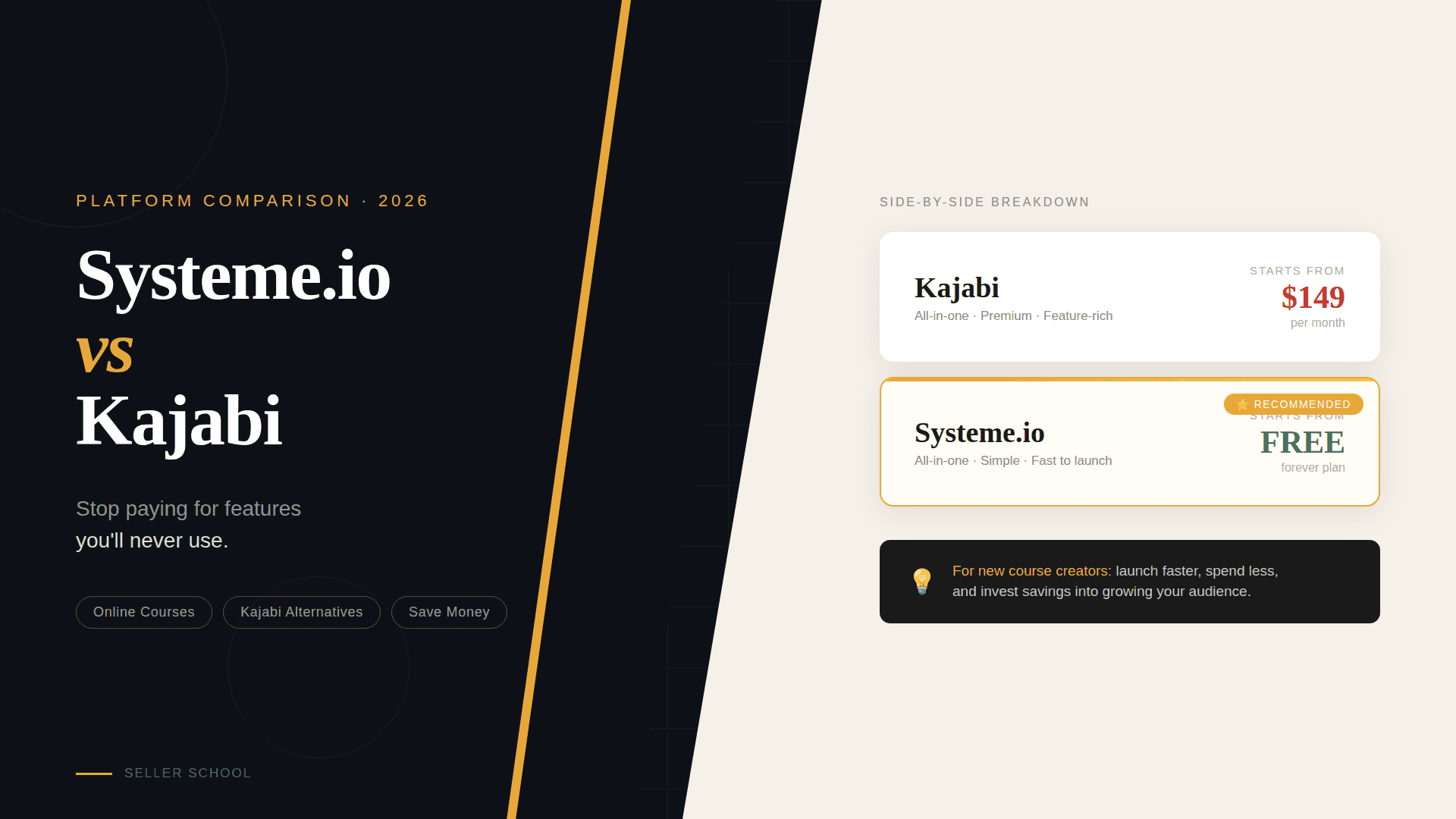
For the first group, platforms like Kajabi or GoHighLevel are worth exploring — though both come with their own trade-offs and price tags. For the second group — which describes the majority of new course creators and coaches — Systeme.io is the most logical answer. It's the most complete platform at the lowest price, with the most accessible interface.
The online course platforms comparison question that matters most for beginners is not "which platform has the most features?" It's "which platform will get me to my first £10,000 fastest, with the least friction and the lowest risk?" On that basis, Systeme.io wins consistently.
How to Host an Online Course Without Getting Buried in Platform Complexity
If you're figuring out how to host an online course for the first time, here's the clearest framework I can offer:
Step one: define your minimum viable setup.What do you actually need to launch? Write it down. For most creators, the list includes: somewhere to host course videos and modules, a sales or landing page, a checkout that takes payment, and a basic email sequence to onboard new students. That's it.
Step two: match your platform to that list, not to your aspirations.You don't need A/B testing, advanced automation, an affiliate programme, a webinar system, and a support helpdesk on day one. You need the four things above. Pick the platform that does those four things most reliably and most easily.
Step three: launch before you're ready.This sounds counterintuitive, but it's the single most important piece of advice I can give. An imperfect course on a basic platform that's live is worth infinitely more than a perfect course on a sophisticated platform that's still being configured. Your first version will not be your last. Ship it.
Step four: upgrade when your revenue justifies it.Once you have paying students and consistent income, the conversation about whether to invest in more sophisticated tools becomes easy. You're spending money you've already made, on features you actually know you need.
The Mistakes That Cost Course Creators the Most
A few of the most common errors I see — and that I made myself before I knew better:
1. Choosing a platform for the business you want rather than the one you have.
The version of your business that needs Kartra's full feature set is a future version. The version that needs to launch its first course is a present version. Match your tools to your current reality.
2. Paying annual subscriptions before you've proven your concept.
Kartra periodically offers significant discounts on annual plans. These can look attractive. Resist the temptation. Pay monthly until you've proven your course sells and your students get results. Never lock yourself into an annual commitment on a platform you haven't fully tested.
3. Underestimating the real cost of a difficult platform.
The monthly fee is only part of the cost. Every hour you spend configuring, troubleshooting, or waiting for support is an hour you're not creating content, marketing your course, or supporting your students. For many creators, the time cost of a complex platform dwarfs its subscription price.
4. Treating a platform switch as permanent.
Many creators stay on the wrong platform far too long because they assume moving is catastrophic. It isn't. Migrating a course from one platform to another is typically a weekend's work. If your current platform is costing you more than it's giving you, switching is a rational decision, not a failure.
5. Ignoring the support question entirely.
I cannot stress this enough: you will have a technical problem at the worst possible moment. Your checkout will fail the night before a launch. A student will lose access to their content during a live event. When that happens, you need fast, helpful support. Check reviews. Not the headline rating — the actual content of what people say about support response times and quality.
Who Should Choose Which Platform?
Systeme.io is the right choice if:
- You're launching your first or second course and haven't yet built consistent revenue
- You want to move quickly and find complex interfaces frustrating
- You've looked at Kartra and the price or the reviews are giving you pause
- You need a reliable all-in-one tool that handles courses, funnels, and email in one place
- You want to test your course concept without committing to a significant monthly overhead
Kartra might work for you if:
- You're an experienced marketer who already understands funnels, automation, and CRM concepts
- You have specific needs that Systeme.io doesn't cover — complex automations, advanced A/B testing, or Kartra's video tools
- You have the time and patience to invest in learning the platform properly
- You have the technical background to troubleshoot issues independently when support is slow
The Clearest Next Step You Can Take Today
If you've been sitting in research mode — reading comparison articles, watching YouTube demos, going back and forth between options — I want to give you a way out of that loop.
The most useful thing you can do right now is sign up for a free Systeme.io account and actually build something in it. Not click around the dashboard for ten minutes — actually create a module, build a sales page, set up a checkout. That's the only way to know whether a platform works for you, and the free plan removes any financial risk from the experiment.
Sign up for your free Systeme.io account here: https://iosysteme.com. No credit card required.
And if you'd like a broader, more structured comparison of all the main platforms worth considering — including Kartra, Kajabi, Systeme.io, Teachable, Thinkific, Zenler, and others — I've put together a free guide specifically for course creators and coaches. It covers what each platform is genuinely good for, who it suits at each stage of building their business, and what to avoid. You can access it here:
https://pro.sellerschool.co.uk/course-creators-tools-comparison
The guide is free. It's practical. And it's designed to save you the kind of expensive, time-consuming guesswork that I — and many other creators — went through before we found the right tools.
The best platform is the one that gets your course in front of students. Everything else is just infrastructure. Build on something solid, keep your costs down while you're getting started, and invest your savings in reaching more people who need what you're teaching.
About the author: This article draws on several years of hands-on experience building and selling courses across multiple platforms, including Kartra, Systeme.io, Kajabi, Zenler, and others. The focus is always on practical, honest guidance that helps course creators make good decisions without having to learn the hard way.