If you've spent any time in online creator circles lately, you've almost certainly encountered Skool. It has Alex Hormozi's endorsement (he called it the biggest investment of his life). It has Sam Ovens at the wheel. It's growing faster than almost any competing platform. And it has a reputation for creating genuinely engaged communities that most other platforms simply can't replicate.
So let's acknowledge what Skool genuinely does well, before we get into the part nobody talks about loudly enough: what it doesn't do.
Because here's the thing — Skool markets itself as having 'everything in one place.' And for a certain kind of creator running a certain kind of business, that's reasonably close to true. But for a new course creator or coach who wants to build an audience, sell a course, run their email marketing, build a funnel, and generate income from scratch — the gaps in Skool are real, and filling them costs more than the platform's headline price suggests.
I've been working with course and coaching platforms for years, testing them, paying for them, and sometimes regretting them. This review is written from that experience, aimed squarely at beginners and intermediate creators who want a clear-eyed picture before they commit — and who deserve to know about a serious free alternative before handing over $99 a month.
What Is Skool and Why Is Everyone Talking About It?
Skool was founded in 2019 by Sam Ovens, the entrepreneur behind consulting.com. His observation was that community-building tools at the time were fragmented — creators were running Facebook groups alongside their courses on Kajabi or Teachable, and the two worlds never properly connected. Skool was built to fix that: a single platform where community, courses, and live events live together.
In 2024, Alex Hormozi — one of the most prominent figures in the online business space — made what he publicly described as the biggest investment of his life into Skool. That endorsement brought an enormous wave of attention to the platform, and growth accelerated sharply. The platform's user base and number of active communities expanded substantially through 2025 and into 2026.
The result is a platform with genuine momentum, a highly vocal community of supporters, and one of the strongest records for community engagement of any tool on the market. The gamification system — points, levels, and leaderboards that reward members for activity — is widely cited as a genuine differentiator. Communities on Skool tend to be more active than on most competing platforms, because the platform is designed to make participation feel like a game.
That's the case for Skool. It's a real case, and I don't want to dismiss it. But the case has important limits.
What Skool Actually Costs
Skool's pricing in 2026 is straightforward, which is genuinely one of its strengths. There are two plans:
- Hobby — $9/month: A basic entry point introduced in 2025 to let creators validate their community idea before committing to the full plan. Limited analytics and features.
- Pro — $99/month: The main plan, giving you unlimited members, unlimited courses, unlimited events, detailed analytics, webhooks, custom URLs, and boosted discoverability in Skool's public network. This is the plan you need to run an actual business on Skool.
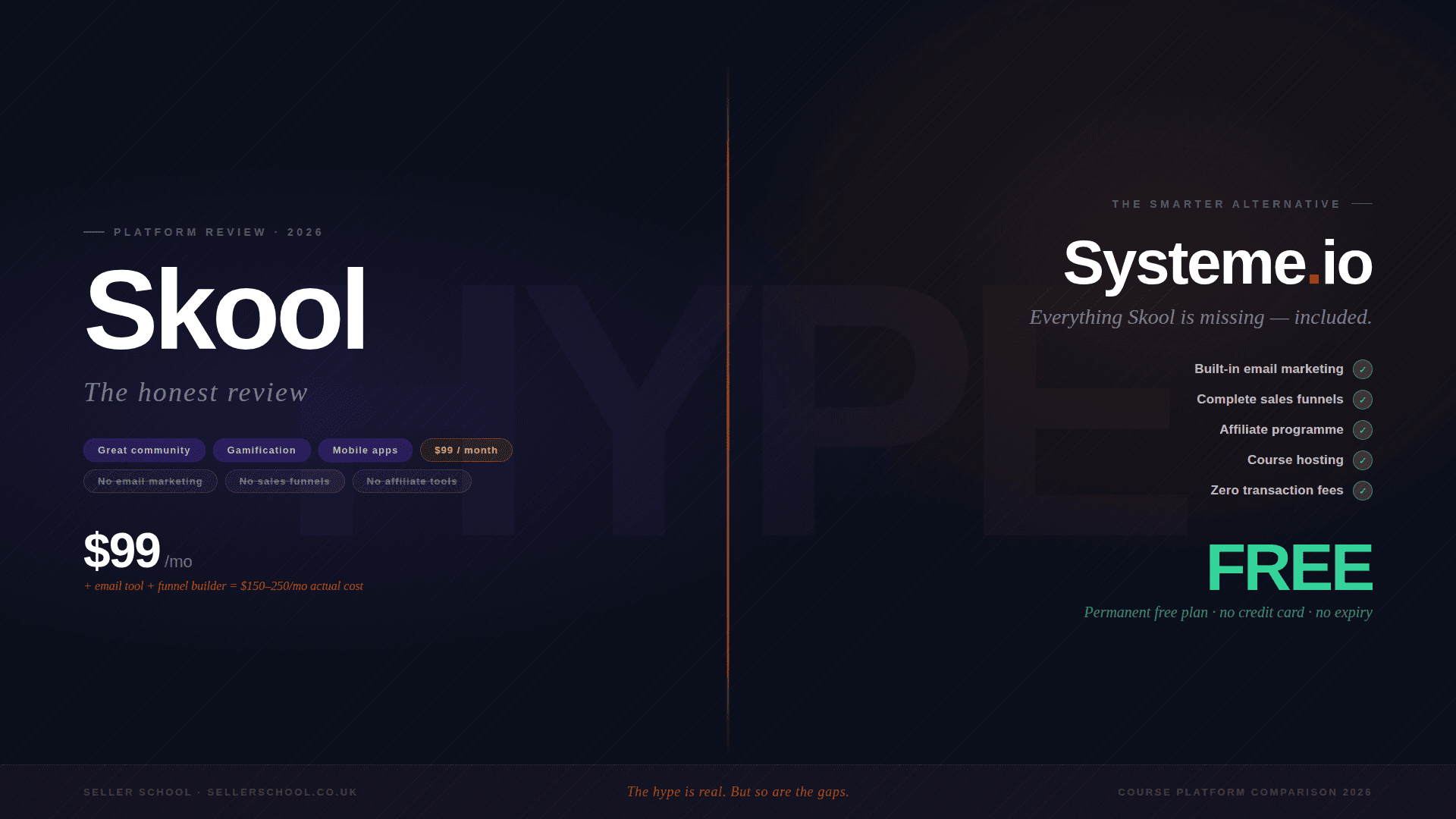
At $99 per month, Skool is not cheap for a platform that — as we'll discuss — does not include email marketing, funnel building, or marketing automation. It is also worth noting that each community requires its own subscription. If you want to run a free community for audience building alongside a separate paid community for paying students, that's two subscriptions — $198 per month.
There is a 14-day free trial, but there is no permanent free plan.
What Skool Does Well: The Genuine Strengths
Community Engagement Is Best-in-Class
Skool's community feed, gamification system, and the tight integration between the community and the course content create a genuinely engaging environment that most competing platforms struggle to match. Members earn points for posting, commenting, and completing course content. Levels unlock as they progress. Leaderboards create friendly competition. The result, consistently reported across multiple independent reviews, is that Skool communities tend to be significantly more active than equivalent communities on other platforms. If keeping members engaged over time is your primary goal, this is Skool's strongest card.
Everything Lives in One Interface — For What It Covers
The combination of community feed, course classroom, events calendar, and payments in a single, clean interface is genuinely useful. Members can move between community discussion and course content without leaving the platform. Events are visible in a shared calendar. The experience feels coherent rather than cobbled together. For the features it includes, the integration is well-designed.
Native Video Hosting (Added in 2025)
A meaningful 2025 improvement: Skool now hosts video natively, with chapters and timestamps. Previously, creators had to embed from YouTube, Vimeo, or Loom — an extra step that added friction. Native hosting removes that requirement and gives members a cleaner viewing experience.
Mobile Apps
Skool has full-featured iOS and Android apps with push notifications. This is a genuine advantage for creators running active communities — members receive notifications and engage from their phones, which drives the kind of daily participation that makes community feel alive.
Simple, Flat Pricing
$99 per month for unlimited members, unlimited courses, and unlimited events is straightforward. No per-member fees, no transaction fees beyond Stripe's standard rate, no complex tier structure. For an established creator with a large, active community, this simplicity has real value.
What Skool Doesn't Do: The Gaps That Matter for New Creators
This is the section that gets glossed over in most Skool content, largely because most of that content is produced by people who already have audiences, email lists, and marketing systems. For someone starting from scratch, these gaps are not minor inconveniences — they're fundamental missing pieces.
No Email Marketing. None.
Skool does not include any email marketing functionality. No broadcasts, no automated sequences, no list management, no drip campaigns. Multiple reviewers across 2025 and 2026 explicitly confirm this: to send marketing emails — to nurture leads before they join, to follow up with people who don't convert, to run any kind of email-based sales campaign — you must use a separate tool.
ConvertKit, Mailchimp, ActiveCampaign — these are the tools Skool users commonly pair alongside their subscription. At entry level, ConvertKit starts at around $25–$29/month. So your actual platform cost is not $99 — it's $99 plus your email tool, typically putting you at $125–$170+ per month before you've run a single ad or created a single piece of content.
No Sales Funnel Builder
Skool is not a website. It is not a funnel builder. It has no landing pages in the traditional sense, no opt-in page builder, no upsell or order bump functionality, no checkout customisation, and no multi-step sales sequences. Multiple independent reviews in 2025 and 2026 describe this as one of Skool's two major limitations for creators who need to sell to people who don't already know them.
To bring cold traffic into your community, you need a separate website and funnel tool. That might be Systeme.io, ClickFunnels, Leadpages, or a WordPress site with a funnel plugin. Each adds cost, complexity, and another integration to manage. The promise of 'everything in one place' breaks down at this point.
No Lead Magnets or Email List Building Tools
Related to the above: Skool cannot help you build an email list. There are no opt-in forms, no lead magnet delivery systems, no mechanisms to capture email addresses from people who aren't yet members. For a creator who hasn't yet built an audience — which describes most of the people reading this — this is a significant structural gap. You cannot use Skool as the top of your funnel. You need another tool to bring people to you, and then Skool to keep them once they've arrived.
No Quizzes, Certificates, or Advanced Course Features
Skool's course builder is clean and simple. What it is not is sophisticated. There are no quizzes or tests, no course completion certificates, no graded assignments with feedback loops, no advanced drip logic with conditional content, and no structured learning paths with prerequisites. For creators whose course quality depends on students doing work and demonstrating progress — coaches with certification programmes, educators with structured curricula — these are real limitations.
Limited Branding and Customisation
You can add your logo and a cover photo to your Skool community. That is largely where customisation ends. You cannot change brand colours, fonts, or button styles. You cannot rebuild the layout. Your community visibly sits within Skool's network design — it doesn't feel like an independently branded space. For creators who care about brand identity and building a presence that feels truly their own, this is a meaningful constraint.
Basic Analytics
Skool's analytics cover the basics: post activity, member levels, course progress. What they don't cover: funnel analysis, churn dashboards, detailed behavioural data, segment-level engagement breakdowns, or attribution tracking. For creators who want to understand in detail where students are dropping off and why, external tools are required.
The 'Everything in One Place' Problem
Let's examine Skool's core marketing claim directly, because it's the one that will most affect a new creator's decision.
Skool says it puts everything in one place: courses, community, and calendar. That's true for those three things. But a complete course business also needs: a way to build and grow an email list, a funnel to convert strangers into buyers, email marketing automation to nurture that list, a sales page that you control and can customise, and ideally an affiliate system to let others sell for you.
None of those things are in Skool.
So what actually happens in practice? Skool users who are serious about building a business end up running Skool alongside an email platform (ConvertKit, $25–$100/month), a funnel or website builder (Systeme.io, Leadpages, or similar, $17–$97/month), and possibly Zapier to connect them (from $20/month). The real total platform cost for a serious Skool-based business is frequently $150–$250+ per month — comparable to or more expensive than an all-in-one platform that actually includes all these tools.
This isn't necessarily a reason not to use Skool. But it is a reason to go in with clear eyes about what you're signing up for, and what it will actually cost to run a complete business alongside it.
Alternatives to Skool: Where Systeme.io Fits
When people search for alternatives to Skool, they're usually in one of two positions. Either they've tried Skool and hit the tool-stacking wall, or they're in the research phase and realising that Skool's gaps are going to require external solutions they'd rather build into their platform from the start.
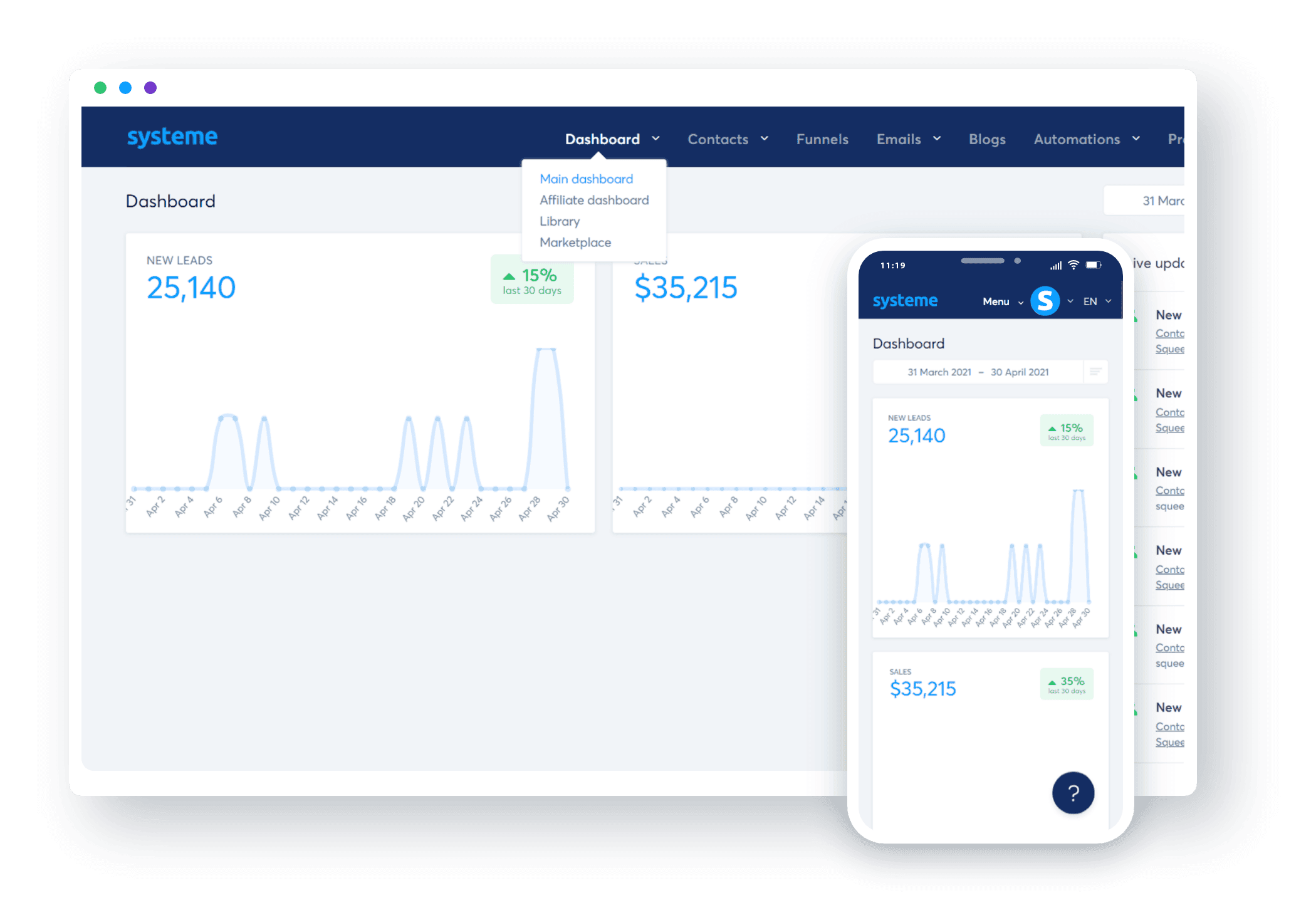
Systeme.io addresses both positions directly. It is the platform that most comprehensively fills the gaps Skool leaves open — and does so at a price that makes Skool's $99/month look expensive by comparison.
The permanent free plan (no expiry, no credit card required) gives you: one course with unlimited students, 2,000 contacts, unlimited email sends, three complete sales funnels with opt-in pages, sales pages, order bumps, and one-click upsells, a full affiliate management programme, a website builder, and automation rules. From your free account, you can build the top-of-funnel infrastructure that Skool entirely lacks.
The Startup plan at $17/month extends these limits to 5,000 contacts, five courses, ten funnels, and ten automation rules. The Webinar plan at $47/month adds evergreen webinars, 10,000 contacts, and 50 funnels. The Unlimited plan at $97/month removes all caps — at the same price as Skool's Pro plan, but including email marketing, funnels, and affiliate tools that Skool doesn't offer at all.
Zero transaction fees apply on every Systeme.io plan.
Systeme.io vs Skool: A Honest Side-by-Side
Community and Engagement
Skool wins. Its gamification system and community-first design create engagement that Systeme.io's community tools can't currently match. If a highly active, gamified community is the centrepiece of your business model, Skool is the stronger choice for that specific function.
Email Marketing
Systeme.io wins comprehensively. Unlimited sends, automation sequences, broadcast campaigns, and list management are all included from the free plan. Skool has nothing in this category — you'd need a separate tool entirely.
Sales Funnels
Systeme.io wins entirely. Complete funnel building — opt-in, sales page, checkout, upsell, thank-you — is available from the free plan. Skool has no funnel building capability whatsoever.
Course Delivery
Skool edges ahead for community-integrated courses where engagement and participation matter. Systeme.io is functional and sufficient for self-paced courses. Neither handles complex interactive learning particularly well.
Affiliate Programme
Systeme.io wins. Full affiliate management is included from the free plan. Skool does not offer a native affiliate management system.
Total Cost for a Complete Business
Systeme.io wins substantially. Systeme.io's free plan covers funnels, email, courses, and affiliates at zero cost. Skool at $99/month requires an additional email tool ($25–$100/month) and a funnel builder ($17–$97/month) to cover equivalent functionality — making the real comparison $99+ vs $0–$17.
Who Should Choose Which Platform?
Skool makes sense if:
- Community engagement is genuinely the central value of your offer — not a nice-to-have, but the main thing students are paying for
- You already have an email list, a funnel system, and a marketing stack in place, and you're looking specifically for a more engaging community platform to replace a Facebook group
- You're a coach running a mastermind or accountability-based programme where daily member interaction drives the transformation
- The Skool Games and network discovery features are part of your growth strategy
Systeme.io makes more sense if:
- You're starting from scratch and need to build an audience, grow an email list, sell your first course, and generate income — all from one place
- You want marketing infrastructure (funnels, email sequences, affiliate tools) without paying for multiple separate tools
- You want to test your course concept at zero cost before committing to any monthly subscription
- You want pricing stability — Systeme.io has cut prices while competitors have raised them
- The idea of managing three or four integrations between separate tools doesn't appeal to you
Common Mistakes When Choosing a Platform
1. Being seduced by social proof rather than fit.
Alex Hormozi endorsing Skool is genuinely significant. He's one of the most credible voices in the online business space. But his business is not your business. He has an existing audience in the millions, an email list, a funnel system, and a team. Skool fits his situation because he doesn't need the infrastructure it lacks. You might.
2. Not calculating total tool cost.
$99/month for Skool sounds comparable to other platforms until you add the email tool ($29/month), the funnel builder ($17–$97/month), and possibly Zapier to connect them ($20/month). Do the maths on what a complete business infrastructure actually costs before committing.
3. Choosing for the business you aspire to rather than the one you have.
Skool's community features are genuinely powerful for creators with engaged audiences. If you don't yet have an audience, you need tools to build one first. Investing in a premium community platform before you have a community is getting the order of operations wrong.
4. Ignoring the missing pieces until they become a crisis.
Several creators describe the same journey: they signed up for Skool, loved the community experience, then realised months later they had no email list, no way to nurture leads, and no funnel to convert cold traffic. By then, they've invested time building on the platform and switching feels costly. Check for gaps before you build, not after.
Start Free Before You Commit to Anything
If there's one practical suggestion I'd give anyone comparing Skool and Systeme.io, it's this: test Systeme.io first, because it costs nothing to do so properly.
The free plan is permanent. No 14-day clock. No credit card. You can build your first course, set up a funnel, create an email sequence, connect your payment processor, and see whether the platform suits how you work — all before spending a penny. If you then decide a community-first platform like Skool suits your business better, you'll be making that choice from experience rather than assumption.
Sign up for your free Systeme.io account here: https://iosysteme.com. Permanent free plan. No credit card required.
And if you'd like a broader guide comparing all the main platforms — Skool, Systeme.io, Kajabi, Teachable, Thinkific, Kartra, Zenler, and others — I've put together a free resource specifically for course creators and coaches. It's available below this article and covers what each platform is actually suited for, what it really costs, and how to make the right decision without learning the expensive way.
Skool is a genuinely impressive platform for what it was designed to do. But for a creator who needs to build from scratch, grow an audience, and generate income — not just engage the one they already have — the gaps matter. Test your options with your own hands before the monthly billing starts.
About the author: This article is based on hands-on experience building and running online courses and coaching programmes across multiple platforms over several years. Platform comparisons are based on real use and current independent reviews, not promotional materials or affiliate incentives.