
Circle.so has built a genuinely impressive reputation in the online community space. Its interface is clean and professional. The Spaces feature gives creators a structured, distraction-free alternative to Facebook Groups. Big names — Pat Flynn, Ali Abdaal, Jay Shetty — run their communities on it. And if you're looking purely at the member experience for an established, active community, it's one of the better platforms available.
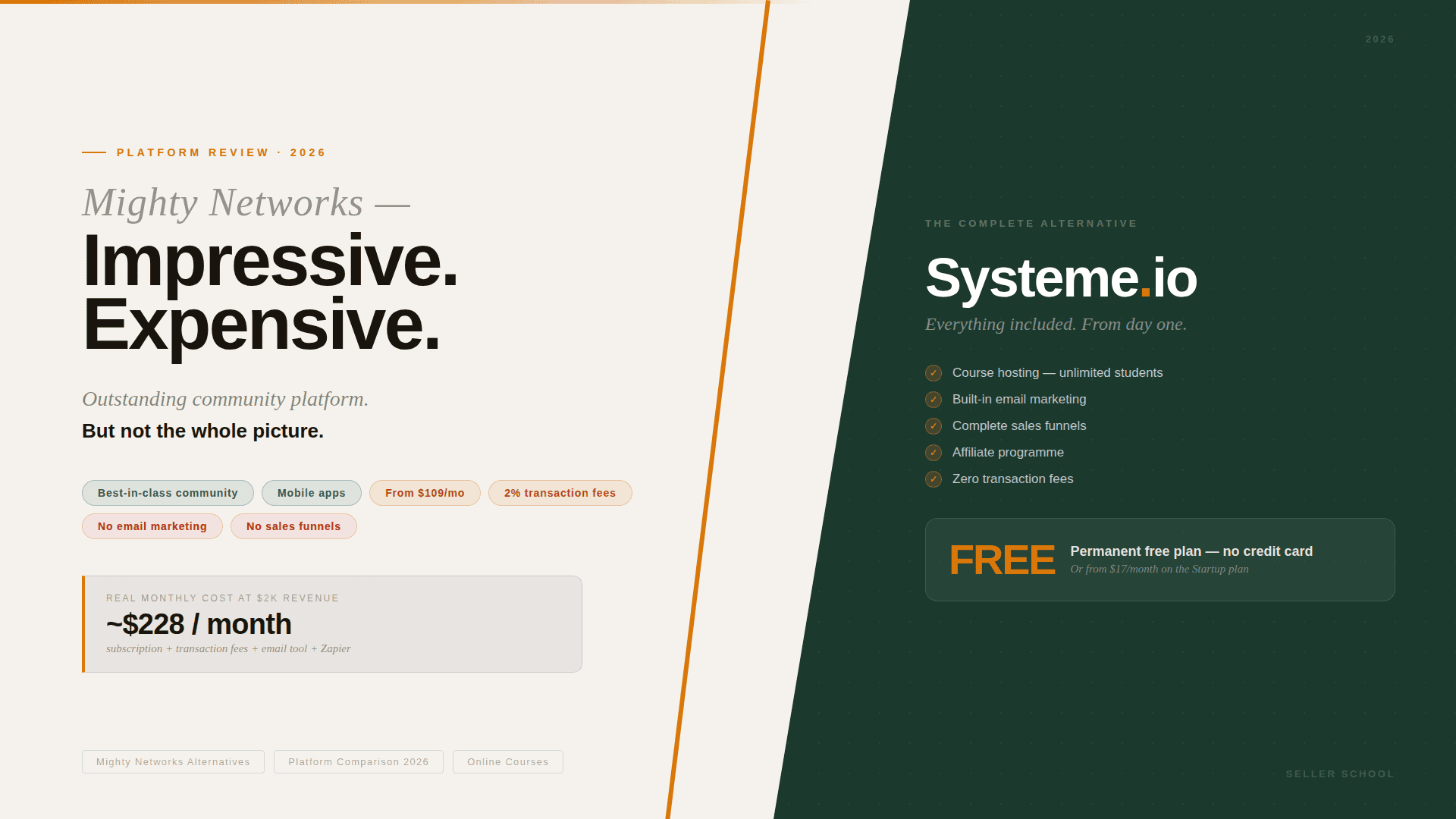
But there's a side of Circle that most glowing reviews don't lead with: a pricing structure with transaction fees stacked on top of already significant monthly costs, a course builder that's only available from the $89/month Professional plan upwards, no email marketing on any plan, no sales funnel tools, and the kind of complexity that can make setup genuinely overwhelming for new creators.
That combination — impressive community features, layered fees, and missing infrastructure — is worth understanding clearly before you commit. I've spent years using and paying for course and community platforms. This review gives you the honest picture: what Circle does well, where it falls short for new course creators and coaches, and why a free Systeme.io account might be a smarter starting point.
What Is Circle.so?
Circle was founded in 2020 and has grown rapidly on a clear positioning: a professional, branded, distraction-free alternative to Facebook Groups and Discord for creators and businesses who want to run paid communities. By 2026, it serves over 17,000 creators and hosts communities for names including Pat Flynn, Ali Abdaal, and Jay Shetty — which gives you a sense of both its quality ceiling and the audience it's primarily designed for.
The platform's Spaces feature — flexible community sections that can be configured as discussion forums, course modules, event calendars, group chats, or knowledge bases — is the centrepiece of what makes Circle distinctive. You can structure your community in a way that serves how your members actually want to engage, rather than forcing everyone into a single feed.
Circle has also added courses, live rooms, events, workflows (automation), and payment tools over time, making it a more complete product than it was at launch. And for an established creator with an active audience, the member experience it delivers is genuinely polished.
The challenge, as we'll get into, is what it costs to access those features and what's still missing for a creator who needs a complete business infrastructure — not just a great community platform.
What Circle.so Actually Costs in 2026
Circle's pricing in 2026 starts at $89/month on annual billing for the Professional plan — their entry-level plan for serious use. Here's the full tier structure:
- Professional — $89/month (annual): Core community features, courses, events, memberships, unlimited members, 200GB storage. Includes a 2% transaction fee on every sale through Circle's payment system.
- Business — $199/month (annual): Unlimited workflows and automations, API access, deeper customisation, higher storage. Includes a 1% transaction fee.
- Enterprise — $419/month (annual): AI agents, advanced analytics, priority support, dedicated customer success. Includes a 0.5% transaction fee.
- Circle Plus — Custom pricing: Fully branded mobile apps, done-for-you launch support. Requires a sales conversation.
The Transaction Fees: The Number Nobody Highlights
Every Circle plan charges transaction fees — and these are in addition to Stripe's standard processing fee of 2.9% + $0.30 per transaction. That means on the Professional plan ($89/month), every sale you make costs you 2% to Circle plus 2.9% + $0.30 to Stripe. On a $200 course sale, that's $4.00 to Circle plus $6.10 to Stripe — $10.10 in processing costs before any platform subscription fee.
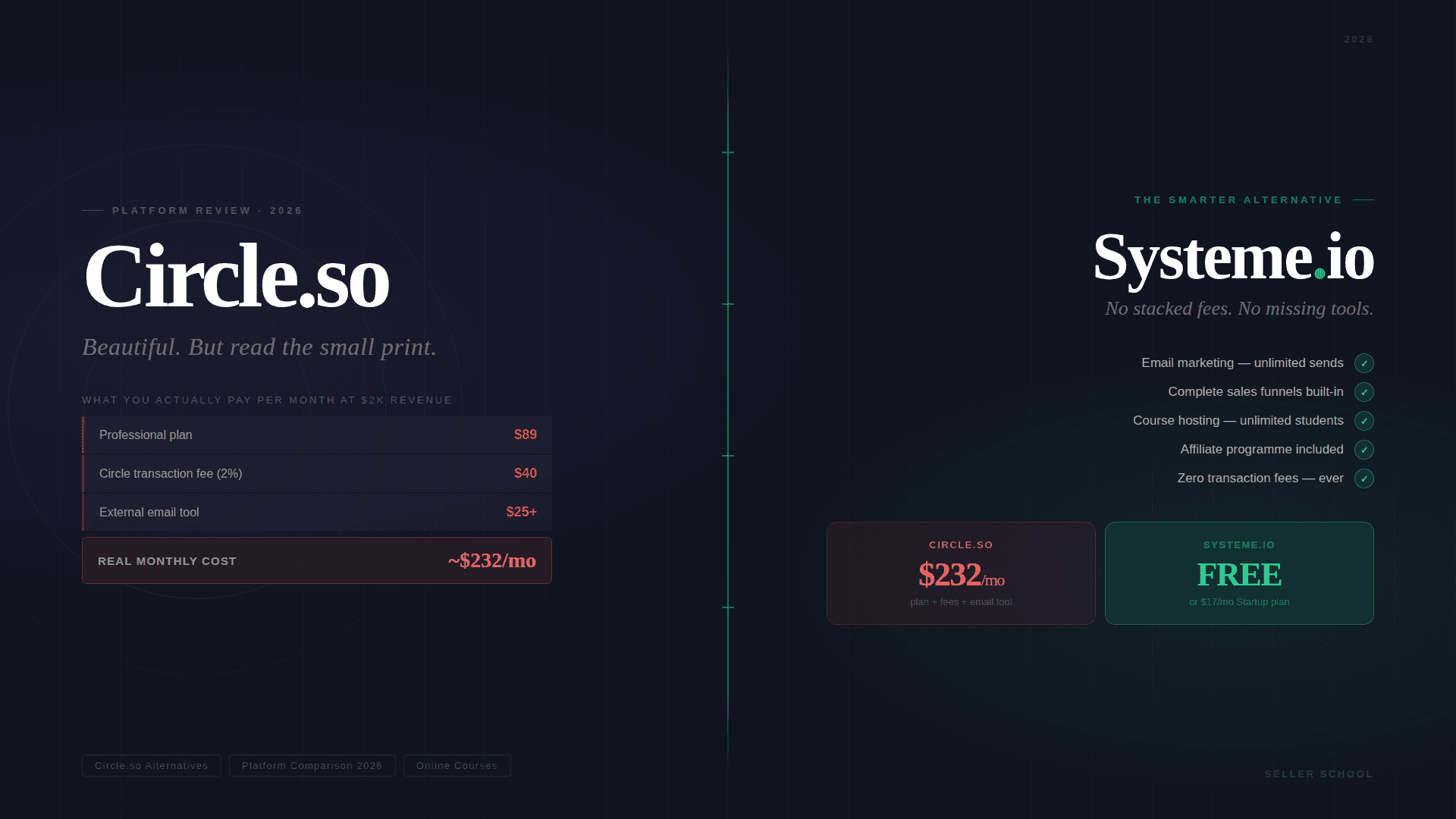
At $2,000/month in course and membership sales on the Professional plan, you pay $89 subscription + $40 in Circle fees (2%) + approximately $78 in Stripe fees = $207/month in platform-related costs. Add a separate email marketing tool (essential, as Circle has none) and you're looking at $230–$280/month for infrastructure that still doesn't include funnels or affiliate management.
The Basic plan — now discontinued for new signups in many markets — charged a 4% transaction fee on top of Stripe. The direction of travel for Circle's pricing has been steadily upward.
No Free Plan
Circle offers a 14-day free trial on all plans, with no credit card required for the trial. There is no permanent free tier. Once the trial ends, you pay or lose access.
What Circle.so Does Well
The Community Experience Is Genuinely Excellent
Spaces — Circle's core feature — are highly flexible. You can build a community with separate spaces for course content, discussions, live events, group chats, and knowledge bases, each configured differently to match how that content should be consumed. It's significantly more structured and professional than a Facebook Group, and more customisable in terms of information architecture than most competing platforms.
The member experience is clean, distraction-free, and designed to feel like a professional branded environment rather than a generic social platform. For creators whose community is the centrepiece of their value offering, Circle delivers one of the best member-facing experiences available.
Workflows and Automation on Higher Plans
The Business plan and above unlock Circle's workflow builder — a visual automation tool that lets you trigger actions based on member behaviour: new signups, course completions, purchases, or inactivity. For established creators managing large communities with complex onboarding flows, this is a genuine differentiator. It's worth noting, however, that this functionality is locked behind the $199/month plan — not available on the Professional tier.
Live Rooms and Events
Circle includes native live streaming, live rooms for small group sessions, and event management. These integrate directly with the community experience, making it easier to run cohort-based programmes, live Q&As, and group coaching calls without leaving the platform.
Clean Branding and Professional Appearance
The platform's design is notably cleaner and more professional-looking than many community alternatives. Creators who care about how their community reflects on their brand will find Circle's default aesthetic more polished than Skool, Mighty Networks, or most other competitors.
Where Circle.so Falls Short for New Course Creators
No Email Marketing on Any Plan
Circle does not include email marketing as a native feature on any standard plan. There is no broadcast tool, no automated email sequences, no drip campaigns, no list management built into the platform itself. Circle does have an add-on email feature for communicating with community members — but this is distinct from a full email marketing system and is not designed for audience building, lead nurturing, or sales campaigns.
For a new creator who needs to grow an email list, nurture cold traffic into warm leads, and convert subscribers into buyers — which describes most people starting out — Circle provides none of the infrastructure to do this. You need a separate email tool, which adds cost and complexity from day one.
No Sales Funnel Builder
Circle is not a website. It is not a funnel builder. There are no opt-in landing pages, no multi-step sales funnels, no checkout pages with upsells and order bumps, and no native affiliate management. To convert cold traffic into community members and paying students, you need a separate website and funnel tool.
Multiple independent reviewers confirm this gap explicitly: creators need website hosting, a funnel builder, and an email platform alongside Circle to run a complete business. The impressive community experience Circle delivers is only half of what a new creator needs.
Transaction Fees on Every Plan — Compounding at Scale
The 2% fee on Circle's Professional plan (the one most new creators would start on) compounds in a way that's easy to underestimate when you're signing up. On $1,000/month in sales, that's $20 on top of Stripe's fees. On $5,000/month, it's $100 — every month, forever, on top of your $89 subscription. These fees decrease on higher plans but they never disappear, even at $419/month on the Enterprise tier. Systeme.io charges zero transaction fees on every plan, including the free tier.
Courses Only Available from the Professional Plan
Circle's course builder is only accessible from the Professional plan at $89/month. On lower plans, you cannot create structured courses with lessons and modules. For a new creator whose primary product is a course rather than a community, the fact that basic course functionality requires a minimum $89/month subscription is a significant constraint.
Even on the plans that do include courses, independent reviewers describe the course builder as limited compared to dedicated course platforms — particularly around completion tracking, interactive elements, and structured learning paths.
Complexity and Overwhelming Setup
Circle's flexibility is also its complexity. Multiple user reviews describe the initial setup as overwhelming — the sheer number of Space types, permission configurations, membership tier options, and workflow settings create a significant decision burden before you've published a single lesson. For a new creator who wants to get their first course live and generating revenue quickly, this is time that isn't being spent on content or marketing.
Limited Customisation Within the Structure
Despite the visual cleanliness of Circle's interface, users report significant limitations on deeper customisation — the ability to change layouts, reorder profile fields, or significantly alter the visual identity of their community beyond logos and colour accents. For creators who want their community space to feel fully and distinctively branded, Circle's constraints become apparent quickly.
Technical Performance and Occasional Outages
User reviews across Trustpilot and independent sources flag two recurring technical concerns: occasional slow loading speeds (described by some users as a materially degraded experience), and erratic behaviour when scrolling through feeds — pages jumping position unexpectedly. StatusGator has also recorded periodic outages of 15–45 minutes involving login issues or site loading failures. For a creator running a live event or time-sensitive launch through Circle, an outage is a significant risk.
The True Cost of Running a Business on Circle.so
Let's be concrete, because the headline price of $89/month tells only part of the story:
- Circle Professional plan: $89/month (annual billing)
- Email marketing tool (ConvertKit Starter for 1,000 subs): $25/month
- Funnel/website builder if needed: $17–$97/month (Systeme.io) or more for alternatives
- Circle transaction fee at $2,000/month revenue: $40/month
- Approximate total: $171–$251/month — before Stripe, before marketing spend
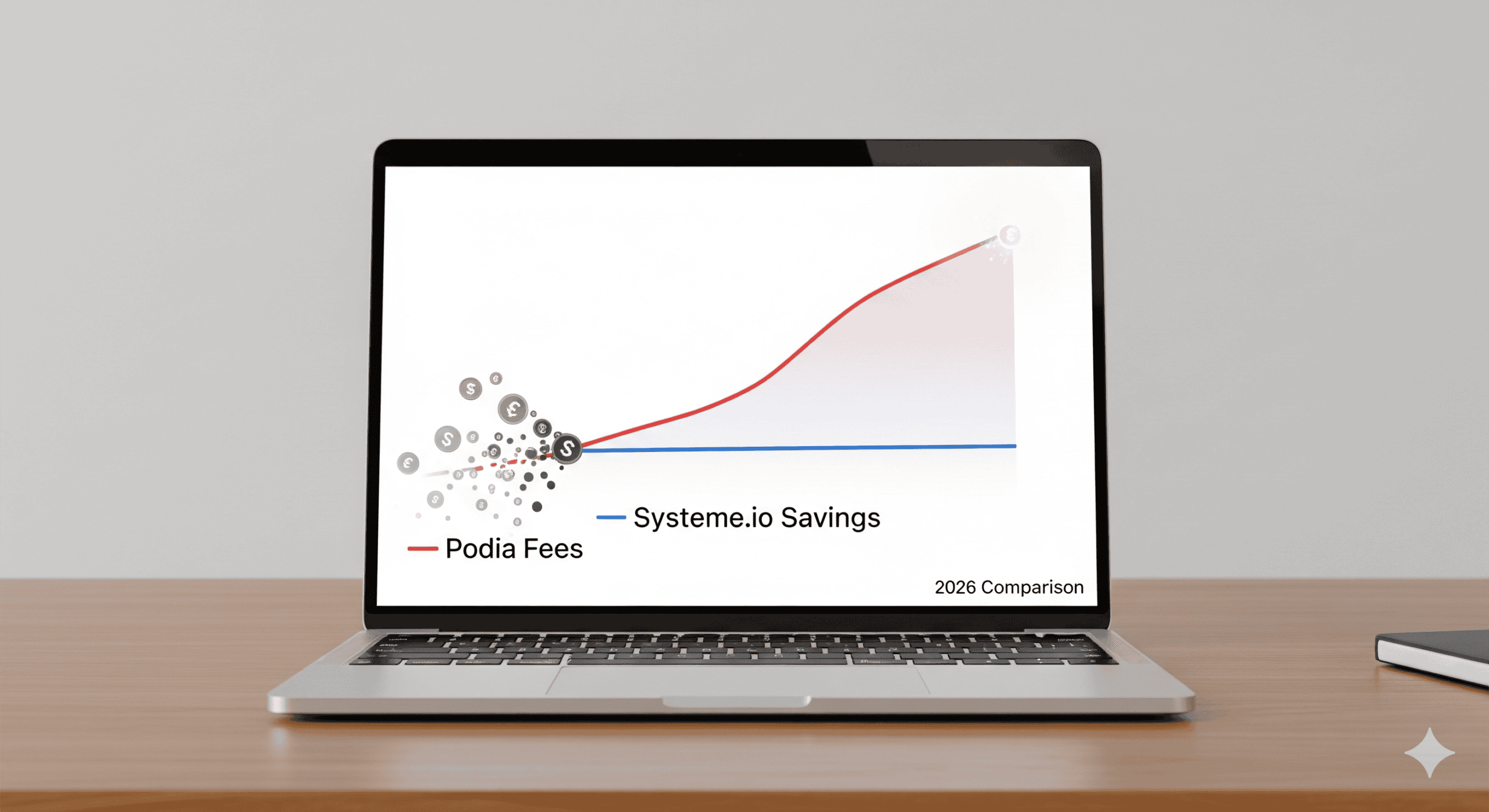
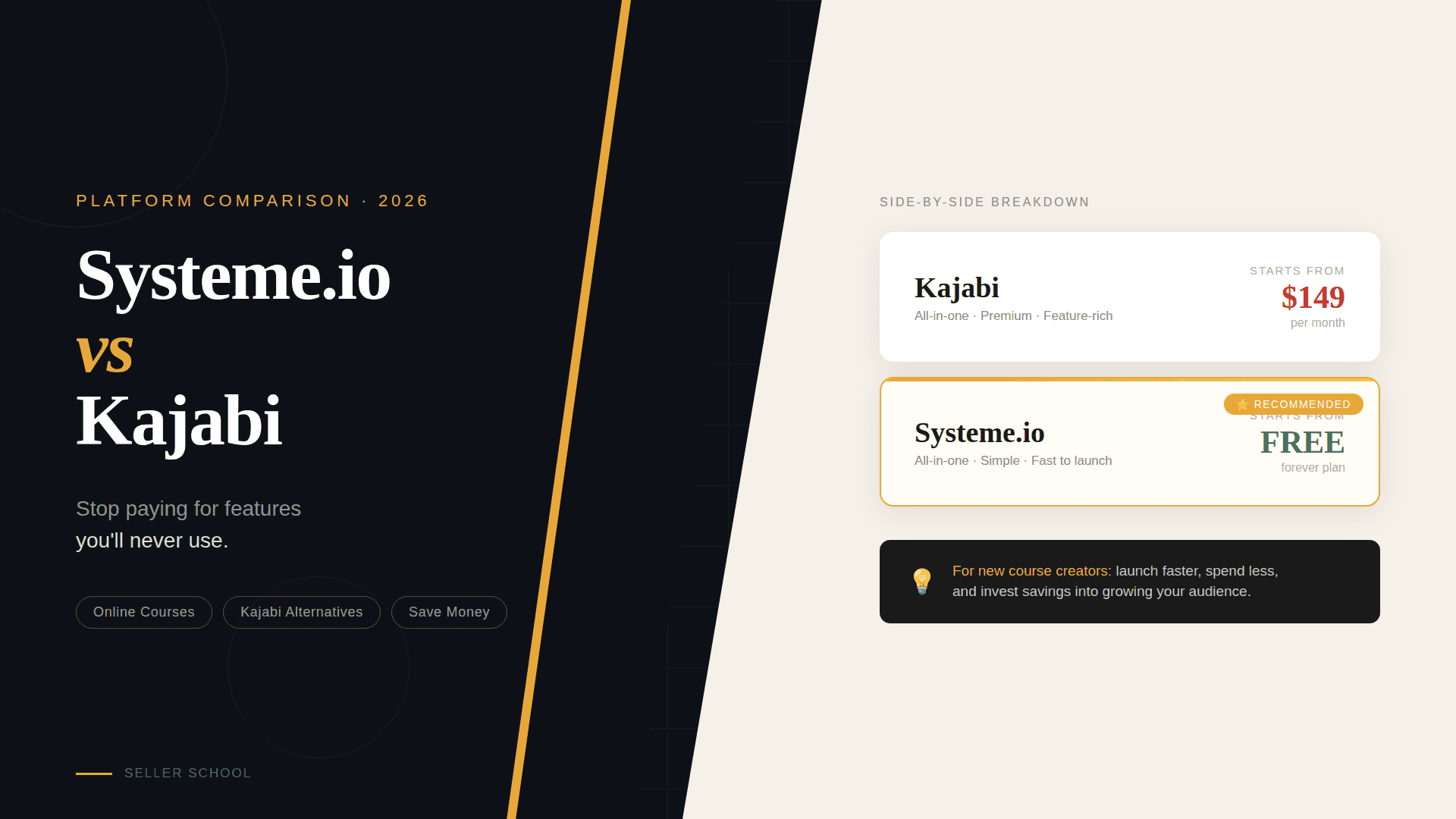
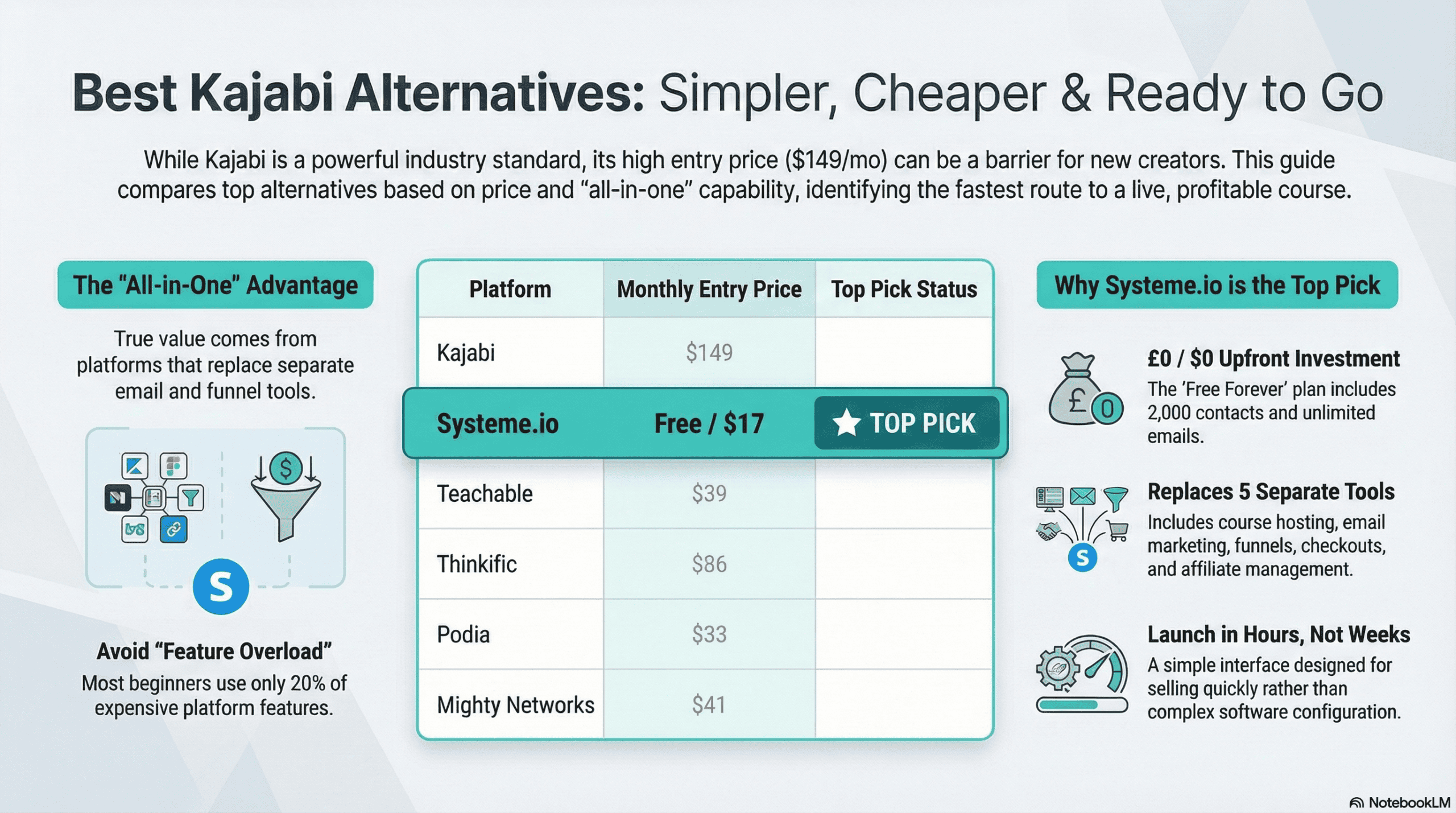
For comparison, Systeme.io's Startup plan at $17/month includes course hosting, unlimited email sends to 5,000 contacts, ten complete sales funnels with upsells and order bumps, an affiliate programme, and automation — with zero transaction fees. At the same $2,000/month revenue level, total platform cost is approximately $75/month (plan fee plus Stripe only). That's a saving of approximately $96–$176 per month — over $1,150–$2,100 per year.
Alternatives to Circle.so: Where Systeme.io Fits
When course creators and coaches search for alternatives to Circle.so, they typically want one of two things. Either they've encountered Circle's fee structure and want something more cost-effective, or they're in the research phase and realising that Circle's gaps — no email, no funnels — require infrastructure they'd rather build into their platform from the start.
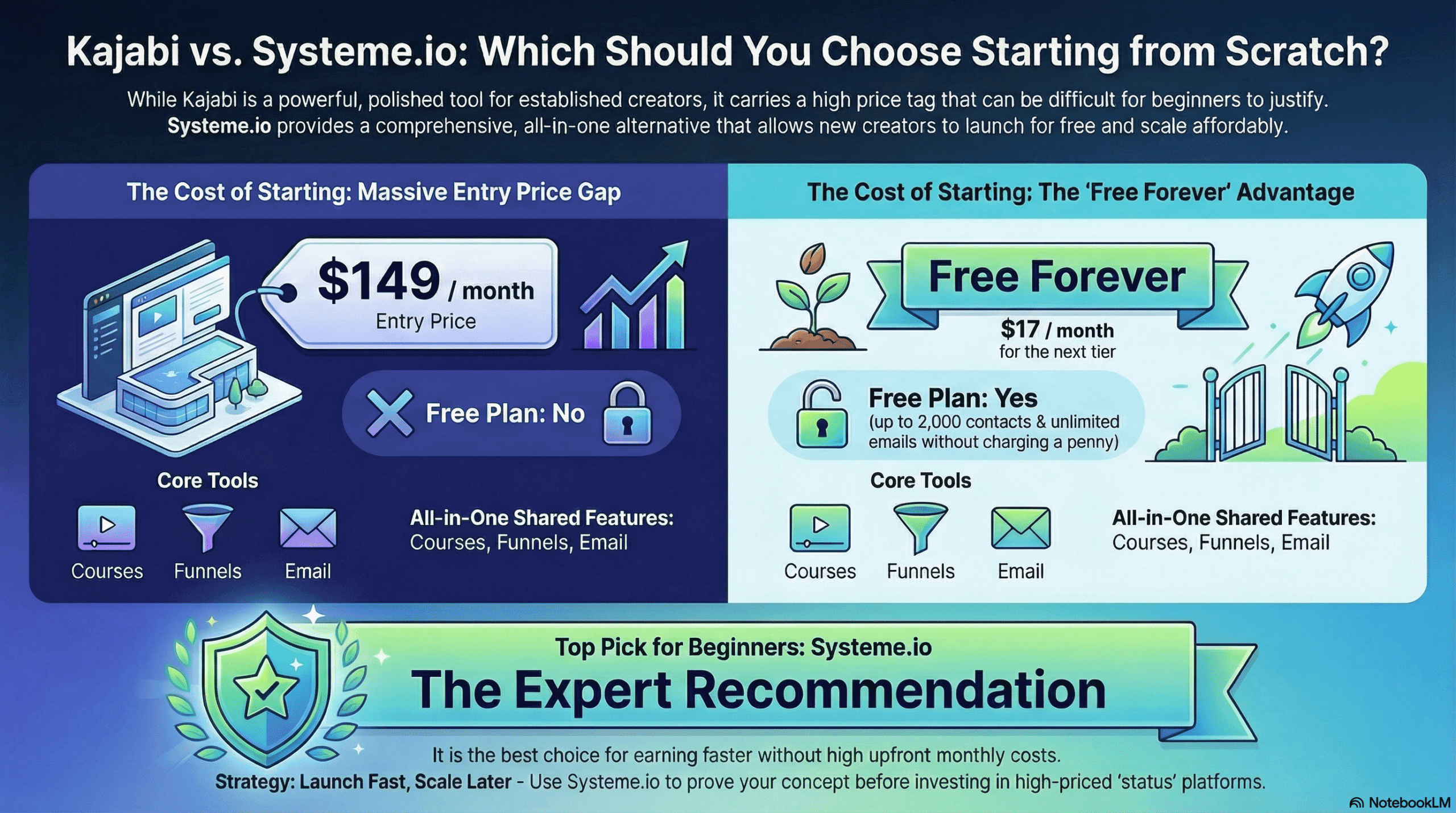
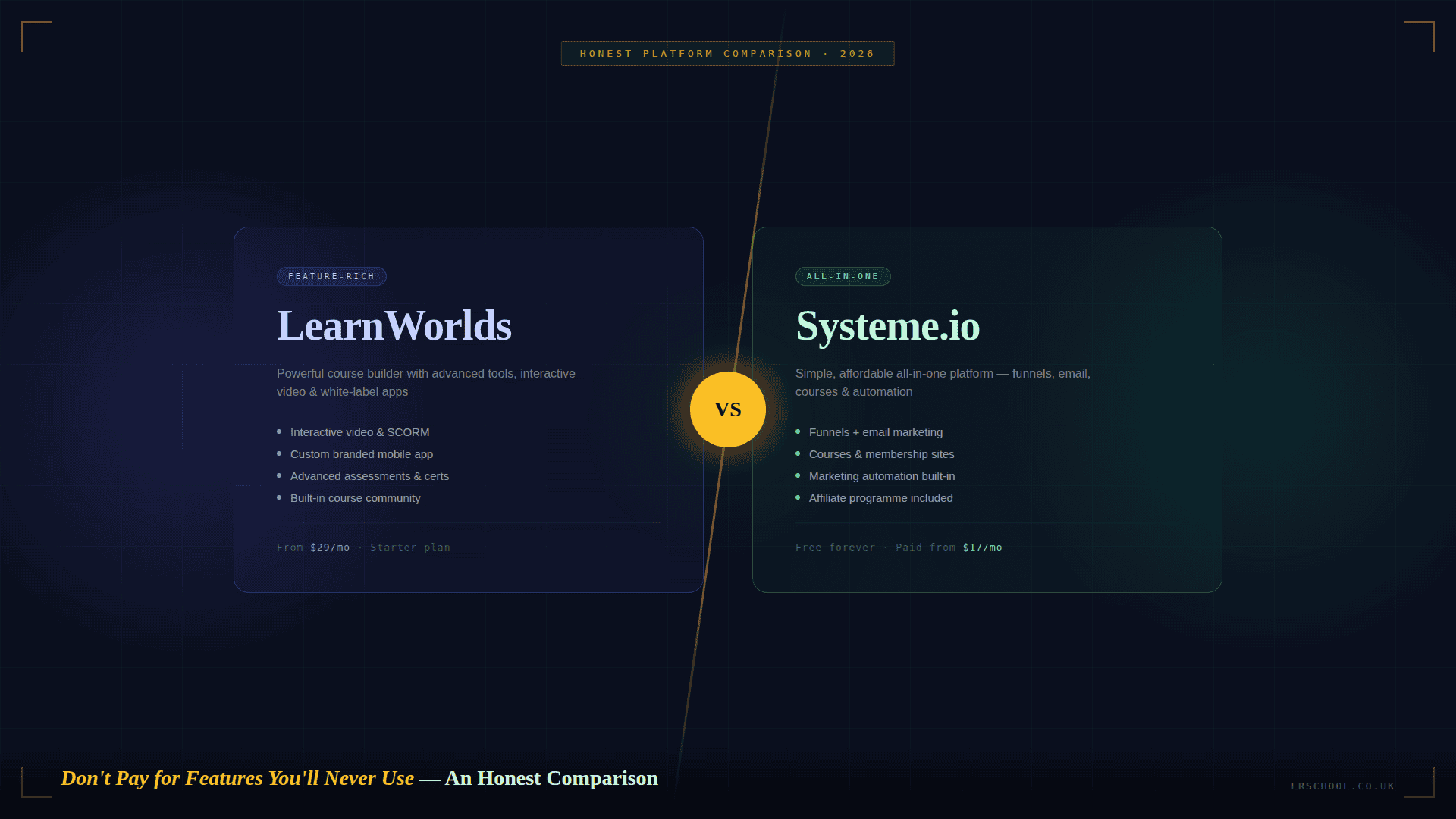
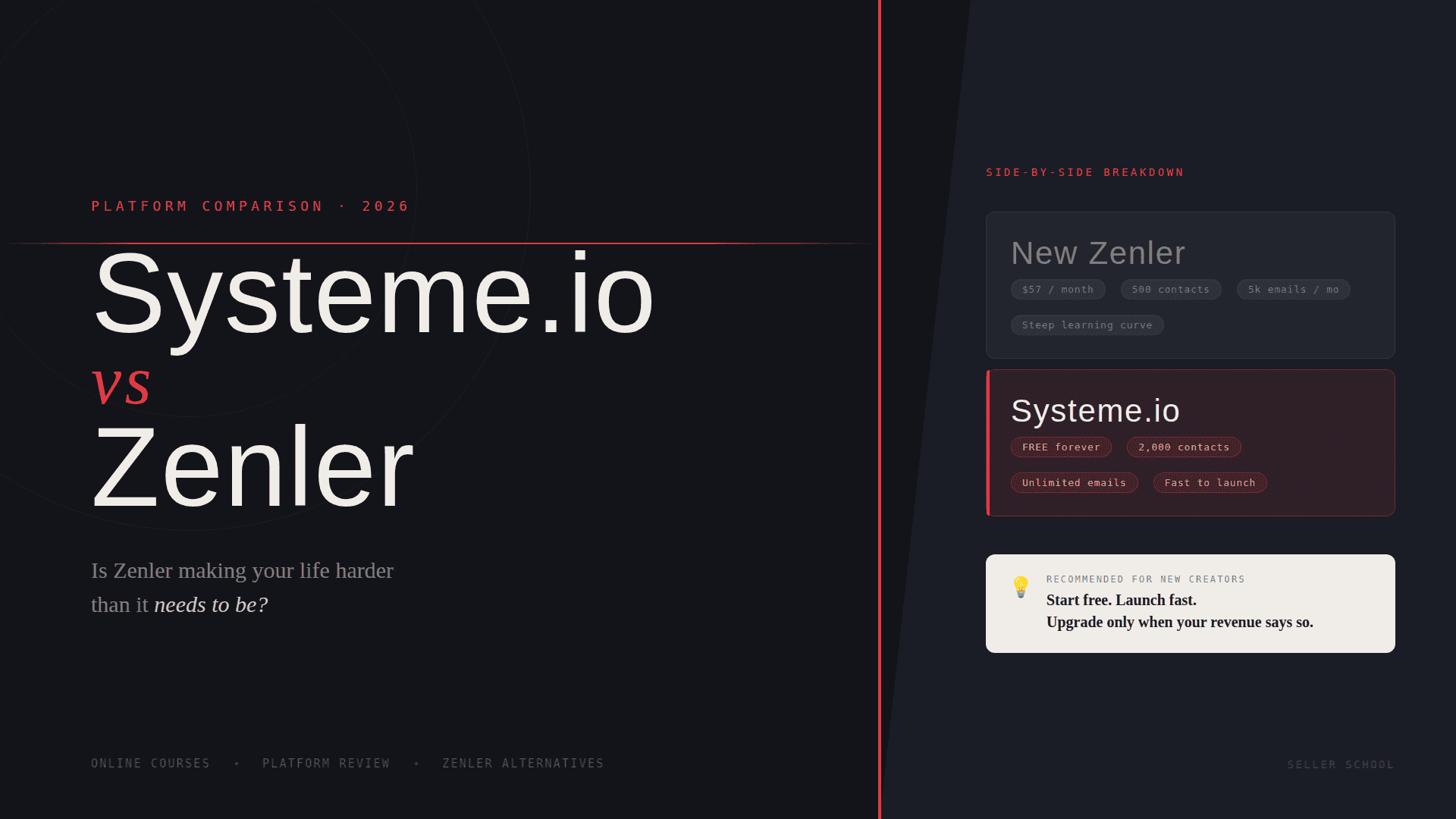
Systeme.io addresses both positions. It provides course hosting, email marketing, sales funnels, affiliate management, and automation within a single platform, starting at zero cost — no credit card, no expiry date, no 14-day trial clock.
The permanent free plan gives you: one course with unlimited students, 2,000 contacts, unlimited email sends, three complete sales funnels with opt-in pages, sales pages, order bumps, and one-click upsells, a full affiliate programme, and automation rules. The Startup plan at $17/month extends these limits substantially: five courses, 5,000 contacts, ten funnels, and ten automation rules. The Webinar plan adds evergreen webinars at $47/month. The Unlimited plan at $97/month removes all caps — and still includes zero transaction fees, which Circle charges on every plan up to and including its $419/month Enterprise tier.
Circle.so vs Systeme.io: The Honest Comparison
Community Features
Circle wins. Its Spaces system, clean member experience, and professional appearance create a community environment that Systeme.io's more basic community tools can't currently match. If a structured, professional, highly-engaged community is the centrepiece of your business model, Circle is the stronger tool for that specific function.
Email Marketing
Systeme.io wins entirely. Unlimited email sends, automated sequences, broadcast campaigns, list management, and tagging are all included from the free plan. Circle has no native email marketing capability on any plan — you pay separately for an external tool on every subscription tier.
Sales Funnels
Systeme.io wins entirely. Complete funnel building — opt-in page, sales page, checkout with upsell and order bump, thank-you page — is available from the free plan. Circle has no funnel building capability whatsoever. Bringing cold traffic through to a paying member requires a separate platform entirely.
Transaction Fees
Systeme.io charges zero platform transaction fees on every plan. Circle charges 2% on the Professional plan, 1% on Business, and 0.5% on Enterprise — on top of Stripe's standard fees. At any meaningful revenue level, this compounds into a significant ongoing cost differential.
Course Creation
Circle's course builder is only available from $89/month and is described by independent reviewers as relatively basic for structured learning. Systeme.io includes course creation from the free plan and is functional for self-paced programmes. Neither is as feature-deep as dedicated LMS platforms, but Systeme.io is available at a fraction of the entry cost.
Total Cost for a Complete Business
Systeme.io wins substantially. Systeme.io at $17/month provides what Circle requires $89/month plus external email tools to begin replicating. The annual saving for a creator at $2,000/month in revenue is over $1,150 — and that gap widens as revenue grows because of Circle's compounding transaction fees.
The Mistakes New Creators Make When Choosing a Platform
1. Choosing a community platform when what you actually need is a business platform.
Circle is excellent at community. It is not excellent at selling courses to cold audiences, building email lists, or automating sales funnels. If you don't yet have an audience to bring into a community, you need tools to build one first. Circle can't help with that.
2. Ignoring the transaction fees in total cost calculations.
A 2% Circle fee is invisible when you're not yet generating revenue. Once you are, it compounds every month. On $3,000/month in sales, that's $60 per month going to Circle on top of your subscription and Stripe's fees — before you've spent a penny on marketing.
3. Treating the 14-day trial as sufficient to evaluate a platform.
Fourteen days is enough to explore a dashboard. It's rarely enough to build a course, launch it, run an email campaign, and see how the platform performs under real conditions. Test platforms with real workflows, not just idle browsing.
4. Buying the vision rather than the present reality.
Circle's marketing — featuring big-name creators, premium design, and ambitious positioning — sells a vision of what your business could look like. That vision is real, for established creators with existing audiences. For someone starting from scratch, that same $89/month plus fees and external tools is a significant overhead before you've validated whether your course sells at all.
The Most Useful Next Step
If you're considering Circle and wondering whether the cost, the missing email and funnel tools, and the complexity are going to work for your business — the lowest-risk thing you can do is test the alternative at no cost.
Systeme.io's free plan is permanent. There is no trial countdown, no credit card required, and no feature restrictions that prevent you from building something real. You can create your first course, build a complete funnel, set up an email sequence, run an affiliate programme, and connect your payment processor — all before spending a single pound or dollar.
Sign up for your free Systeme.io account here: https://iosysteme.com. Permanent free plan. No credit card required.
And if you'd like a broader comparison of all the main platforms — Circle.so, Systeme.io, Kajabi, Skool, Mighty Networks, Teachable, Thinkific, Kartra, and Zenler — I've put together a free guide for course creators and coaches that covers what each platform is genuinely suited for, the real total cost at each stage of your business, and how to make the right decision without the expensive guesswork. The guide is available below this article.
Circle.so is a genuinely impressive platform for what it was designed to do. For an established creator with a large audience, a budget for the full infrastructure it requires, and community-led learning at the heart of their offer — it earns its reputation. For a course creator or coach who is starting from scratch, needs to build an audience, and wants a complete business infrastructure without compounding fees and separate tools — there is a more practical starting point. Test it first, at zero cost, before the monthly billing starts.
About the author: This article is based on hands-on experience building and running online businesses across multiple platforms over several years. Pricing figures are sourced from Circle.so's published pricing page and independent reviews current as of early 2026.