There's a reason Thinkific has built a loyal following among course creators. The platform is genuinely good at what it was designed to do: help you build a well-structured, professionally delivered online course. The course builder is solid. The student experience is clean. The onboarding is friendlier than most.
But here's the thing that nobody tends to tell you before you sign up: Thinkific was built primarily as a learning management system, not as a complete business-building tool. And those two things are not the same.
If your goal is to create an excellent learning experience and you have a separate email marketing tool, a separate funnel builder, a separate checkout system, and the budget to knit them all together with integrations, Thinkific can work well. But if you're a course creator or coach who needs one platform that handles everything — creating your course, selling it, following up with leads, and running your marketing — Thinkific leaves meaningful gaps that will cost you time, money, or both.
I've spent years working with platforms across the full spectrum of the course creator world. I've paid for tools that turned out to be the wrong fit. I've built on platforms that sounded perfect and revealed their limitations only after I was already committed. This comparison is written from that experience — aimed at creators who want to make a smart decision the first time, not an expensive one.
The Core Problem: How Thinkific Thinks About Your Business
Thinkific's philosophy, at its root, is that course delivery is the product. Everything else — marketing, sales, email, automation — can be handled by third-party tools that plug in via Zapier or the Thinkific App Store. The platform's job is to give your students a great learning experience.
For some creators — particularly those who already have an email list, an existing audience, and familiarity with building marketing systems — that philosophy works fine. They can build the missing pieces around Thinkific and end up with a competent, if complex, business setup.
For most new creators, though, it's a problem. They don't have a separate email marketing tool. They don't know how to build a funnel. They've never run an affiliate programme. And they don't have the budget — or the time — to figure out which third-party tools to buy, how to make them talk to each other, and what to do when the connection breaks.
The honest answer to 'how to host an online course' isn't just 'pick a platform and upload your videos.' It's 'pick a platform that handles the full cycle of your business, so you can focus on creating and delivering great content.' That distinction matters enormously for beginners, and it's where the Thinkific vs Systeme.io comparison becomes very clear.
What Is Thinkific? The Strengths and the Gaps
Thinkific launched in 2012 and has since built a substantial user base — over 50,000 course creators across 165 countries, by their own figures. It's a well-funded, professional platform with a strong track record in the LMS space.
What Thinkific Does Well
The course creation experience is genuinely strong. The drag-and-drop builder supports video, audio, PDF, text, quizzes, and live events. Drip scheduling, course completion certificates, and student progress tracking are all well-implemented. The student-facing interface is clean and professional. If you want to build a well-structured course that delivers a genuinely good learning experience, Thinkific has the tools for it.
The platform also has a reasonable community feature — though it's locked behind the higher-tier plans and has drawn criticism for limited customisation. And in 2024, Thinkific added its own basic email marketing feature, which begins to address one of the longer-standing complaints about the platform.
Where Thinkific Falls Short for New Creators
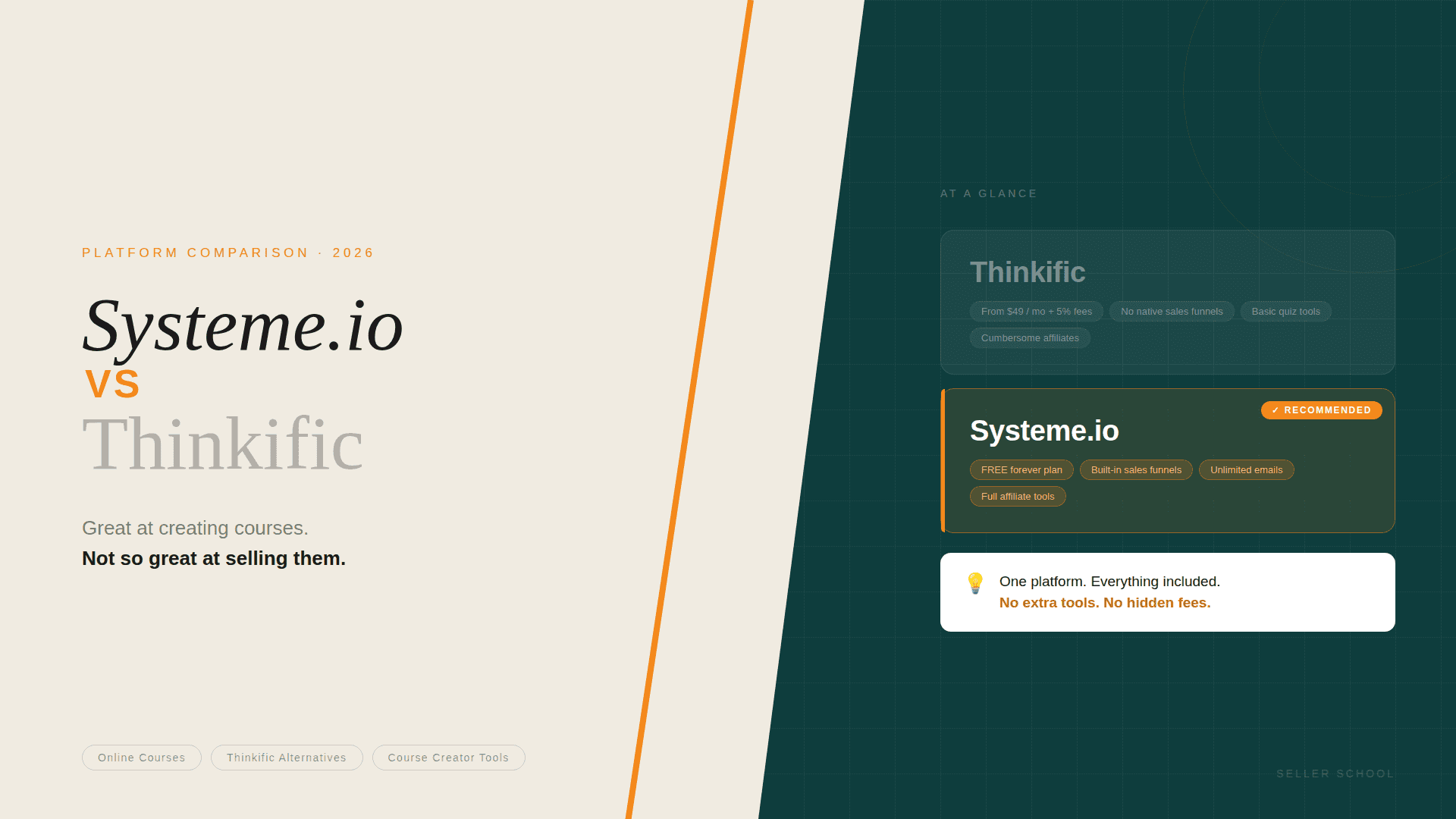
The marketing gap is real and persistent. Despite the addition of email marketing, Thinkific still doesn't have a native sales funnel builder. There's no built-in landing page editor designed around converting visitors into buyers, no upsell or order bump functionality in the checkout flow, and no way to build the kind of sequential opt-in-to-sales sequence that most creators need to sell to a cold audience. For all of that, you still need third-party tools.
The affiliate management system has been a recurring source of frustration. Multiple users across Capterra and G2 describe it as cumbersome — requiring individual commission approvals, lacking intuitive reporting, and being generally slow to work with. For a creator who wants affiliates to be a meaningful marketing channel, this is a real limitation.
Quiz functionality is basic by most assessments. Creators who need branching logic, scoring systems, or advanced assessment tools will find Thinkific's built-in quiz builder limited — and will need to look at third-party integrations to fill the gap.
Technical performance has been a consistent complaint in reviews, including recent ones from 2025 and early 2026. Slow page loads, video buffering on certain browsers, and intermittent issues with the course player are flagged by users on G2 and Capterra. These aren't catastrophic failures, but for a platform at this price point, they're more friction than creators should expect.
The Real Cost of Thinkific
Thinkific's pricing in 2026 runs as follows: the Basic plan is $49 per month (or $36 per month billed annually). The Start plan, which unlocks memberships, live lessons, and assignments, is $99 per month ($74 annually). The Grow plan — which you need to remove Thinkific branding, access advanced analytics, and manage multiple communities — is $199 per month ($149 annually).
There is a free plan, though as of 2026 it comes with significant restrictions — limiting you to one course and removing access to many of the features that make the platform useful. It's more a taster than a working business setup.
But the listed price isn't the full picture. Using your own payment processor (Stripe or PayPal) triggers additional transaction fees: 5% on the Basic plan, 2% on Start, and 1% on Grow. A creator earning $1,000 a month on the Basic plan pays an extra $50 in transaction fees alone — on top of the $49 subscription. For a branded mobile app, add another $199 per month. For Zapier automations to connect Thinkific to your email tool, add at least $20 per month. The costs compound quickly.
The headline price is only the beginning of the actual bill.
What Is Systeme.io? The Case for the Alternative
Systeme.io is a French-built all-in-one platform that has grown rapidly on the strength of a single compelling argument: everything you need to build and run a course business, starting completely free.
The free plan — a permanent account, not a time-limited trial — gives you three courses, 2,000 contacts, unlimited email sends, three full sales funnels with upsells and order bumps, an affiliate management programme, a website builder, and automation rules. Paid plans start at $17 per month for 5,000 contacts and five courses, rising to $97 per month for the Unlimited plan which removes all caps. All Systeme.io annual plans give subscribers two months free.
The design philosophy is the opposite of Thinkific's. Rather than building the best possible course delivery tool and leaving you to assemble the rest from third-party products, Systeme.io builds a complete business infrastructure that's intentionally straightforward — one interface, one subscription, all the pieces in place.
It won't have every advanced course feature Thinkific offers. But for the vast majority of new creators, it has every feature they'll actually use.
Systeme.io vs Thinkific: The Comparison That Matters
Course Creation and Delivery
Thinkific edges ahead on the course creation experience specifically. The course builder is more refined, the student portal is more polished, and for creators who want to build complex, multi-format courses with sophisticated assessment tools, Thinkific offers more native depth.
Systeme.io's course builder is clean and functional. You can create structured modules with video, text, PDF, and audio content. Drip scheduling works. Students get a clear, navigable course experience. For self-paced courses — which represent the vast majority of what new creators build — it does everything needed without fuss.
Verdict: Thinkific wins on course creation depth. Systeme.io covers the essentials completely adequately for most new creators.
Marketing, Funnels, and Sales
This is where the comparison becomes very one-sided. Thinkific has no native funnel builder. No upsells in the checkout flow. No order bumps. No built-in landing page editor optimised for conversion. Basic email marketing was added in 2024, but it doesn't replace a full marketing stack.
Systeme.io was built with funnels at its core. You can create an opt-in page, a sales page, a checkout with order bump and one-click upsell, and a post-purchase thank-you page in under an hour — all from one interface, on the free plan. The funnel builder is logical and template-driven, designed specifically for non-technical creators.
This matters enormously for someone trying to sell their first course. Getting traffic to convert into paying students requires a sales process — a way of moving someone from interested to committed. Without a funnel builder, you're improvising that process. With Systeme.io's built-in tools, you have a structured, proven path from day one.
Verdict: Systeme.io wins clearly and significantly. This is the central limitation of Thinkific for creators who don't already have a separate marketing stack.
Email Marketing and Automation
Thinkific's email marketing addition is a step forward, but it remains basic — designed primarily for student communication rather than audience building, nurturing, and conversion. To run sophisticated email sequences, you still need a third-party tool like ConvertKit, ActiveCampaign, or Mailchimp.
Systeme.io includes full email marketing and automation from the free plan. You can build multi-step sequences that trigger based on opt-ins, purchases, or custom tags. Broadcasts, automation rules, and contact management are all in one place. Unlimited sends are included on every plan, with no additional per-email charges.
For a new creator who's trying to build an email list and convert subscribers into buyers, the difference is significant — not just in cost, but in the complexity of having to manage separate tools.
Verdict: Systeme.io wins on email functionality as a complete marketing tool. Thinkific's email addition addresses student communication but not full audience marketing.
Affiliate Management
Thinkific includes affiliate management from the Basic plan, but the system is widely described as cumbersome — requiring manual individual commission approvals, offering limited reporting, and being generally slow to work with for creators who want affiliates to be a meaningful revenue channel.
Systeme.io includes a full affiliate management programme even on the free plan. Affiliates can be set up with custom commission rates, tracking links are generated automatically, and commission management is considerably less manual. For a creator who wants to build an affiliate network as part of their growth strategy, Systeme.io's system is more practical from the start.
Verdict: Systeme.io wins on affiliate management practicality.
Pricing, Value, and Real Cost
A creator on Thinkific's Basic plan at $49 per month, using Stripe, earning $2,000 in monthly course sales, would pay: $49 platform fee, $100 in transaction fees (5%), plus whatever they spend on a separate email tool and funnel builder. Before marketing costs, that's potentially $169 or more per month for an incomplete setup.
The same creator on Systeme.io's Startup plan at $17 per month gets their course hosting, email marketing, sales funnels, upsells, order bumps, and affiliate management in one place. No transaction fees beyond standard payment processor rates. Total platform cost: $17 per month (or $14 per month if paid annually).
The value gap is stark. Systeme.io delivers more of what a new course business actually needs, for a fraction of the combined cost of Thinkific plus the third-party tools required to fill its gaps.
Verdict: Systeme.io wins decisively on overall value and total cost of ownership.
The Mistake Most Creators Make — and How to Avoid It
The single biggest mistake I see course creators make when choosing a platform is letting the quality of the course delivery experience override every other consideration.
It makes a kind of intuitive sense. You're building a course. The course platform should be great at delivering courses. So you pick the platform with the best course delivery.
But here's the reality: your students are not choosing your course because of the platform it's delivered on. They're buying it because of the problem it solves, the transformation it promises, and the trust they have in you as the person teaching it. A slightly less polished course player is irrelevant to that decision.
What does matter — and what directly affects whether you actually reach those students in the first place — is whether you can get your sales process up and running quickly, convert interested visitors into buyers, follow up with people who didn't buy on the first visit, and do all of it without needing a degree in marketing automation.
Platforms like Thinkific are built to impress you at the course creation stage. Systeme.io is built to support the full arc from first impression to completed purchase and beyond. For a new creator who hasn't yet made their first $10,000, that distinction matters more than any course builder feature.
Other Common Platform Mistakes Worth Naming
1. Paying for annual plans before proving your concept.
Thinkific's annual plans offer meaningful discounts — but committing to a year's subscription before you've sold your first course is a bet on an untested idea. Start monthly, prove the concept, then consider locking in a lower annual rate once you have paying students.
2. Treating platform-switching as catastrophic.
Many creators stay on the wrong platform too long because moving feels overwhelming. In practice, migrating a course from one platform to another is typically a few days of work — not a disaster. If your platform is costing you more than it's giving you, switching is a rational business decision.
3. Assuming you'll use advanced features eventually.
Every platform sells you on the features you might want in three years. Buy for where you are now. If you outgrow Systeme.io's free plan, you'll have the revenue to upgrade. If you pay for Thinkific's Grow plan from day one because you think you'll need it, you'll likely spend six months paying for things you're not using.
4. Underestimating the cost of tool fragmentation.
Using Thinkific plus a separate email tool plus a separate funnel builder isn't just a financial cost — it's a time cost and a complexity cost. Every additional tool has its own learning curve, its own integration to maintain, and its own failure points. Simplicity in your tech stack is a genuine competitive advantage when you're starting out.
5. Confusing product quality with platform quality.
A course built on a basic platform that genuinely helps students get results will outperform a beautifully designed course on a premium platform that doesn't actually deliver transformation. Invest your energy in the curriculum. The platform is just the vehicle.
Who Should Choose Which Platform?
Systeme.io makes more sense if:
- You're building your first or second course and haven't yet generated consistent revenue
- You need marketing tools, funnels, and email in the same place as your course hosting
- You want to keep costs as low as possible while you validate your course concept
- You've looked at Thinkific's pricing and the gaps concern you
- You want to get up and running quickly without building a tech stack from multiple tools
Thinkific makes more sense if:
- You already have a working marketing stack — email tool, funnel builder, automation — and just need excellent course delivery
- You're building a sophisticated course with complex assessment requirements, certifications, or SCORM content
- You're an established creator with consistent revenue who can justify the cost and absorb the tool-fragmentation complexity
- Your audience expects a premium course player experience as part of what they're paying for
The Clearest Next Step
If you're still early in the research phase — comparing platforms, trying to figure out which one to commit to — I'd encourage you to do one concrete thing: sign up for a free Systeme.io account and actually build something in it.
Not a trial that expires. A free account that stays free. Build your first course. Set up a sales page. Create a basic email sequence. Run a checkout. See how it all connects. That practical experience will tell you more than any comparison article — including this one.
You can sign up for your free Systeme.io account here: https://iosysteme.com. No payment details required.
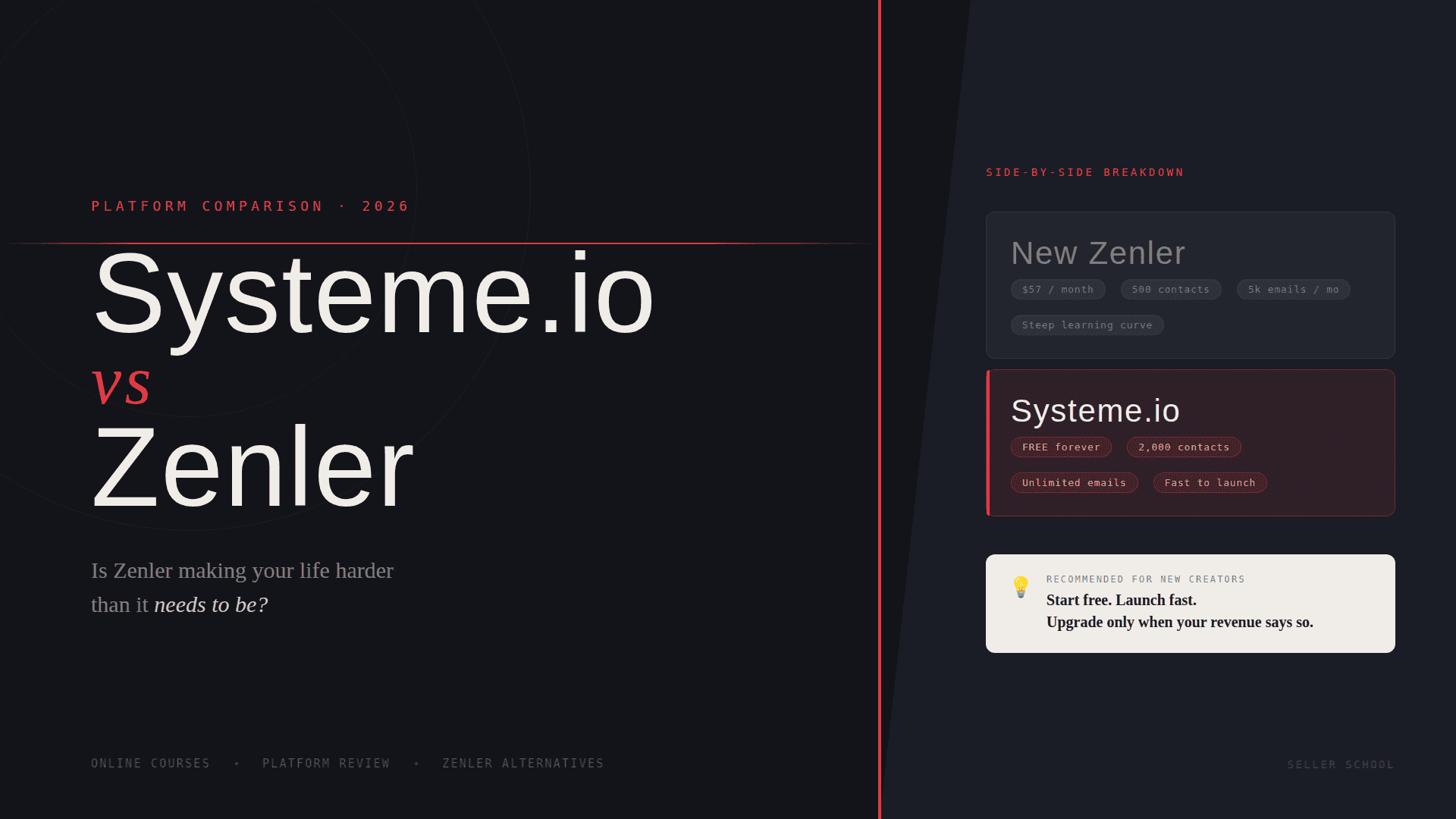
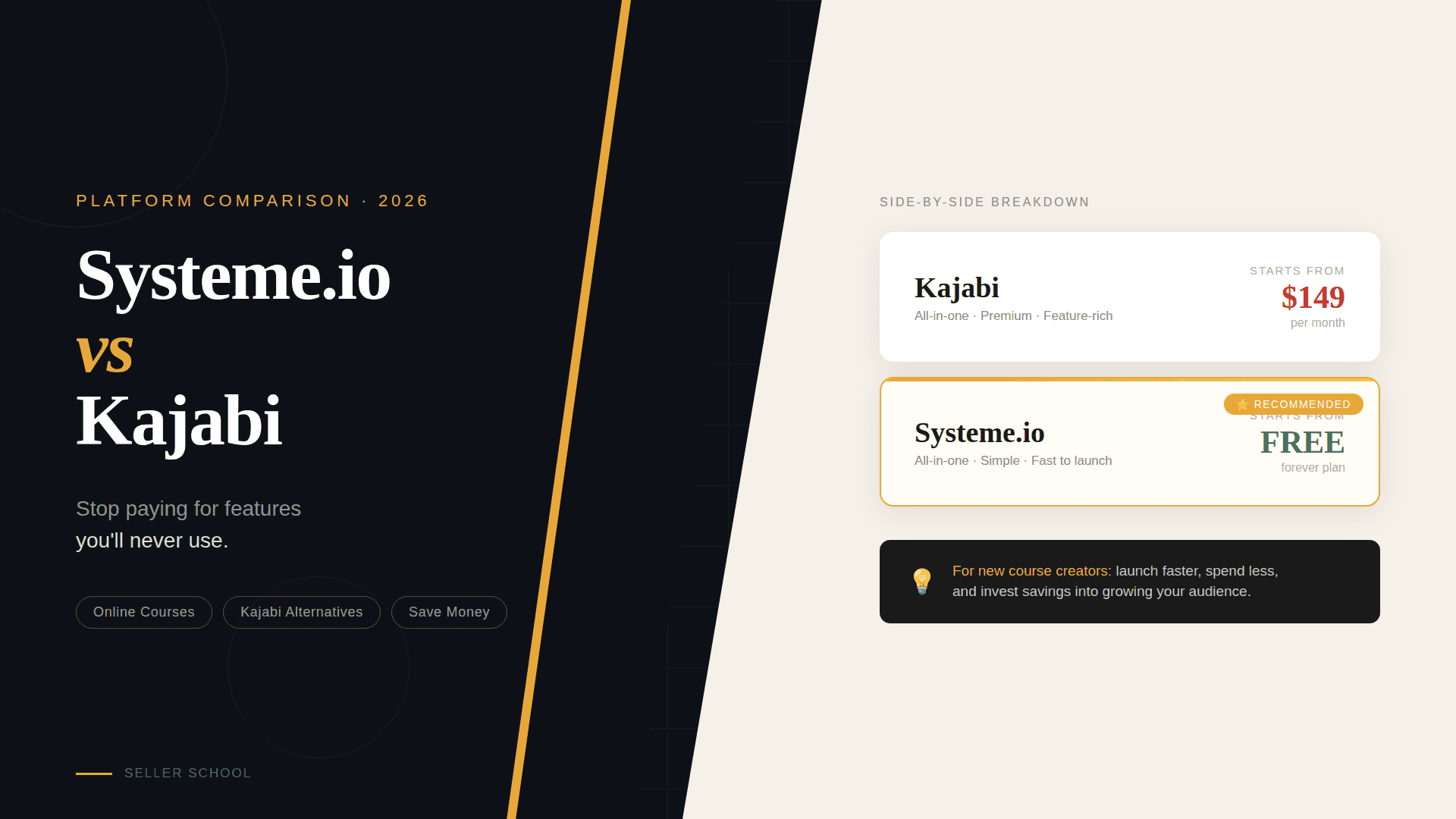
And if you'd like a broader guide that covers all the main platforms worth considering for course creators and coaches — Thinkific, Systeme.io, Kajabi, Zenler, Kartra, Teachable, and others — I've put together a free comparison resource that maps out what each platform is genuinely good for, who it suits, and what it really costs when you factor in everything. The free guide is available below this article.
The right platform is the one that removes obstacles between you and your students — not the one that adds them. Make the choice that gets you moving.
About the author: This article draws on several years of hands-on experience building and selling courses across multiple platforms, including Thinkific, Systeme.io, Kajabi, Zenler, and others. The goal is always the same: practical, honest guidance that helps course creators make smart decisions and avoid the expensive mistakes that slow them down.