Podia has built a well-deserved reputation as one of the friendlier course platforms on the market. It's genuinely easy to use, the interface is clean, and it brings courses, email, and digital products into one place without requiring a computer science degree to navigate. For a certain type of creator — someone selling simple products to a small audience — it's been a solid choice.
But here's the thing nobody tells you clearly enough when you're signing up: Podia's entry-level pricing is a trap with a ticking clock on it.
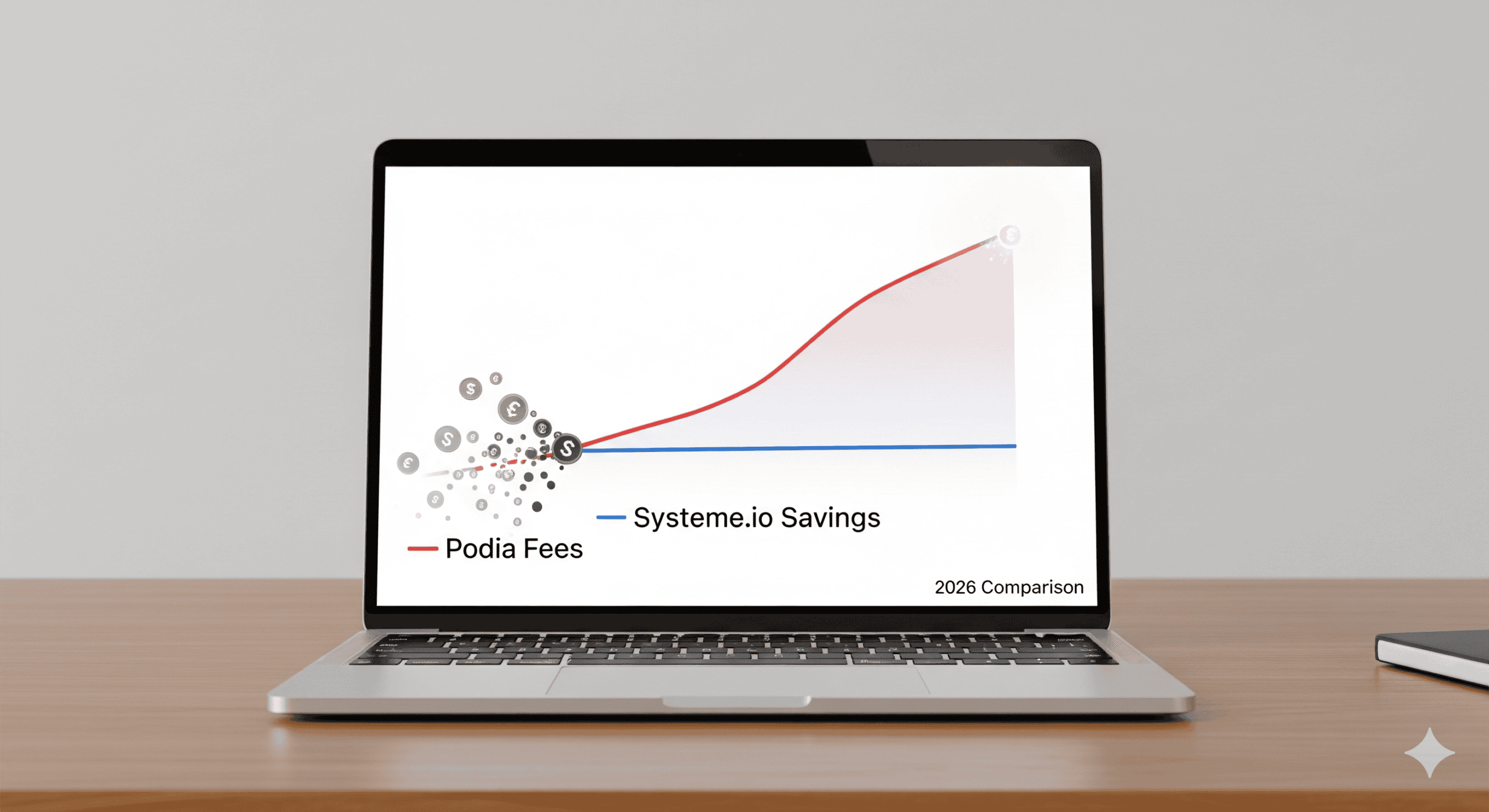
The Mover plan costs $39 per month. That sounds reasonable until you look at what's hiding inside: a 5% transaction fee on every sale. That means for every $100 course you sell, Podia takes $5 before Stripe takes their cut too. Sell $1,000 in a month and you're handing Podia $50 on top of your subscription fee. Sell $2,000 and that's $100. The fee compounds with your success, penalising you for doing well — until the pain of it forces you onto the $89/month Shaker plan just to make it stop.
Add to that the removal of Podia's free plan in late 2024, the locking of affiliate marketing behind the Shaker plan, the basic course features, the lack of any native sales funnel builder, and the email marketing that starts charging extra once you pass 100 subscribers — and you have a platform that looks straightforward on the surface but gets expensive in practice.
I've been using and paying for course platforms for years. This comparison is written from real experience, not from a features list on a sales page. Let's look at what Podia actually offers, where Systeme.io genuinely outperforms it, and help you decide which platform makes more sense for where your business is right now.
The Problem Nobody Solves for You: Platform Cost at Scale
Before getting into the platforms, I want to address something that most comparison articles skip entirely: the relationship between your platform choice and what you actually keep from your sales.
Most new course creators think about platform pricing in terms of the monthly subscription. They compare the headline numbers, pick the cheaper-looking one, and move on. What they don't think about — because nobody makes it obvious — is the effective cost per sale over time.
On Podia's Mover plan, every sale you make costs you 5% to Podia plus the standard 2.9% + $0.30 to Stripe. That's nearly 8% of every transaction gone before it reaches you, on top of the $39/month subscription. At $840 in monthly revenue, Podia's own breakeven calculator shows you'd actually save money by upgrading to the $89/month Shaker plan — because the fee savings exceed the plan cost difference.
In other words, on Podia's Mover plan, your success punishes you. The more you sell, the more the transaction fee costs you, and the more pressure you feel to upgrade to a plan that's more than double the price.
Systeme.io charges zero transaction fees on every plan, including the permanent free tier. From your very first sale on a $17/month Startup plan, you keep 100% of your revenue minus standard payment processor fees. That's a fundamentally different proposition.
What Podia Offers — An Honest Assessment
Podia is genuinely not a bad platform. I want to be fair about that. Here's where it earns its reputation:
Where Podia Works Well
- Simplicity and ease of use: Podia has one of the cleanest, most approachable interfaces of any course platform. Creators who are new to the space can build their first product quickly without getting lost in configuration. The design is uncluttered and the setup process is logical.
- Unlimited products on paid plans: Unlike Kajabi, which limits the number of products you can sell based on your tier, both Podia plans allow unlimited courses, coaching sessions, webinars, downloads, and bundles. This is a genuine strength and a meaningful differentiator from some more expensive competitors.
- Built-in email on both plans: Up to 100 subscribers, email is included free. For creators just starting out with a small list, this removes the need for a separate email tool — at least initially.
- Digital downloads and mixed products: Podia handles a mix of product types — courses alongside ebooks, templates, and workshops — particularly smoothly. If your business involves selling a variety of digital products rather than just structured courses, Podia's product management works well.
- No mobile app, but clean student experience: The student-facing course player is professional and distraction-free. Students can access content across devices through a browser, and the experience is polished.
Where Podia Genuinely Falls Short
- The transaction fee on the entry plan is a significant structural flaw. It's not a small administrative charge — it's a meaningful percentage of your revenue that scales with your success. For any creator who starts to gain traction, it creates pressure to upgrade to a plan at more than double the price, or accept an increasingly costly leak in their income.
- No native sales funnel builder. Podia has landing pages and sales pages, but it does not have a funnel builder in the way that Systeme.io does. You cannot build a sequential opt-in-to-sale-to-upsell sequence within Podia. For creators who want to actively convert cold traffic into customers — rather than just sell to an existing audience — this is a real limitation. You'd need a third-party tool, which adds cost and complexity.
- Affiliate marketing locked to the $89 plan. If you want affiliates to help you sell — a highly effective growth strategy for course creators with limited audiences — you need the Shaker plan. On a $39/month platform entry price, that's an abrupt jump to justify.
- Email marketing costs extra beyond 100 subscribers. The headline 'built-in email' is somewhat misleading once you grow past a tiny list. From 101 subscribers, you start paying an add-on fee that scales with list size — starting at $7/month. For a creator building a list of 2,000 or 5,000, this adds meaningful overhead that isn't visible in the plan price.
- Basic course features for structured learning. Podia's course builder is simple, which is great for beginners — but it doesn't support in-course exercises, practice assignments, or interactive learning activities. The quiz tool is multiple choice only. For creators whose course quality relies on students doing work and receiving feedback, these limitations matter.
- No free plan since October 2024. Podia removed its free plan in late 2024. New users get a 30-day free trial, but there's no permanent free account to test the platform risk-free. If you want to explore whether Podia fits before committing, you're on a clock from day one.
- No built-in automation funnels below the Shaker plan. Zapier actions — the ability to have other apps respond to Podia events — require the Shaker plan. Basic Zapier triggers are available on Mover, but for any kind of meaningful marketing automation, you're again looking at the $89/month tier or an external automation tool.
What Is Systeme.io and Why Does It Keep Coming Up?
Systeme.io is a French-built all-in-one platform founded in 2018, built on the premise that course creators were paying too much for too many fragmented tools. By 2026, it serves over 300,000 businesses globally and has consistently grown by offering substantially more functionality at significantly lower prices than its competitors.
The permanent free plan allows you to host one course, manage 2,000 contacts with unlimited email sends, build three complete sales funnels, run an affiliate programme, and build a basic website — all for nothing, with no expiry and no credit card required. The Startup plan costs $17 per month and extends those limits considerably. The Webinar plan is $47 per month, and the Unlimited plan is $97 per month — still less than Podia's Shaker plan.
Zero transaction fees apply on every plan, including the free tier.
Systeme.io vs Podia: The Comparison That Matters
Pricing and Transaction Fees
This is where the comparison is most clear-cut. Podia's Mover plan at $39/month plus a 5% transaction fee means your effective cost grows with every sale. Systeme.io's free plan costs nothing and takes no transaction fee. The Startup plan at $17/month — less than half Podia's entry price — also takes no transaction fee.
The real-world difference on $1,000 in monthly course sales: on Podia Mover, you pay $39 plan fee plus $50 in transaction fees plus Stripe fees — approximately $107 in total platform-related deductions. On Systeme.io Startup at $17/month, you pay $17 plus Stripe fees only — approximately $46. The saving is $61 per month, or over $730 per year, at that revenue level. As revenue grows, the gap widens.
Verdict: Systeme.io wins decisively on pricing at every level.
Sales Funnels and Marketing
Systeme.io was built with funnel-building at its core. From the free plan you can create complete opt-in funnels, sales funnels with order bumps and one-click upsells, and webinar funnels — all within the same platform, using the same templates and builder. This matters enormously for creators who don't yet have an established audience and need to convert cold traffic into paying students.
Podia does not have a native funnel builder. You can create individual landing pages and sales pages, but you cannot build a sequential marketing sequence within Podia. For creators who want to actively grow their audience and convert it — rather than simply hosting content for people who find them elsewhere — this is a meaningful functional gap.
Verdict: Systeme.io wins clearly. Podia is primarily a hosting and selling platform; Systeme.io is a complete marketing and selling infrastructure.
Email Marketing
Both platforms include email marketing, but with different structures. Podia includes email free for up to 100 subscribers, then charges extra on a sliding scale — a cost that grows with your list and can add meaningfully to your monthly bill once you have a few thousand subscribers.
Systeme.io includes unlimited email sends to all contacts on every plan. On the Startup plan at $17/month, you can email up to 5,000 contacts as many times as you like with no additional charges. On the Unlimited plan, there are no contact limits at all. Automation rules, sequences, and broadcast campaigns are all included within the plan price.
Verdict: Systeme.io wins on email value, particularly for creators with growing lists.
Affiliate Management
Systeme.io includes a full affiliate management programme on every plan, including the free tier. You can set up custom commission rates, generate tracking links, and manage payouts from day one, regardless of your subscription level.
Podia locks affiliate marketing behind the Shaker plan at $89/month. If you want affiliates as part of your growth strategy — and for most creators, they're an excellent low-cost acquisition channel — you're paying $89/month minimum on Podia. On Systeme.io, that functionality is free.
Verdict: Systeme.io wins. Affiliate tools included from the free plan vs locked behind an $89 tier on Podia.
Course Hosting and Delivery
Podia's course delivery experience is clean and professional. The student-facing interface is polished, and the content builder supports video, audio, PDF, text, and multiple-choice quizzes. What it lacks is depth: no in-course exercises or practice assignments, no interactive activities, and no support for structured cohort-based programmes with live components.
Systeme.io's course builder is functional and well-organised. It supports modules, lessons, drip scheduling, and varied content types. The student experience is clean and competent. Like Podia, it's better suited to self-paced content than to intensive live cohort programmes.
Verdict: Roughly comparable for self-paced courses. Podia has a marginally more polished student interface. Neither is ideal for complex interactive learning.
Ease of Use
Both platforms are genuinely accessible to beginners. Podia's interface is slightly more refined in its visual design — it feels a little cleaner and more curated. Systeme.io's interface is logical and functional, if slightly less polished aesthetically.
The key difference is scope: Podia's simplicity comes partly from doing fewer things. Systeme.io does more, which means there's slightly more to learn — but everything you learn is still within one platform, rather than across multiple tools.
Verdict: Podia has an edge on pure interface polish. Systeme.io is still very accessible and covers significantly more ground.
Alternatives to Podia: The Honest Market Picture
When creators search for alternatives to Podia, they're typically looking for one of two things: a simpler, cheaper way to get started, or a more complete marketing infrastructure that doesn't require bolting on external tools.
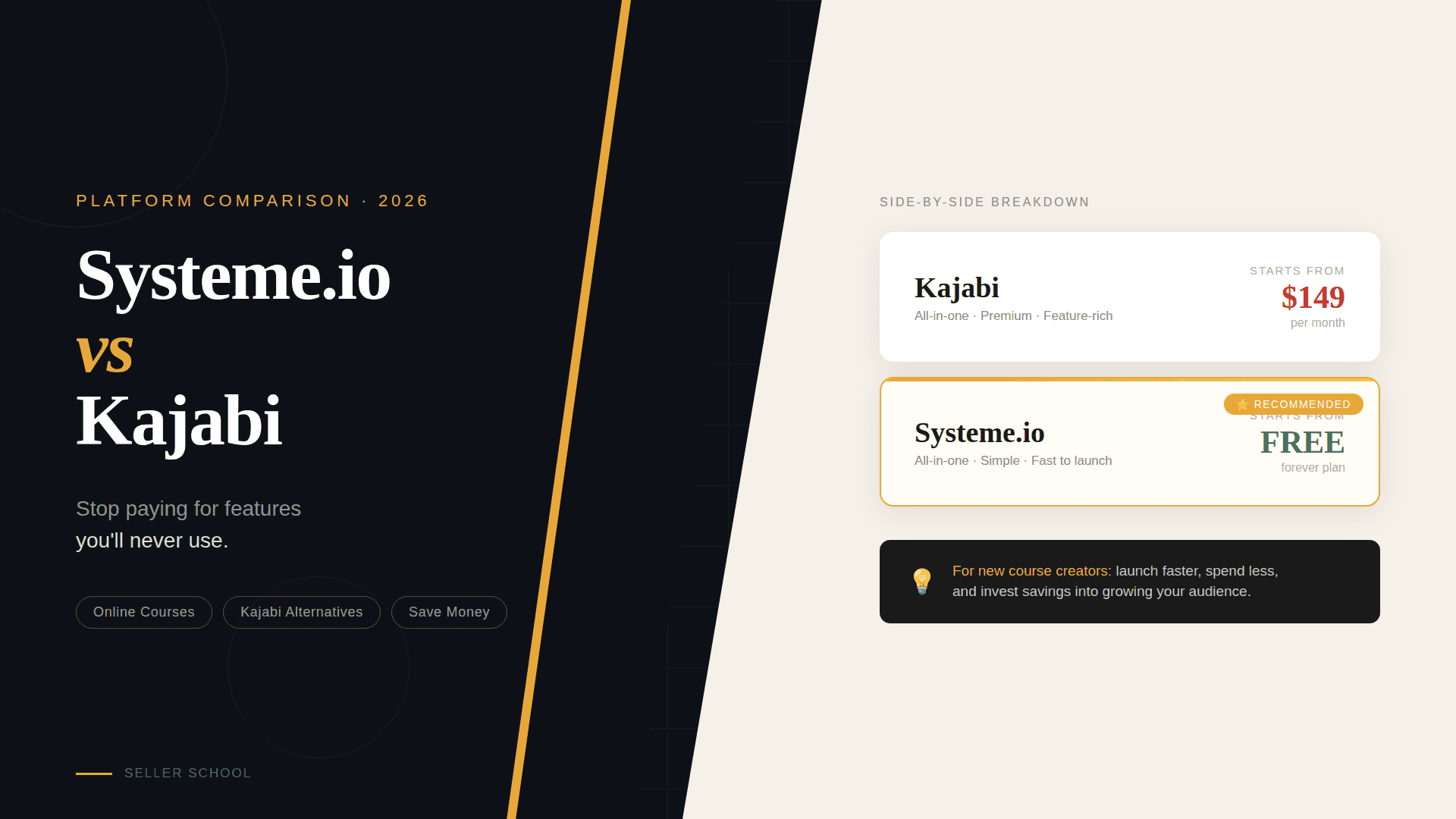
The alternatives to Podia worth considering include Teachable (comparable simplicity but its own pricing issues in 2025–2026), Thinkific (stronger on course delivery, weaker on marketing), Kajabi (the most feature-complete option, starting at $149/month), and Systeme.io (the most complete all-in-one option at the lowest price point).
Systeme.io occupies a distinctive position in this landscape as the only platform that genuinely replaces Podia's functionality while also adding what Podia lacks — specifically funnel building, comprehensive email marketing, and affiliate management — and doing all of it for less money, with no transaction fees at any tier.
For a creator who hasn't yet built consistent revenue and wants to minimise overhead while they grow, the online course platforms comparison essentially ends with Systeme.io as the most rational starting point. The question of how to host an online course stops being complicated once you realise you can do it, market it, and sell it from one platform for $17 a month — or nothing.
The Mistakes Most Course Creators Make When Choosing a Platform
1. Ignoring the transaction fee in the total cost calculation.
A 5% transaction fee is invisible until you start selling. Once you do, it compounds with every sale and creates a pressure to upgrade that most creators didn't anticipate when they signed up. Always calculate your total platform cost at your expected revenue level before committing — not just the subscription price.
2. Choosing for the features you'll want eventually rather than the ones you need now.
Podia's Shaker plan at $89/month has genuinely useful features for established creators. But for someone building their first course, paying $89/month for an affiliate programme they won't use for six months is a cost that doesn't return value. Buy for your present business, not your hoped-for future one.
3. Assuming all 'all-in-one' platforms are equivalent.
Podia calls itself all-in-one. So does Systeme.io. But they mean different things. Podia includes course hosting, basic email, and a website. Systeme.io includes all of that plus funnel building, advanced automation, and a full affiliate programme. Those differences are material to how you grow your audience and convert it.
4. Not testing before committing.
Podia's free plan is gone. You have 30 days, then you're paying. Systeme.io's free plan is permanent. The risk profile of testing Systeme.io is zero. If you're comparing these platforms, there's no reason not to test Systeme.io first — build your course, create a funnel, see how it feels — before making any payment commitment.
5. Staying on the wrong platform out of inertia.
Creators stay on platforms that don't serve them well because switching feels complicated. In most cases, migrating a course from one platform to another takes a weekend at most. If your platform is costing you more than it should — in fees, in missing features, or in complexity — the cost of staying is usually higher than the cost of moving.
Who Should Choose Which Platform?
Systeme.io makes more sense if:
- You're launching your first course and want to test your idea without paying transaction fees on early sales
- You need marketing tools — funnels, email sequences, affiliates — built into your platform rather than assembled from separate tools
- You're currently on Podia's Mover plan and the 5% fee is eating into margins as your revenue grows
- You want to build an email list and convert it into sales, not just host content for people who already know you
- You value pricing stability and transparency over time
Podia might still work for you if:
- You already have an established audience and a separate marketing stack — email tool, funnel builder — that you don't want to replace
- The visual polish of your course and sales pages is a priority and Podia's more refined templates suit your brand
- You're selling a mixed bag of digital products (downloads, webinars, coaching) and value Podia's clean product management for that mix
- You're on the Shaker plan and getting good value — particularly if you use the affiliate programme and have no transaction fee concerns
The Most Useful Thing You Can Do Right Now
If you've been comparing platforms and trying to decide where to start — or whether the platform you're on is still the right one — I'd encourage you to make this concrete rather than theoretical.
Systeme.io's free plan is permanent, requires no payment details, and gives you everything you need to actually build your first course and funnel. Not browse a dashboard — build something real. Create your first module. Set up a checkout. Write a basic email sequence. You'll know within a few hours whether the platform fits how you work.
Sign up for your free Systeme.io account here: https://iosysteme.com. No credit card required.
And if you'd like a broader independent comparison of all the main platforms — covering Podia, Systeme.io, Kajabi, Teachable, Thinkific, Kartra, and Zenler — I've put together a free guide that maps out what each platform genuinely suits and what it actually costs when you account for everything. It's available below this article.
The best platform is the one that gets your course in front of students and keeps more of your revenue in your pocket. On that measure, Systeme.io is a hard choice to argue against in 2026.
About the author: This article is based on several years of hands-on experience building and selling courses across multiple platforms, including Podia, Systeme.io, Kajabi, Teachable, Thinkific, and others. The goal is always practical, honest guidance — not recommendations shaped by which affiliate programme pays the most.